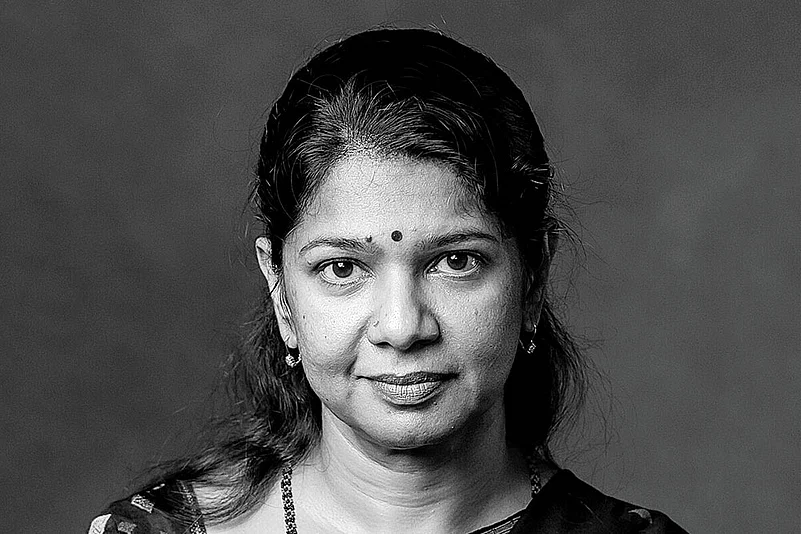
Kanimozhi Karunanidhi forcefully opposed linking women’s reservation to delimitation in Lok Sabha, foregrounding federalism and fair representation.
From Parliament to an international stage in Madrid, she balances Dravidian ideological clarity with diplomatic restraint.
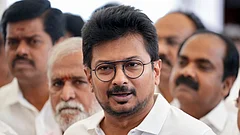
Despite key roles in the Dravida Munnetra Kazhagam and a solid electoral base, her trajectory appears constrained amid the growing prominence of Udhayanidhi Stalin.
“Justice is not about giving everyone the same thing; it is about giving each person what they need and deserve.” Quoting Periyar E.V. Ramasamy, the ideological father of the Dravidian movement, Kanimozhi Karunanidhi delivered one of her most forceful speeches in the Lok Sabha on April 17, during the debate on the delimitation bill.
The political line first drawn in Chennai by M.K. Stalin, opposing the linkage between women’s reservation and delimitation, was carried to Delhi by his half-sister, Kanimozhi. In a speech marked by clarity and conviction, she dissected the bill’s provisions, foregrounding concerns of federalism and fair representation.
Tamil Nadu has historically produced one of the country’s most formidable women leaders, former Chief Minister J. Jayalalithaa. In the present day, while both Houses of Parliament feature several articulate voices from the state, Kanimozhi, daughter of M. Karunanidhi—stands out for the distinct ideological clarity and rhetorical force she brings to national debates.
Her sharp political instincts were on display in Madrid, Spain, when, as part of an all-party delegation, Kanimozhi was asked a deceptively simple question: what is the national language of India? For a leader from the Dravida Munnetra Kazhagam (DMK), a party that has historically resisted the imposition of Hindi, the moment carried clear political risk, with the potential to unsettle the carefully balanced optics of a united delegation abroad.


Kanimozhi’s reply was characteristically precise. The national language of India is unity in diversity,” she said—sidestepping a contentious binary while subtly reiterating the Dravidian position. In a single line, she managed to assert ideological clarity without provoking diplomatic discomfort, illustrating a political style that blends conviction with calibration.
Considered the literary heir to her father, M. Karunanidhi, Kanimozhi is a poet who began her professional career as a sub-editor at ‘The Hindu’ before entering politics. Her public life has been shaped as much by words as by political conviction.
She formally entered Parliament in 2007 as a member of the Rajya Sabha, a role she held for a decade, quietly honing her political voice.
Her shift to direct electoral politics came in 2019, when she contested the Lok Sabha elections from Thoothukudi. The victory marked not just a personal milestone but her transition into a more visible, mass-based political role. Since then, she has represented the constituency in the Lok Sabha, emerging as one of the more articulate and ideologically grounded voices from Tamil Nadu.

Her most significant political crisis came in 2011, when she was arrested in connection with the 2G spectrum case that shook the country during the UPA regime. She, along with the other accused, was acquitted of all charges later, bringing an end to a prolonged legal and political battle.
Within the DMK, Kanimozhi holds several key organisational roles—serving as deputy general secretary and heading the party’s women’s wing. Over the years, she has been entrusted with significant responsibilities, and in the party’s long history, she stands out as one of its most prominent women leaders.
Yet, even as the party remains firmly under the control of the family of M. Karunanidhi, her political trajectory appears to face a visible ceiling. The elevation of Udhayanidhi Stalin, son of Chief Minister M.K. Stalin, as Deputy Chief Minister has only made those limits more apparent.

MORE FROM THIS ISSUE


This article is part of the magazine issue dated May 11, 2026, called 'Khela Hobe? ' about Assembly Elections 2026 and how West Bengal may prove to be the toughest battleground for the Bharatiya Janata Party.