






Russian President Vladimir Putin’s visit to India last week at a time of geopolitical churn and in the backdrop of a downturn in India-US ties over tariffs was keenly watched in world capitals. The red carpet welcome, the pomp and ceremony were all in place as it was a state visit.
But what mattered more was the messaging behind it. The choreography of warmth signalled a partnership that refuses to bow to pressure. For Moscow, the embrace by the world’s largest democracy is a powerful affirmation of acceptance, more so as the US and Europe have attempted to isolate Russia since its invasion of Ukraine in 2022.
The message from India was to remind the world and the domestic audience that strategic autonomy, or as foreign minister S. Jaishankar puts it, “Freedom of choice,” is not just a slogan. US President Donald Trump has slapped a 50 per cent tariff on Indian exports, half of it because of lifting Russia oil, which the US claims is fuelling Moscow’s Ukraine war. Ironically, the US wants India to stop buying discounted oil while America continues to import nuclear fuel from Russia. So does Europe. China buys more oil than India, yet China is not singled out. India has drastically reduced its oil imports from Russia and could stop altogether for fear of further punitive tariffs. At the same time, India has ramped up oil imports from the US. Trump’s tariffs are aimed at India, possibly to browbeat New Delhi into agreeing to a trade deal on America’s terms. The bilateral trade deal between India and the US continues to be a work in progress and is unlikely to be sealed this year.


The meeting underscores New Delhi’s deliberate choice to sustain longstanding ties with Russia even as it deepens relations with the US and the wider West. Significantly, there is talk now of a President Volodymyr Zelenskyy visit to India, though nothing is official yet. It is also common knowledge that the chief guests for next year’s Republic Day will be Ursula von der Leyen, the European Commission President, and the European Council President António Costa. The January visit is to coincide with an India-EU summit to finalise a long-pending trade agreement that has been under negotiations for several years.
Cynics characterise Putin’s visit as high on optics and low on substance and a celebration of traditional friendship between India and Russia that had survived the Cold War era.
“What is interesting is how little comment the meeting seems to have produced. I think Narendra Modi’s visit to Moscow was a turning point for a lot of people in the US and Europe, showing where India stood. And this meeting didn’t produce anything new, in terms of images or significant agreements,” says Ian Hall, professor in the School of Government and International Relations at Griffith University, Australia.
Jaishankar observed after the summit that India-Russia relations remain “among the steadiest big-power relationships in the world”, especially when contrasted with Moscow’s fluctuating ties with China, Europe and the US. The same could be said of India’s own partnerships, but with Russia, the consistency stands out. This was reinforced in the joint statement, which described the relationship as “a time-tested progressive partnership, anchored in trust and mutual respect”, and cast it as “an anchor of global peace and stability”.

The summit has come at a time when both India and Russia stand to gain from reaffirming a partnership under global strain. It resulted in successful signalling by both countries: “India asserted its strategic autonomy without jeopardising its relations with either the US or Europe, its main partners. Neither India nor Russia wants to antagonise the US. India has repeated its stand on Ukraine, and batted for peace,” says C. Raja Mohan, analyst and visiting research professor at the Institute of South Asian Studies (ISAS), National University of Singapore. “The emphasis was on the economy. India hopes to diversify its trade basket, and Russia too wants to tap the opportunities provided by the world’s fifth-largest economy and look beyond China for trade.” adds Raja Mohan.
Defence and security co-operation have been the bedrock of India-Russia ties, but at this year’s summit, the focus was primarily the economy. Despite warm political relations and excellent government-to-government cooperation, economic ties, especially private investments, remain the weakest link. Both Prime Minister Narendra Modi and President Putin are hoping to accelerate economic growth and hit $100 billion trade by 2030, and the PM was confident the figure would be reached much ahead of the deadline. The large business delegation accompanying President Putin is testimony to the interest in expanding economic cooperation.

The most important document signed during the visit was the mobility agreement that would allow Indians to work in Russia. The idea is to make it legal and seamless. Blue collar workers, especially in sectors like construction, are much in demand.
Joint ventures on fertilisers are another important agreement. India is the world’s second-largest fertiliser importer after Brazil. Most of that comes from Russia, and joint production would go a long way to assure steady supplies for Indian farmers.
“Economic cooperation, I would say, is the driving impulse and the most important focus of this particular visit,” foreign secretary Vikram Misri told reporters after the talks. “...expanding bilateral trade and strengthening economic cooperation requires swiftly addressing non-tariff barriers and regulatory impediments,” Misri added.
New Delhi was looking to increase Indian exports to Russia in sectors such as pharmaceuticals, agriculture, marine products and textiles to correct the current trade imbalance. Indian exports to Russia at the moment are a pathetic $5 billion, while India imports to the tune of nearly $68 billion.
Both sides went into detailed discussions on the steps needed to usher in an era of much greater bilateral economic engagement. The intent was clear, but how long it would take for economic exchanges to pick up is an open question. India and Russia are keen to insulate their trade from Western sanctions by using national currencies for trade. However, the process will take time and effort to take off.
While India’s relations with Russia are marked by a high degree of trust, and most people in India regard Russia as a steadfast friend, Moscow’s increasing dependence on China since the Ukraine war is of concern in Indian policy circles.
Despite a thaw in frosty relations since the India-China military confrontation in the summer of 2020, tension remains and China continues to pose a major threat to India. In these circumstances, it is difficult to forge a three-way relationship between Russia, India and China that Moscow wants in place.
Yet Moscow too wants to break away from its over-dependence on China and Beijing’s rising economic and geopolitical clout across Eurasia. Putin does not want to put all its eggs in the China basket. So the emphasis on expanding economic cooperation with India remains a part of Putin’s strategy. Balancing its ties with Beijing with traditional friend India works well for Moscow.
Many in India also worry about Russia’s engagement with Pakistan, a country it had scrupulously avoided in the past.
“Russia’s friendship with China is tactical. Its ties with Pakistan are transactional and an attempt to keep the Chinese balanced in the region,” says former Indian diplomat Anil Wadhwa. He is confident that the future of the India-Russia relationship “will move at an even keel with both sides looking for new avenues of cooperation”.
So far, India has succeeded in balancing relations between Russia on the one hand and the US and Europe on the other. Can India continue doing so? Jaishankar thinks so and often mentions India’s foreign policy as one of “multi-alignment” focused on engaging with as many countries and global groupings as possible to maximise national options and interests. India has been doing so and the Modi-Putin summit was part of this engagement. The meeting may not have produced dramatic outcomes, but has reaffirmed the durability of a relationship that has weathered geopolitical storms, including the break-up of the former Soviet Union.
Seema Guha is a senior journalist covering foreign affairs
MORE FROM THIS ISSUE


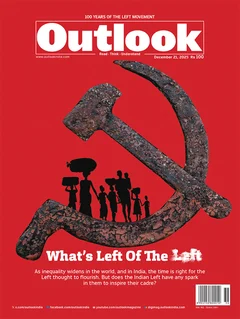
This article appeared as Delhi Moscow On Time in Outlook’s December 21, 2025, issue as 'What's Left of the Left' which explores the challenging crossroads the Left finds itself at and how they need to adapt. And perhaps it will do so.















