As Prime Minister Narendra Modi attended a Christmas service in Delhi and shared messages of peace, compassion, and unity, several states reported incidents of vandalism and disruption of Christmas celebrations.
In Assam, Chhattisgarh, and Maharashtra, schools and public spaces saw alleged attacks and disruptions linked to right-wing groups, including vandalism of a school in Assam, damage to Christmas decorations at a Raipur mall, and a school intrusion in Virar, leading to arrests and police cases.
The incidents sparked political reactions and renewed debate over the safety of religious minorities and religious freedom in India, with civil society groups warning of growing intolerance during one of Christianity’s most important festivals.
As carols echoed through Delhi’s Cathedral Church of Redemption and Prime Minister Narendra Modi stood among the congregation, Christmas appeared, at least symbolically, to be a moment of warmth, harmony and shared faith.
The Prime Minister’s presence at the service, amplified through carefully framed social media posts, projected an image of inclusivity and national unity. Yet beyond the church doors and far from the capital, the festive season unfolded very differently for many across the country.
In the days leading up to Christmas, reports of vandalism and disruption linked to Christmas celebrations surfaced from multiple states, casting a long shadow over the season of goodwill. The contrast between the Prime Minister’s public embrace of the festival and the violence witnessed on the ground sparked sharp political reactions and renewed anxieties about the safety of religious minorities in India.


Violence During Christmas
In Assam, the festive calm was broken when a school was vandalised ahead of Christmas. Decorations were damaged and religious symbols defaced, prompting the arrest of four people. Police said the act appeared deliberate and was being investigated for possible communal motives. For local Christian communities and educators, the incident felt deeply unsettling—less an act of random mischief and more a targeted message aimed at a minority-run institution during its most important festival.
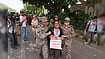
Chhattisgarh saw a more public confrontation. At Raipur’s popular Magneto Mall, a group allegedly linked to right-wing organisations vandalised Christmas decorations, tearing down festive displays while objecting to the celebration of Christmas in a public space. Videos of the incident spread rapidly online, turning a local act of vandalism into a national talking point. Police booked around 40 people for vandalism and unlawful assembly, but the images left behind a lingering sense of hostility intruding into what is usually a season of collective celebration.
In Maharashtra’s Virar town, the disruption took on a performative edge. Members of the Bajrang Dal allegedly entered a school wearing Santa Claus costumes, only to remove them and begin reciting the Hanuman Chalisa inside the premises. The group claimed it was protesting Christmas celebrations in schools, arguing they encouraged religious conversion. The incident drew widespread condemnation, with parents and educators describing it as intimidation and religious moral policing—an intrusion into a space meant for learning, not ideological confrontation.
All of this unfolded as Prime Minister Modi shared visuals from the Christmas service on X, captioning them with wishes for “renewed hope, warmth and a shared commitment to kindness.” In the videos, he is seen standing among worshippers, listening to the choir and offering prayers. In another post, he described the service as reflecting the “timeless message of love, peace and compassion,” while extending wishes for “a joyous Christmas filled with peace, compassion and hope.”

Inside the church, the mood was celebratory. Choir members expressed delight at the Prime Minister’s presence, with one singer telling ANI that it “felt great that he celebrated Christmas with us,” calling it a memorable experience. The images and statements were carefully calibrated to signal respect for India’s Christian community and its traditions.
Yet as investigations into the incidents across states continue, the juxtaposition remains stark. On one hand, there is the symbolism of unity at the highest level of political leadership; on the other, a series of ground-level confrontations that have left minority communities feeling vulnerable during one of their most significant festivals. Together, they underline a growing tension in India’s public life, between the language of inclusion and the lived realities of religious freedom during moments meant for celebration.