The foreign policy conduct of United States reveals a consistent pattern where strategic interests are framed as moral imperatives, leaving international law selectively applied.
From Iran to Taiwan, and from Venezuela to Israel, legality yields to alignment, eroding the credibility of institutions like the United Nations and its founding principles.
Ultimately, wars of choice are paid for not by strategists, but by civilians whose lives become collateral.
It is time to abandon a few comforting illusions. The American armada did not move towards Iran to rescue the oppressed or to “defend” theoretical principles. America does not deploy aircraft carriers for “moral” instruction. They do so to protect their own interests. The United States, more than any other power, has perfected the art of presenting interest as virtue and strategy as necessity. America has neither friends nor foes, she has her own interests and priorities.
From Korea and Vietnam to Cambodia and Laos. From Iran in 1953 to Guatemala, Chile, and Nicaragua during the Cold War. from Panama and Grenada to Serbia; From Afghanistan and Iraq to Libya and Syria - the pattern is pretty evident! Different eras supplied different slogans: anti-communism, counter-terrorism, non-proliferation, humanitarianism. Yet the underlying logic has remained strikingly consistent.
Where resources, transit routes, regional dominance, or strategic positioning mattered, American power intervened, overtly through invasion, covertly through coups, sanctions, proxy warfare, and economic strangulation. Venezuela fits squarely within this continuum: a modern case of intervention without invasion, subjected to financial sanctions, oil embargoes, diplomatic isolation, and open support for regime replacement, not to advance democracy, but to reassert control over energy flows and political alignment. Where no such interests existed, moral urgency reliably receded. This is not cynicism, it is realism stripped of its public relations. What we are witnessing is not a deviation from American conduct, but its continuity - force unleashed, not reluctantly, but fully instrumentally and deliberately.




To understand why Iran sits at the centre of this storm, one must begin not with ideology, but with chemistry. Venezuela possesses immense oil reserves, yet much of its crude is so heavy, it resembles sludge. It cannot be transported or refined without blending with lighter oil. Iran produces precisely the condensates required for that process. For decades, Tehran quietly enabled Venezuelan exports, undermining a sanctions architecture designed to choke alternative energy flows.
This was not defiance for its own sake. It was functionality. Iran was becoming useful — not just ideologically resistant, but economically enabling. That, far more than rhetoric or enrichment levels, made it intolerable. Sanctions were not imposed to punish behaviour, they were imposed to interrupt capability. When sanctions failed, pressure escalated. When pressure failed, force prevailed.
As Karim Sadjadpour, senior fellow at the Carnegie Endowment for International Peace, observed recently, “this will not be remembered as a war of necessity, but as a war of choice. And wars of choice are always the most dangerous, because they are unconstrained by urgency and unburdened by humility.”
This logic extends beyond the Middle East. In East Asia, China has stated with full confidence and increasing clarity that China will be “Unified” and Taiwan will be brought under its control within 2026. In Washington, this is framed as a moral dilemma — democracy versus authoritarianism. History suggests a colder calculus. Taiwan anchors global semiconductor supply chains and critical maritime routes. If these assets remain essential to American primacy, engagement will follow. If not, ambiguity will be rebranded as restraint. Principles, as ever, will arrive after interests.

At this point, the discussion cannot remain confined to strategy alone. The question that inevitably arises is this: what, then, of international law? International law is not ambiguous on the use of force. It is simply inconvenient. Its prohibition is categorical. Force is unlawful unless exercised in immediate self-defence against an armed attack or authorised by the UN Security Council. Everything else is political violence in a legal costume.
The targeted killing of senior leadership figures of a sovereign state, carried outside a declared war and without international authorisation, is not a grey area. It is a breach. Article 2(4) of the UN Charter exists precisely to prevent powerful states from unilaterally deciding who may live and who must die. Article 51 permits response, not prophecy. Allowing speculative future threats to justify force does not preserve the rule. It dissolves it, leaving behind only the discretion of the powerful.
Nor does the language of counter-terrorism rescue such acts. International humanitarian law presupposes an existing armed conflict and rests on distinction, necessity, and proportionality. Remove the battlefield and these constraints collapse. What remains is executive fiat (it shall be done). Intelligence claims shielded from scrutiny, lethal force detached from accountability, and death, administered without due process. This is not law enforcement, it is categorical elimination.
What makes this moment particularly eroding is not the violation itself, but its selectivity. Rules are enforced against adversaries and suspended for allies. Compliance becomes irrelevant and alignment becomes decisive. A state may sign treaties, submit to inspections, and relinquish prohibited weapons, yet still be branded as an “existential threat” if it sits outside the preferred architecture of power. Another may refuse treaties, evade inspections, and maintain undeclared arsenals, yet remain diplomatically untouchable so long as it remains strategically useful. Pakistan represents a clear nuclear threat. A state long dominated by military dictators, steeped in the language of goons rather than governance. With a documented history of nurturing militant groups and a nuclear arsenal uncomfortably close to ideological extremism. While dictators openly boast of “taking the world down” with them, yet, surprisingly (rather not so surprisingly), Washington sells them advanced aircraft, transfers sensitive technology, and lauds their dictators as indispensable allies. “Great gentleman” in President Trump’s true eloquence.

This is how legal order decays - not through open abandonment, but through double standards dressed as realism. Law ceases to restrain power and instead becomes the language through which power explains itself. Institutions continue to speak, reports continue to circulate, judgments continue to be written - but outcomes are decided elsewhere.
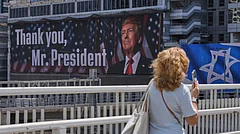
This hierarchy of legality is most clearly visible in the extraordinary relationship between the United States and Israel. Despite repeated violations of international norms, despite open defiance of non-proliferation principles, Israel remains insulated from consequence. This immunity is not accidental. it is blessed well structural! It is sustained through a dense network of military aid, lobbying power, ideological alignment, and narrative control.
Every year, billions of dollars in American taxpayer money flow into Israel’s military apparatus. Post World War II, totals exceed $260 billion. That is roughly $10 million every single day! War is not merely a strategy, it is a thriving industry!
Domestic politics completes the power structure. Questioning unconditional support carries electoral cost. Media narratives reinforce moral imbalance. Religious movements glorify policy. The result is a politically unanimous consensus, so rigid that dissent itself becomes suspect! What emerges is not just an alliance, it is capture, not coordination. It is dependency disguised as loyalty.
Netanyahu’s official aircraft (the equivalent of the American Air Force One) was last (February 28) seen landing in Germany. The irony is profound! The Prime Minister of the only Jewish country in the world, now seeking refuge in Germany. It hurts too much to laugh and I am too old to cry!
Behind the scenes, the story grows even more intricate. Saudi Arabia’s Crown Prince Mohammed bin Salman allegedly privately urged U.S. President Donald Trump to strike Iran, making multiple calls in the weeks leading up to the attack. Publicly, Riyadh spoke of diplomacy and restraint, insisting it would not allow foreign aircraft to operate from its territory. Privately, however, MBS pressed for decisive action, warning that inaction could embolden Tehran.

This duality - public moderation, private insistence on force - is a stark reminder that regional power plays are often conducted far from the eyes of the soft-headed citizens, while the consequences fall on them ultimately!
It is tempting, at this point, to recall a remark attributed to Georges Clemenceau (two time French Prime Minister), who observed that America is the only nation to have gone from barbarism to decadence without civilisation in between. (Aristocratic contempt, razor wit, and a very French horror - untempered by culture!) Whether delivered as wit or an actual warning, the line endures to this day. It captures a deeper disorder. A power so assured of its own virtue that it no longer interrogates its conduct, so fluent in the language of law and liberty that it forgets restraint. What remains is eloquence without humility, strength without self-doubt, and a confidence that mistakes dominance for moral authority.
Empires rarely collapse from weakness. They unravel through incoherence: the widening gap between what they claim to defend and what they routinely destroy. The consequences of this conflict extend far beyond immediate theatrics. The killing of Iran’s Supreme Leader, Khamenei, has pushed the Islamic Republic into its most precarious moment since 1979. A temporary three-man council now exercises executive authority, while the opaque succession process remains firmly controlled by institutions Khamenei himself shaped. Speculation about successors is rife, but clarity is absent by design.
Militarily, the regime has taken a serious blow. Senior commanders were killed, command centres damaged, and decision-making forced into crisis mode. Yet Iran retains operational capacity. Within hours, missiles struck US bases, Israeli targets, and civilian infrastructure in Dubai, Abu Dhabi and Kuwait, signalling retaliation and the risk of regional escalation.
Across Iranian cities, celebrations and anxieties intermingle. Protests may grow, fragment, or be suppressed, making public sentiment unpredictable.

For regional powers such as India, the implications are grave. Energy security, trade routes and regional stability are at stake, creating mounting pressure in an already volatile strategic environment with deeply uncertain short-term outcomes.
The implications are serious. India has long managed a difficult triangle: a civilisational and energy relationship with Iran, a deepening strategic partnership with the United States, and a sustained rivalry with China. Prolonged instability in Iran threatens energy security, undermines regional connectivity projects, and destabilises maritime trade routes critical to the Indian economy.
More troubling is the precedent now being set. India supports a rules-based order not out of naivety, but out of strategic calculation. Restraint is not weakness; it is the only safeguard in a system where even major powers must be protected from arbitrary force. India is today a significant power—economically, militarily and diplomatically—yet it depends on norms that restrain escalation and ensure predictability. An order in which sovereign leaders can be targeted outside war, law bent by alignment, and force normalised as policy is fundamentally unjust.
Beyond strategy, law and precedent lies a truth no doctrine can obscure: war is borne by civilians. Children pay first, not generals; mothers grieve, not strategists. Streets, hospitals and homes become the real theatres of conflict. Long after speeches fade and borders shift, grief remains—personal, enduring and inescapable.
Persian civilisation, forged through centuries of conquest and collapse, understood this long before modern states learned to cloak violence in strategy. Sa‘di of Shiraz warned rulers intoxicated by power:

Bani-Adam a’za-ye yek digarand
Ke dar afrad-e jahan nafas be yek nafasand
Agar yek a’za be dard aaye
Degar a’za ra asabaanat vaarad.
(Human beings are members of one another, created from the same essence and soul. If one member suffers, the others cannot remain at rest!)
Enough blood has been shed. Enough children have been buried too soon. Enough mothers have cried for sons they will never see again. Too many lives have been taken so that powerful nations can pursue ambition. Each life lost is not a statistic, but a world extinguished. Yet even in this fragile world, humanity endures, seeking recognition, justice and mercy. The quiet cry of a child or the whispered prayer of a mother stands as proof that violence cannot fully silence conscience.
As force is once again unleashed in the name of order, it is worth remembering that no empire is immune to consequence, and no narrative can outpace grief. Strategy may explain why wars begin, but only humanity explains why they should not. If international order is to mean more than the convenience of the strong, it must begin here, not with missiles or mandates, but with the simple truth that every life lost diminishes the world we claim to protect.