A series of missile and drone attacks on vessels, including the Hercules Star and Ocean Electra, have turned the Strait of Hormuz, through which 20 per cent of the world's oil passes, into a flashpoint, causing traffic to plummet by nearly half as ships flee the area.
The escalating conflict triggered a violent spike in Brent crude oil prices to a 52-week high of $79.40, while simultaneously wiping billions off global stock markets, with the Dow Jones, S&P 500, and major European indices suffering sharp losses.
The crisis threatens to force shipping companies to bypass the Persian Gulf for the lengthy Cape of Good Hope route, drastically increasing transit times, insurance premiums, and costs. For major importers like India, this could disrupt supply chains, though diversified sourcing may cushion the economic blow.
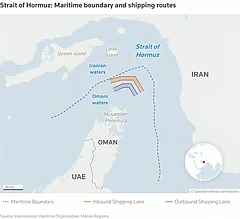
The exchange of fire between the US-Israel alliance and Iran has ignited a powder keg at the world's most critical maritime artery for oil. The Strait of Hormuz, a narrow passageway separating the Persian Gulf from the open ocean, has transformed from a vital trade route into a high-risk war zone. In the last 48 hours, a line of fire has been drawn across the sea, with several vessels struck by missile attacks. Among the casualties, the Spanish-flagged Hercules Star was hit 20 nautical miles off the coast of the United Arab Emirates, while Greece’s Ocean Electra was reportedly struck by either a drone or a missile, underscoring the indiscriminate threat to commercial shipping.


The World's Energy Lifeline
The Strait of Hormuz is not just a geographic landmark; it is the economic lifeline for the world's energy supply. As the sole sea passage from the oil-rich Persian Gulf to the vast Arabian Sea, it serves as the mandatory gateway for Saudi Arabia, Iran, Iraq, Kuwait, Qatar, and the UAE. Its strategic value is immeasurable, channeling approximately one-fifth of the planet's daily crude oil consumption and one-third of its liquified natural gas (LNG).
Markets Panic as Conflict Spreads
The escalating military conflict has sent immediate and violent shockwaves through global markets. Investors fled risky assets as the prospect of a broader Middle East war became tangible. Brent crude futures skyrocketed, hitting a new 52-week high of $79.40 per barrel, a staggering 9.3% surge. The panic was equally evident in equities. US stock futures collapsed in early trading, with the Dow Jones tumbling roughly 550 points, the S&P 500 dropping 63 points, and the Nasdaq declining 270 points.
The sell-off was global and relentless. Asian equities slid approximately 1.5%, while European markets opened deep in the red. London’s FTSE 100 fell 0.9%, Germany’s DAX plunged 2.3%, and France’s CAC 40 slumped 2.4%. Only the oil and gas sector provided a safe haven, while every other industry bled value.
Maritime Exodus and the Looming Supply Crunch
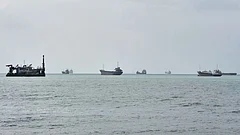
The physical impact on shipping traffic has been immediate and dramatic. According to S&P Global Commodities at Sea, vessel activity within the strait had collapsed by 40% to 50% as of the evening of Feb. 28, with analysts noting a clear fleeing pattern. Satellite data reveals a logjam of crude oil tankers gathering near the UAE's Port of Fujairah, just outside the danger zone, as vessels en route scramble for safe harbor.
This paralysis is forcing a critical re-evaluation of global shipping routes. A report by CareEdge Ratings warns that a prolonged escalation could make the Persian Gulf unnavigable. Shipping companies are now weighing the option of abandoning the Red Sea and the Gulf entirely, opting for the long and costly detour around the Cape of Good Hope.
Iranian forces have been hailing commercial vessels near the Strait of Hormuz since missile strikes started on Saturday. Iran’s foreign minister Abbas Araghchi told Al Jazeera on Sunday that Tehran does not plan to close the Strait of Hormuz at this time. However, at least three commercial vessels reported being hit by projectiles on Sunday, according to the UK Maritime Trade Operations, and the deteriorating security environment, coupled with rising insurance premiums and cancellations of war risk policies, is acting as a de-facto deterrent for shipping in the region.
The Joint Maritime Information Center said that there is no formal legal closure of the Strait of Hormuz.
Ripple Effects: The View from India
The repercussions extend far beyond the Middle East, posing a direct threat to major importers like India. Over 40% of India’s crude oil and a substantial portion of its LNG imports, sourced from key West Asian players like Iraq, Saudi Arabia, and the UAE, must pass through the Strait of Hormuz. Any disruption, whether from outright blockades or skyrocketing insurance premiums, threatens to inflate costs for Indian Inc.
"Any prolonged escalation... and the consequent increase in shipping costs, insurance premiums, and short-term price fluctuations in Brent crude would potentially impact the profitability of India Inc," warned Priti Agarwal, Senior Director at CareEdge Ratings.
However, a perfect storm may be averted by strategic diversification. Agarwal notes that the impact on the broader Indian economy is expected to be limited, citing adequate global oil supply, stable container availability, and India’s savvy strategy of diversifying its crude basket with alternative suppliers like Russia, the United States, Nigeria, and Brazil.
Furthermore, a crucial paradox remains: Iran itself is heavily dependent on the Strait of Hormuz to export its own oil. A self-imposed blockade would effectively be economic self-sabotage, a factor that may yet prevent the crisis from escalating into a total shutdown of the world's most important energy corridor.