



Hezbollah keeps a hidden military presence in southern Lebanon, relying on secrecy and guerrilla tactics against the stronger Israel Defense Forces (Tzahal).
The region has a long history of conflict, from battles around Beaufort Castle to modern wars involving Israel and armed groups.
Civilians suffer the most, as repeated Israeli bombardments and regional tensions force people to flee and leave towns in ruins.
A few years ago, during the heat of the Syrian war, I was in southern Lebanon near the small village of Deir Kifa. There was no sign of the Hezbollah fighters who defend southern Lebanon. This region runs from below the Litani River to the Blue Line that divides Lebanon from Israel.
The United Nations troops—in fact, from the Punjab Rifles—sat at their camp not far away, outside the town of Marjayoun. I asked one of their commanding officers, Colonel Sajesh PG, if they had ever seen the Hezbollah fighters in a show of force. “No”, he told me. “They respect the understanding that is in this area: that our UN troops have a mandate to disarm them if we see them”. There was no sign of the Hezbollah, but neither did I see any Lebanese Army forces in the region. It appeared as if entire southern Lebanon was already disarmed.
But this was a mirage. “Secrecy,” said Naim Qassem, the Hezbollah deputy leader at the time, “was the key to success on the battlefield”. What he meant was that the Hezbollah fighters had to deal with the asymmetrical relationship of their conflict with Israel, which had been heavily armed by the United States and had already demonstrated its ability to bombard Lebanon from the air with almost no challenge from the ground.


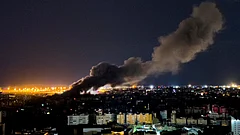

Neither the Lebanese Army nor the Hezbollah, which was more adept than the official army, was able to bring down the US-delivered Israeli aircraft when they tore in from the sea to bomb the land. There was only one day when I saw the fighters in southern Lebanon with a public display: this was when their military wing ran down the street of the village with their guns aloft for the funeral of a fighter killed in Syria, chanting “Labayka ya Zaynab” (We are with you, Zaynab—the eldest daughter of Imam Ali, whose shrine is in Damascus, Syria).
The landscape of the South is mired in wars that never seem to end. Driving to the 12th-century Beaufort Castle near the village of Arnoun, one is reminded that the crusaders tore a swathe through this region in their fanatical quest to take the Holy Land. In 1976, the Palestinian Liberation Organization took the castle and used it as a base for its operations against Israel, leading the latter to bomb it repeatedly and then capture it in 1982 in the Battle of Beaufort. The Israelis held the castle till 2000, when the Hezbollah raised the cost of their occupation and they had to withdraw in defeat. The castle blends into the rockface, innocent of the blood spilled into its crevices.
I was thinking about the Beaufort Castle when Israel began attacking Lebanon, a day or so after its illegal bombardment of Iran. A friend in Beirut told me that as part of this attack, the Israelis carried out sweeps through Khaim and the Marjayoun plains and bombed the highlands around the castle. The Israeli operation is called Lion’s Roar. It is a roar that has been heard in Lebanon almost since the establishment of Israel in 1948, when, through the Nakba (catastrophe), the new armies chased out Palestinian residents to Lebanon and the Israeli state seized parts of Lebanon’s land to better control water sources.
In June 1920, the British wanted to seize Metulla Finger, a piece of land that stretches from Hula Valley to Metulla, a four-kilometre strip of arable land that draws the groundwater and has been able to keep this area green and fertile for centuries. The Israelis occupy it now, calling it the Finger of the Galilee.
Israel is a highly developed agricultural economy. Lebanon looks bare. The water has been drained from Lebanon to Israel—the price of occupation and war.
The Beaufort Castle, a spectator of wars since the 12th century, continues its vigil. A jagged line from Jerusalem to Tripoli links those century-old fortresses to new battles. There is little expectation in Lebanon’s South—a battlefield in which people struggle to live—that peace will come in our lifetime. As Israel began its bombardment of homes that had already been bombed during the highpoint of the genocide of the Palestinians since 2023, Lebanese civilians—who had been living in these ruins—rushed to areas north of the Litani River. Their plight has been overshadowed by the devastation of large parts of Iran by the vicious bombardment by Israel and the United States.
The road towards Israel in Lebanon sits above Bint Jbeil, one of the South’s main towns, now largely reduced to rubble. In 2006, Israeli tanks had lined up and bombed the town to smithereens. Israeli aircraft did the same in 2024 and 2025.
After 2006, the Hezbollah’s reconstruction wing, Jihad al-Bina, took only 31 days to rebuild the town using money from the poor of the South and also from Iran. No such money came in the past few years because Iran has been impoverished by the sanctions and because there was no route to get aid to southern Lebanon, given that Syria is now ruled by a former al-Qaeda chieftain.
The people of the towns of the South, including the communist stronghold of Houla, have now had to flee—their precious belongings stuffed in bundles and dumped in the trunks of old cars and trucks. The roads have already been bombed; the Israeli drones in the air are harassing their transit northward.
Overlooking the Israeli kibbutzim of Avivim and Yir’on is Maroun al Ras. The Iranians built an Iran Park on its edge. The park was a tourist stop, complete with an observation tower that looked out at Israel, and a picnic area with a children’s playground. Each part of the picnic area was named after a region in Iran and offered a potted history lesson of that area. The most striking thing about this overlook was that you got a view of the difference between the landscape in Israel and in Lebanon.
Israel is a highly developed agricultural economy, illustrated by its green fields and expensive infrastructure, as well as its migrant workforce that is, in this sector, largely from Thailand. Lebanon, on the other hand, looks bare. The water has been drained from Lebanon to Israel—the price of occupation and war. When Israel bombed Lebanon these past few years, the Iran Park was one of the first casualties.
In the name of building a security perimeter, Israel has wiped out Lebanon’s South. Years ago, I had the opportunity of being at a seminar in Europe that was being addressed by an Israeli official. I asked the official what security is possible when a state is permanently occupying the people who lived on that land, and when the state is built as a fortress to maintain that occupied population as a subordinated citizenry through an apartheid legal structure. The other scholars seemed embarrassed by my question. The Israeli smiled at me. The chair of the seminar asked me to leave the room because he felt that I was being disruptive. The balance of forces for the conversation in Europe and in North America was on the side of Israel. It has been impossible to prod beneath the surface of an ugly consensus that hides human suffering behind the idea of ‘security’.
For the Israeli citizenry to have this kind of security, it needs to live behind enormous walls, treating those who have seen generations of their families removed from land and property as lesser and foreign; this is an ugly form of security that essentially jails the humanity of the Israelis to retain their false sense of ownership and superiority. That attitude is what allows Israel and the United States to conduct the genocide of the Palestinians, the bombing of Lebanon, and the enormously destructive bombing of Iran.
In the little village of Ebel es-Saqi, near the Indian base in Lebanon’s South, there is a hopeful memorial. The townspeople built two gardens to honour the UN detachment under whose shadow they survive. There is the garden of the Norwegians (jnayet al Narooj) and there is the garden of Gandhi (jnayet Gandhi). Until the bombings started two years ago, on Gandhi’s birthday, the townspeople and the Indian troops used to gather near Gandhi’s statue to honour his legacy.
In one of his last statements on Palestine, to Reuters in May 1947, Gandhi said that the Jews who were there “should meet the Arabs, make friends with them, and not depend on British aid or American aid or any aid, save what descends from Jehovah”. Sage advice from Gandhi that bears repeating today for the sake of Israel, Lebanon, Iran, and Palestine. But this is lonely advice. The Israel and US bombing is not going to close the cycle of violence. It will only deepen it. Friendship does not come from this kind of devastation.
(Views expressed are personal)




Vijay Prashad is the director of Tricontinental: Institute For Social Research. His Latest Book is On Cuba: Reflections On 70 Years Of Revolution And Struggle, Written With Noam Chomsky
This article is part of Outlook 's March 21 issue Bombs Do Not Liberate Women which looks at the conflict in West Asia following US and Israel’s attacks on Iran leading to the assassination of Ayatollah Ali Khamenei, while the world wondered in loud silence, again, Whose War Is It Anyway?















