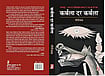
'Antim Aashray' restores human warmth and emotional vulnerability to their proper place in our literature.
It raises the fundamental question: what is the final refuge of a human being?
At the core of this novel lies a sprawling social history of Bihar
In the landscape of contemporary Hindi fiction, it is rare to encounter a writer who has witnessed the skeletal framework of the state apparatus from within and yet managed to preserve in his creative vision that vital dust, fragrance, and subterranean reality available only to the most instinctive of novelists. Tripurarari Sharan emerges, in this precise sense, as a singular presence. In his acclaimed debut, ‘Madhopur ka Ghar’, he chart-mapped the slow attrition, displacement, and intergenerational splintering of a north Bihar agrarian village through the non-judgemental eyes of a faithful Labrador named Lora. Extending that same narrative stream and rich reservoir of lived experience onto a far vaster canvas, his new novel, ‘Antim Aashray’ (The Last Refuge), wears a deceptive simplicity, concealing beneath its quiet prose a formidable architecture of social and psychological complexities.
This is less a conventional story and more an elegant, sorrowful archive of nation-building, the slow curdling of the Nehruvian socialist dream, and the socio-political trajectory of post-colonial Bihar. Sharan brings to the page a formidable sociological gaze nurtured at St. Stephen’s College and Jawaharlal Nehru University (JNU), sharpened by decades at the highest echelons of the civil service. His vocabulary has an academic gravity, but it is constantly tempered by an acute, restless empathy for the ground-level frictions of Indian society. Through the prism of this novel, he conducts a deeply moving autopsy of our progressive pretensions, the stubborn peripheries of upper-caste anxieties, and the profound, echoing isolation that awaits a human being at the end of the road.


The Great Bihar Saga
'Antim Aashray' refuses to settle into a mere lament for old age or a melancholic song of loneliness. At its core lies a sprawling social history of Bihar, stretching from the final years of the freedom struggle to the hyper-financialised, globalised present. The roots of the narrative are embedded in the soil of a remote village in the Gopalganj district, within a family steeped in orthodox Sanskrit scholarship. From here, a boy named Radhanandan Tripathi flees the claustrophobia of tradition and runs away to Kashi. Propelled by sheer intellect, he eventually finds his way to the Gurukul Kangri University in Haridwar, spending twelve years in ascetic, scholarly devotion.
It is in Sharan’s treatment of Radhanandan’s homecoming that the novel strikes its first profoundly ironical note, raising an unsettling question about the fragile nature of human identity. When Radhanandan returns to his village after more than a decade, he discovers that his community, having equated his long absence with death, has already performed his funeral rites. He has been ritually erased. Yet, instead of surrendering to this ghostly status, he rebuilds his existence from the foundational bricks of his intellectual and educational authority.
The episode serves as an eloquent emblem of an era when education was viewed not just as a passport to livelihood, but as an instrument for the reconstruction of the human self. Radhanandan later throws himself into the nationalist movement at Mahatma Gandhi’s call, wandering into the forested, difficult terrains of what is now Jharkhand to work among indigenous communities and counter mass conversions. This is the unchronicled history of nation-building; the quiet, heroic labour that standard historical textbooks relegate to the margins.

The Illusion of Progressivism
The emotional weight of the novel rests on the shoulders of Radhanandan’s daughter, Rama Tripathi, and her husband, Ramashish Singh. Both belong to the middle class, yet their caste geographies are entirely separate. Raised by a father shaped by Arya Samaji reformism, Rama’s sharp intelligence is recognised early. She is sent away to Gurukul and then to the prestigious Banasthali Vidyapith in Rajasthan, before attending Patna University for her higher education.
The novel confronts its central, aching dilemma her: is our modern progressivism merely a garment of convenience, donned to suit our immediate desires?
Drawn by a rare intellectual alignment that transcends caste boundaries, Rama and Ramashish enter into a love marriage. In the Bihar of that era, such an alliance was not just unusual; it was an act of social defiance. They break the old taboos, raising the banner of individual liberty. The true betrayal, however, arrives when this vanguard couple faces their own children. Their son, Mukul, educated at JNU, joins the Indian Police Service (IPS) and is assigned the Bihar cadre. He chooses to marry Barbara, a classmate from his university days and a Goan Christian.
Rama, who had once waged her own war against orthodoxy to marry the man she loved, finds herself incapable of welcoming a Christian daughter-in-law. Sharan offers no easy moral resolutions here; he merely steers the reader to the edge of a precipice. Is this the unyielding boundary of upper-caste progressivism, which tolerates individual autonomy only so long as it conforms to a recogniseable vocabulary? Or is it the deeper, older sickness of the modern Indian psyche, split cleanly down the middle, beautifully sophisticated on the surface but fiercely insular within?
The consequences are devastating and permanent. The mother-son relationship remains permanently fractured. Ramashish, guided by a more accommodating, pragmatic humanism, maintains his ties with his son and daughter-in-law. But for Rama, this estrangement digs a deep, dark well of loneliness that she can never quite fill. In this landscape of emotional exile, the only warmth comes from her granddaughter, Riya. Born to Mukul and Barbara, Riya eventually relocates to Japan, establishing herself as a successful designer. Yet, she remains tethered to her grandmother by an instinctive affection, an invisible thread that leaps over generational divides to weave the past and the future together.
The Architecture of Belonging and the Receding City
To prevent the narrative from collapsing into a singular domestic tragedy, Sharan introduces a series of parallel movements and characters that enrich the book’s texture. This is a story of families, but it is equally a story of friendships. The relationship that blossoms between Rama and Rameshwari Devi during their shared years in the education department, and the subsequent distance that grows between them due to small, human misunderstandings, finds its resolution years later in a chance encounter in the Rajendra Nagar neighbourhood of Patna. It is a beautiful demonstration of how, amidst the frantic rush of urban life, old intimacies return to the soul like an unexpected medicine.
Even more luminous is the figure of Premshankar, Rama’s childhood playmate. Sixty years after their shared youth, Premshankar travels from Kolkata to Rama’s marital home in Keshopur, driven by nothing more than the fragile hope of finding her. Following a faint clue, he travels to Ranchi, where Rama lives with her daughter, Roshni, a schoolteacher.
This reunion, happening after more than half a century, is proof that time cannot diminish the purity of early memories. Premshankar's character acts as a repository of human warmth in an increasingly cold world. When Roshni is diagnosed with cancer in her sixties, it is Premshankar who hurries from Kolkata, bringing with him not just financial relief but a restorative spiritual grace. His own sons are settled comfortably in America and he lives an affluent life, yet, the old-world courtliness and respect with which he repeatedly welcomes Rama and Roshni to his home is a quality that has turned antique in our times.

The Paper Bridges of a Restless Class
Structurally, the novel relies heavily on epistolary exchanges, which remain its finest stylistic achievement. The letters between Rama and Rameshwari, and the correspondences between young Alok and his 'Rama Auntie', are not mere plot devices; they are delicate X-rays of shifting emotional topographies. Rameshwari’s younger son, Alok, who moves from St. Stephen’s to IIM Ahmedabad, chooses his first professional posting in Patna for the sole purpose of sharing his mother’s solitude, surrendering his private hours to preserve hers.
In contrast, Rameshwari’s elder son, Anant, is away at sea with the Merchant Navy, maintaining an unarticulated relationship with Rama’s daughter, Roshni, a quiet romance that breathes in the spaces between the lines. Together, these characters form the portrait of a contemporary middle class that is heading breathlessly toward its material ambitions, even as it carries an unvoiced, persistent guilt regarding the elders left behind on the shore. These letters are attempts to bridge that profound silence between two generations where face-to-face speech has broken down. Sharan uses this correspondence to construct a transparent, fragile bridge across the chasm of shifting urban landscapes.
The Final Question
The title itself, 'Antim Aashray', remains an overarching metaphor and a persistent riddle. In the evening of her life, where does Rama stand, this formidable woman who lived so fully, who possessed such an enviable treasury of principles, and who witnessed the great transitions of her century? Her son’s home cannot be her sanctuary because her own internal walls blocked the entrance. With her husband, Ramashish, the final decade of marriage was spent in a quiet, mutual agreement of separate lives.
What, then, is the final refuge of a human being? Is it the landscape of one's own memories? Is it the childhood friend who returns from the horizon after 60 years? Or is it that small, dark room of unfulfilled desires that every individual is condemned to inhabit alone? The novel is an elegant study of this essential, human incompleteness that persists despite a life well-lived.
We congratulate ourselves on our cosmopolitanism, our progressiveness, our digital globalism; we orchestrate large revolutions on small screens. Yet, 'Antim Aashray' holds up a mirror to the uncomfortable truth of our unchanged interiorities, asking if we have truly cast off the ancient burdens of caste pride and religious insularity. It forces us to consider whether in this blind race towards globalisation, we are losing our histories, our anchors, and the very people who tether us to the earth.
Sharan’s prose has a lucid, transparent fluidity. The narrative balances the dignity of classical vocabulary with the rustic simplicity of the countryside. He handles the immense weight of old age, loneliness, and social hypocrisy with an intimacy that never becomes heavy or pedantic.
'Antim Aashray' restores human warmth and emotional vulnerability to their proper place in our literature. Long after the book is returned to the shelf, its questions continue to hum in the quiet spaces of the mind. It is a necessary text for anyone who, in these fractured times, is searching for their own last refuge.
(Ashutosh Kumar Thakur is a management professional, literary critic, curator and translator. He is currently based in Bengaluru)