In a country where libraries are unevenly distributed and bookstores sparse outside major cities, festivals become sites of access
The Indian book market is estimated at over USD 6 billion, making it one of the fastest-growing globally.
India publishes close to 90,000 new titles annually, placing it among the top 10 publishing nations globally.
The assertion that most Indians do not read for pleasure, and that the country’s profusion of literature festivals is therefore an anomaly, rests on a fragile assumption. It assumes that reading is a private, silent, solitary act. It assumes that books live primarily on shelves or bedside tables. And it assumes that literary cultures announce themselves chiefly through sales charts and leisure surveys.
India unsettles all three assumptions.
On a winter afternoon in Kolkata, the city’s annual book fair spreads across the Maidan like a temporary republic of print. Schoolchildren negotiate loudly over dog-eared Bengali novels. College students line up for discounted translations of Dostoevsky and García Márquez. Elderly readers drift between stalls, not necessarily to buy but to browse, to listen, to belong. Nearby, a poet reads aloud to an audience seated on the grass. Some will buy books. Many will not. Almost all will return.
By the time the International Kolkata Book Fair closes after two weeks, it will have drawn close to three million visitors and recorded sales of over Rs 26 crore. It will do so without glossy global coverage or celebratory industry reports. Yet it remains among the largest book gatherings anywhere in the world.


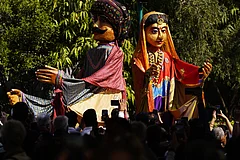
This is the scene that rarely enters international discussions about India’s reading culture including a recent article in The Guardian that asked why a country where most people supposedly do not read for pleasure hosts more than a hundred literature festivals. The question appears logical when filtered through Western metrics of reading. It falters when confronted with India’s social and linguistic realities.
A Publishing Powerhouse in Plain Sight
India is today one of the world’s largest producers of books. According to data from the Federation of Indian Publishers and UNESCO, the country publishes close to 90,000 new titles annually, placing it among the top ten publishing nations globally. These books appear in more than two dozen languages, many of them with long and fiercely defended literary traditions.
Roughly half of India’s publishing output is in Indian languages. Hindi, Bengali, Tamil, Malayalam, Marathi, Maithili, Telugu, Gujarati, Punjabi, Assamese and Urdu together sustain vast, decentralised literary ecosystems. Much of this production happens outside metropolitan centres, through small and medium presses that rarely figure in global market analyses.
The Indian book market itself is estimated at over USD 6 billion, making it one of the fastest-growing globally. Educational publishing accounts for nearly 70 percent of this market. Textbooks, exam guides, and reference works dominate sales. For millions of families, books are not cultural accessories but instruments of aspiration. They are bought to secure jobs, to clear examinations, to escape precarity.
This has often led observers to conclude that Indians read instrumentally rather than for pleasure. The conclusion collapses once one recognises that in societies where access to books has historically been uneven, pleasure often arrives sideways. Through browsing. Through listening. Through collective discovery.
When the Numbers Tell Another Story
If Indians truly did not read, book fairs would be among the first casualties. Instead, they flourish.
The Pune Book Festival, organised by the National Book Trust, recently recorded over 1.25 million visitors and sales exceeding INR 50 crore. The New Delhi World Book Fair continues to draw close to two million visitors in a fortnight. In Kerala, district-level book fairs routinely report footfalls that rival those of major cultural festivals.
In smaller towns, the figures are no less striking. In Kanchipuram in Tamil Nadu, a local book fair recorded over 800,000 visitors. In Guwahati, the Assam Book Fair has grown steadily over three decades into a major regional event. These are not elite gatherings curated for global visibility. They are mass events, attended by students, teachers, clerks, farmers, retirees, and families.
They function less as festivals in the Western sense and more as civic rituals. Recurring, stubborn, deeply local.
Literature as a Public Encounter
Literature festivals in India emerge organically from this ecosystem. They are not substitutes for reading. They are extensions of it. Yet the contemporary form they now take can be traced to a decisive turning point.
That turning point was Jaipur.
Before the Jaipur Literature Festival, literary gatherings in India were largely inward-facing. They were often limited to universities, cultural institutions, or closed auditoriums. Jaipur altered the grammar. It placed literature in open, accessible public spaces and treated the reader not as a specialist but as a citizen. In doing so, it redefined what a literary festival could mean in the Indian context.
Jaipur’s significance lies not merely in scale or celebrity but in structure. It brought regional languages into conversation with English on equal terms. It placed translators at the centre rather than the margins. It made room for historians, journalists, poets, novelists, and political thinkers to share the same platform without disciplinary hierarchy. Most importantly, it normalised the idea that listening itself is a legitimate form of literary participation.
Once this model took root, it began to travel.
At the Bangalore Literature Festival, conversations now move fluidly between Kannada and English, between memoir and public policy, between first-time authors and veteran translators. In Kozhikode, the Kerala Literature Festival draws tens of thousands to the beachfront, many of whom sit through entire sessions without buying books. The act of listening becomes a bridge, often the first step towards reading.
Across India, festivals in Jaipur itself, Dehradun, Kolkata, Bhubaneswar, Nainital, Patna, Jamshedpur, Moradabad, and Lucknow reflect this inheritance. They draw audiences that include students, teachers, civil servants, pilgrims, and first-time readers. Literature here is not separated from faith, history, or politics but braided into everyday life.
In Banaras, one of India’s oldest living cities, the literature festival acquires an additional layer. The Banaras Lit Fest does not announce itself as a break from tradition but as a continuation of an older culture of public discourse. Situated in a city shaped by scripture, commentary, debate, and oral transmission, the festival folds contemporary writing into a landscape already steeped in listening. It inherits Jaipur’s openness while drawing from Banaras’s own long history of argument, annotation, and storytelling.
Further east, literature festivals in Shillong, Imphal, Kohima and Guwahati extend the model into the Northeastern states. Here, festivals foreground oral histories, indigenous languages, and narrative traditions that have long existed outside print. The festival becomes an act of recognition, allowing voices that were always present to be heard on their own terms.
Beyond India, the ripple is visible in South Asia. In Nepal, the Pokhara Literature Festival operates within the ecosystem Jaipur helped set in motion. It creates a shared literary common legacy where Nepali, Maithili, Hindi and English writers converse across borders that politics often hardens but literature continues to soften. Questions of translation, memory, migration, and language loss echo across sessions, underscoring the region’s shared cultural anxieties and aspirations.
To dismiss these gatherings as spectacles is to misunderstand their function. In a country where libraries are unevenly distributed and bookstores sparse outside major cities, festivals become sites of access. They allow people to listen before they read. To encounter writers before purchasing books. To discover that literature is not a remote institution but a living conversation.
Jaipur’s most enduring legacy is not the festival itself but the ecosystem it enabled. It demonstrated that literature in India thrives when it is made public, porous, and participatory. The many festivals that now dot the country and the wider region are not imitations. They are local responses to a model that proved one essential point.
That literature, when given space to be heard, will always find its readers.
The English Trap
Much global scepticism about Indian reading habits stems from modest English-language book sales. Even successful English-language titles in India often sell only a few thousand copies. Compared to Western markets, these numbers appear anaemic.
But English is only one thread in India’s dense textual weave.
Hindi publishing alone accounts for an estimated 25 to 30 percent of total trade publishing. Malayalam literature enjoys intense public engagement in Kerala, supported by strong library networks and local publishing houses. Bengali publishing continues to sustain a robust readership in eastern India. Tamil, Marathi, Telugu and Gujarati literatures maintain their own canons, controversies and audiences.
International publishers have adapted to this reality. Global houses such as Penguin Random House, HarperCollins, Bloomsbury, Hachette, Pan Macmillan, and Westland now coexist with Indian presses like Juggernaut, Rupa, Aleph, Speaking Tiger, Niyogi Books, Rajkamal Prakashan, Vani Prakashan, Setu Prakashan, DC Books, Ananda Publishers, Kalachuvadu, Antika, Navarambh, Bee Books, and Sahitya Akademi publications. Their presence at festivals is often less about volume sales and more about visibility, translation and cultural exchange.
For many readers, a literature festival is the first place they encounter a translated work. Or an author from another language. Or the idea that literature travels.
Scenes That Refuse to Be Counted
At a literature festival in Banaras, a schoolteacher from a nearby district explained why he brings his students every year. They may not buy books today, he said. But they will see writers speak. They will know that books are made by people, not institutions.
At Pune, a teenage girl queued for hours to meet a poet she had discovered on social media. She left with three slim volumes in Marathi, bought with money saved over months. At Kolkata, elderly readers return annually not because they need more books, but because the fair has become part of their calendar. A ritual as familiar as a religious festival.
These moments resist quantification. They do not appear in leisure reading surveys. Yet they explain why literature festivals continue to proliferate.
The Inheritance of Listening
India’s literary history is inseparable from its oral traditions. Epics were heard long before they were read. Poetry was sung before it was printed. Listening has never been considered a lesser form of engagement.
Literature festivals tap into this inheritance. When audiences gather to hear a poet read aloud or a novelist speak about a book they have not yet read, literature moves from the private to the communal. For many, this is not the end of reading but its beginning.
Asking the Wrong Question
The question of why India hosts so many literature festivals despite low leisure reading assumes that festivals exist to compensate for absence. In reality, they exist because reading in India has always been entangled with social life.
To ask whether Indians read for pleasure is to impose a narrow definition of pleasure. In a society shaped by linguistic plurality, inequality of access and strong oral traditions, pleasure often arrives through listening, debate and shared discovery.
What the Festivals Actually Signal
India’s literature festivals are not symptoms of a culture estranged from books. They are evidence of adaptation. They show how literature survives and evolves in conditions where reading is uneven but curiosity is abundant.
They remind us that reading cultures cannot be measured solely by bestseller lists or leisure surveys. They must be understood through the spaces where people gather, listen, argue and return.
India reads.
Just not in ways the world has learned to count.
Ashutosh Kumar Thakur is a writer and columnist and is the curator of Banaras Lit Fest. He writes on society, literature, and the arts, reflecting on the shared histories and cultures of South Asia.