New media artist Afrah Shafiq’s work, which forms the façade of the pavilions at India Art Fair, brings together the language of embroidery with augmented reality
Elaborating upon the Charpai Project, curator Ayush Kasliwal and AI artist Goji speak to Outlook on the conversation between rural India and artificial intelligence
Curator and critic Johnny M.L challenges the advent of AI with an ambitious show on printmaking
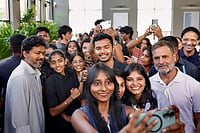
A group of students from the National Institute of Fashion Technology is training their mobile phones at a wall and giggling away like teenagers are wont to do. At first glance, they appear to be capturing the excitement of being among friends and creating Instagram reels. But take a closer look and you realise they are scanning the façade of a cavernous tent. As they move the phone camera towards the gate, the buffalo on the wall begins to gallop and the peacock on the wall takes flight: This is augmented reality at play. The artwork on the façade is the handiwork of Goa-based artist Afrah Shafiq at the India Art Fair 2026.
About 50 yards away from the tent, on a sunny winter afternoon, groups of young men and women lounge around on stringed cots. Above them, on the ceiling are trippy videos of the weft and warp of charpoy strings in psychedelic colours. In The Charpai Project, conceptualised by curator Ayush Kasliwal and AI artist Goji, the rustic appeal of rural India engages in an alternative conversation with futuristic tech. The installation navigates through a lattice of stacked charpais and scaffoldings, akin to a Snakes and Ladders board, inviting visitors to climb, recline, and connect with the installation with spontaneity. For Goji, it was like recreating a jungle gym that he grew up experiencing in his childhood. “When I first discussed it with Ayush, we explored different kinds of AI outputs, but nothing really caught our eye. We agreed that the best way to do it was using tactile, real-world elements. So, I ended up asking Aayush for some images of actual charpais. That's how I was able to edit and bring them to life. We thought about how someone actually uses the charpai. By laying down on it or sitting on it, taking a breather, taking a break. And we've kind of brought those elements as images and woven them into creating the same utility in the project, using AI,” explains Goji.



At a time when artificial intelligence and augmented reality appears to be threatening artistic practices, originality and creative expression, a few artists associated with the ongoing India Art Fair 2026 are turning over a new leaf, complementing age-old artistic traditions with cool interactive tech tools.

Goa-based new media artist Afrah Shafiq’s work, which forms the façade of the pavilions at India Art Fair, for instance, uses the language of embroidery, bringing meaning to motifs and their histories through an Augmented Reality interface. In her art practice, Shafiq often seeks ways to retain the tactile within the digital and poetry within technology, she tells Outlook. “I've been interested in embroidery over the past few years. and especially all kinds of domestic work that women did in their house, and the mathematical and computational aspects of it, whether it's work that they did in their leisure, like crochet, knitting, embroidery, and all of the ways in which these are linked to programming and future computer technologies, etc. So for this facade, I've picked embroidery that is based on the grid. It's called Counted Stitch Traditions,” she elaborates. A lot of embroidery that features on the façade is familiar to most of us. But Shafiq approaches it in a new light. “We've seen these embroidery motifs in our homes. We've seen our grandmothers and mothers use them. But I wanted a lens for the audience to see it in a way that's more critical, closer and richer. And that's where augmented reality comes in. We've developed an app to go along with the facade, and when you scan it, you can see the embroidery come alive. Many parts of the facade will be animated, and you can also learn about embroidery traditions. So, for instance, you will look at a motif and you probably think it's just a decorative border or a flower or something, but when you look at it in the app, you realise actually, this is from the Toda tribe of the Nilgiri Hills,” she explains.
Will AI algorithms and robots spell the end of human creativity and artistry, or can they be harnessed to augment our own creative potential?
At Dhoomimal Art Gallery, curator and critic Johnny M.L is challenging the perception of artificial intelligence that threatens to devour everything from original writing, art and literature. His show Print Age: The Art of Printmaking in the Age of AI, showcases 156 original prints cutting across time and genre – from Pablo Picasso, Marc Chagall, Jyoti Bhatt to Anish Kapoor. What provoked him to counter the advent of AI with such an ambitious show? “We often say that artificial intelligence is something which will replace human creativity and one day we won't have anything that could be done with our hands or something like that. And also, there is a fear that human creativity will go useless or astray. So, my theoretical premise is actually to inquire into this assumption that AI will replace human creativity,” he explains. “When you look at printmaking, you can see that it is a genre that involves multiple levels of creativity. It is almost like making a sculpture. You have to knead the clay, you have to have an armature, you have to build it and mould it. There is a kind of a trial-and-error method. So, one remembers what Walter Benjamin wrote in the 1940s. He talked about a work of art in the age of mechanical reproduction. His contention was that if you could reproduce a work of art or any creative object, its aura will be diminished because we’ll always talk about the original, which is coming out of human genius and human intelligence. So, he said that it will cut down the aura. But he was actually making the thought process wider for further engagement. After more than 80 years we have the advent of AI and that is always done through human prompts. So, human agency is never reduced. We know that despite all this artificial intelligence hasn’t yet evolved into a more capable thinking organism. It still hasn't created something of its own. Human agency is always there. So, even if smartphones have democratised digital photography, people still go back to analogue and even keyhole photography. Human agency hasn’t yet gone out of circulation,” he declares.
Even at India Art Fair 2026, says Johnny M.L, traditional practices such as weaving, embroidery and printmaking are finding newer audiences. “There is a revival in enthusiasm towards investing in prints which have been appreciating in the auctions market as well. So, I think we are in a fertile field where printmaking could actually make things easier for the entry-level collectors. And once entry level collectors are there, once they get the taste of it and they are going to make it big,” he says.


Afrah Shafique has been interested in the cross-section of technology for a long time, but she keeps a sharper focus on the linkages between handmade art and technology, she says. “That is why, overlaps between the analogue and the digital and augmented reality work really well for me. In this, one is looking at something in real life but augmenting onto it a new layer. You're able to see a new sort of magical treatment almost to something physical. I think that the conversation around AI is a much longer and complex conversation outside of this moment. I haven't really worked with AI, and I have my own sort of reservations with it. I think there are certain things that it brings to discourse and to art, environment and ecology that is taking away, in some senses, from the spirit of uniqueness. And so, I haven't felt drawn to using AI for that reason.”