While books risk becoming décor and unread trophies, literature festivals are reviving curiosity by making books approachable through conversation, performance, and live debate rather than quiet, solitary reading.
By turning writers into speakers and thinkers on stage, lit fests draw people into stories, politics, culture, and emotion, often sparking unexpected connections with new authors and ideas.
More than organisers or stars, it is the listening, engaged audience that defines lit fests, proof that humans still crave stories, dialogue, and the shared magic of words.
Is reading obsolete, has it become a quaint cute act our ancestors used to indulge in? Everyone is writing a book but is anyone reading them? Some fear books are in danger of ending up as a drawing room decoration, a must décor; a vase filled with flowers and a shelf full of books slanted prettily in a row where they best catch the light. The red spines merge into brown ones and then on to blue, ending with cream and white. Good to take a selfie against.
There was a time when boasting about the books you read was a thing; now we boast about the books we are not going to read because we don’t have the time. Our life is too hectic and happening to pretend to have read a book we didn’t and never will. Indians are the opposite of Japanese in this regard. Tsundoku is the art of collecting books for the pleasure of reading them later in Japan; here we call it raddi.
Into this disenchantment with the printed word came a new genre called lit fests, which helps the average shy ‘I don’t have time to read’ Indian to forge a tentative relationship with bestsellers and classics. Literature festivals make books appear harmless, even painless. No one is judging you by the number of books you haven’t read, as long as you are nodding your head or shaking it as the author speaks on stage. Against your will you get involved. Into the written word via the spoken one.


Lit fests demand many things of you, including what is called an intellectual wardrobe involving a lot of linen or some amount of khadi, but what they also do is temporarily make books cool again. When writers who have interesting opinions on everything from fairy tales to AI give us their take, they leave us reversing what we had thought so far, and sometimes even shaping our minds on things we had never considered before. And the themes are varied: politics, gender, food, romance, air quality… The discussions are on just about anything under the sun—and that’s the beauty of these sudden informal chats curated perhaps haphazardly or with deliberate intent to kickstart this emotion or that in us.
Free speech in action is always a thing of beauty. As different speakers talk and their words go up against each other’s, an entire audience tunes in. Their preferences and preoccupations of the moment are cast aside for the simple act of listening. And while a small part of the audience is sitting there just to rest their feet after all that walking from one venue to another, a large chunk is there to listen. The startling urgency of a live event is infectious.
Of course, a William Dalrymple or a Vikram Seth will get the bigger crowds and more applause, but then you just may run into a little-known writer you’ve never heard of but are now enthralled by, and makes you curious about what they have written and why. That joy of discovering your own personal writer, a writer who seems to have written a book just for you, is unparalleled. Of course, you continue your marriage with Dalrymple or Seth (sometimes bigamous with both), but you have begun to get crushes on others now. Go on, cheat a bit. Leave your favourite authors for a spot of literary infidelity.
The secret sauce is honesty. On stage with a timer facing them, authors go into heart-to-heart no-holds-barred mode. We know what they are thinking right now right here on this topic or that. We may have feared grandstanding but what we get is measured thought, the airing of innermost feelings, secrets. Someone may play to the gallery now and then, or the moderators will out-talk the person they interview, but the moments bathed in light at a lit fest are those when you discover a kindred soul. Oh my God, you go, he is saying what I was going to think. Fluency is a drug.
Smita Tharoor, host of the podcast ‘Stories Seldom Told’, says: “Lit fests are one of the few safe places we have left where discourse and debate can flourish. From long conversations on stage or ones I conduct on my podcast—now nearly six years old—I’ve learned that honesty thrives when people aren’t rushed or judged. Public spaces don’t need less disagreement; they need more patience, enquiry, and the space to let someone finish a thought.”
And, oh, the drama! Sometimes, at lit fests, historical moments are played out right before your eyes. During one Bangalore Literature Festival session long ago, when late Girish Karnad and Arun Shourie went up against each other like boys fighting on a playground in a session on freedom of speech in 2014, moderator Arshia Sattar nobly and ably brought about order on stage. Now and then political conversations can even lead to defamation lawsuits, as some speakers find out. But where else can the Left and the Right come together?
It is the magic of being out in the open under a starry sky and listening to unshackled and unhurried words. Words going up like quiet fireworks in your bloodstream, rewiring your brain. The publishing industry turns transparent right before our eyes. How are books made, why are they written, who has written what… Titles and covers, translations and editing, short stories and novels, fiction and nonfiction.
Folklore dances and ditties sing. Stories come alive. We were put to sleep as kids with lullabies and little yarns; it is in our blood, this need to be soothed with fiction. At the Scottish International Storytelling Festival last year, Mimesis Heidi Dahlsveen, an associate professor in oral storytelling from Norway, blew minds with what she called a story that was going to be a little vulgar. I’ve never been more entertained.
One day in the future it is true that the statue of a bespectacled man reading a book will be in a glass cage next to the one with a caveman inventing the wheel, but until that time there are literature festivals bursting open in every nook and cranny of the nation. Called forth by the imagination of future readers.
Lit fests are defined by their audience. Organisers, speakers, curators are all replaceable but not the readers, not the audience. So do go to the next lit fest in your town. When your eyes meet an author’s eye across a crowded lawn, the world stands still—you fall in love with a book. You can queue up to get a book signed, so what if the author has, in a hurry, signed it to ‘Rasi’ and your name is a numerologically corrected Raashheey. You have the perfect gift for a Rasi if you ever meet one.
MORE FROM THIS ISSUE
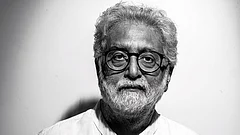
Shinie Antony is an author and festival director