




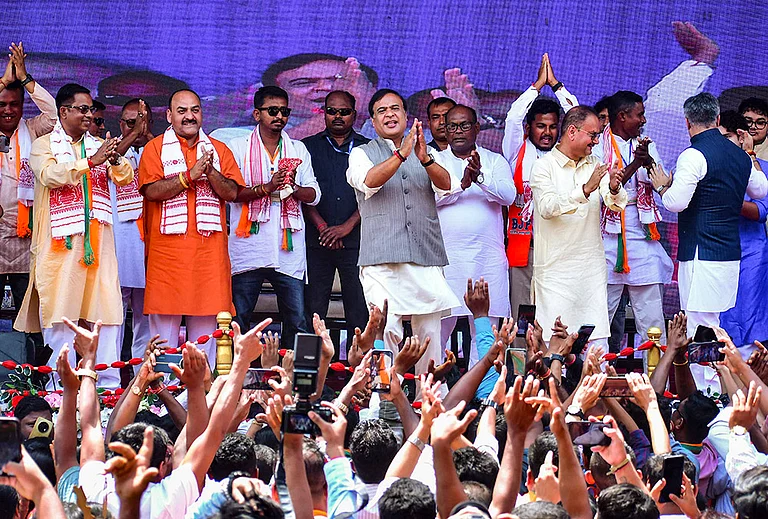
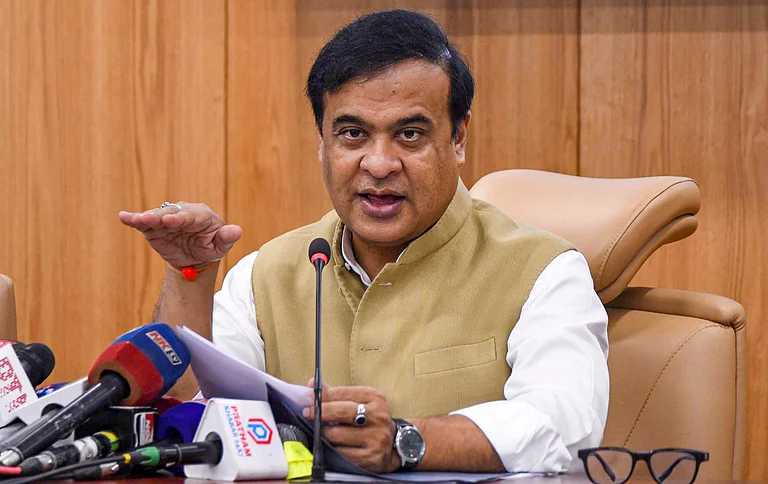
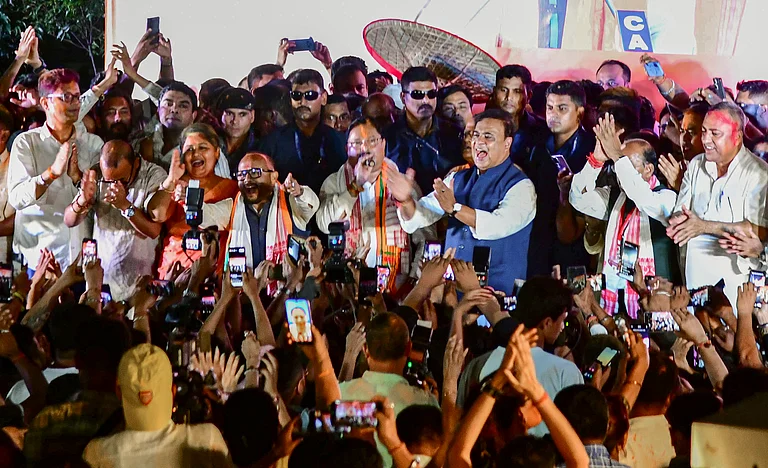
“Every woman will receive benefits from the Orunodoi scheme if you vote the BJP back to power,” Chief Minister Himanta Biswa Sarma declared at a public meeting in March, just before transferring Rs 9,000 under his government’s flagship welfare scheme, barely a month before elections were announced in Assam.
Seconds later, he slipped into an easy sense of familiarity. “If I return to power, I should be able to give not only oil and dal, but even half a kilo of tea to every family,” he quipped. “Only then will you offer me tea if I come to your house.”
Later, Sarma knelt and sat cross-legged on the stage as women crowded around him, shaking his hand and calling him mama or maternal uncle. The optics were unmistakable. It felt as if the election had been settled already.
Over the past decade, Sarma has come to dominate Assam’s politics through welfare populism, muscular Hindutva and relentless political manoeuvring. That blend of accessibility and aggression marked him early. Entering politics through the All Assam Students’ Union (AASU) during the Assam Agitation, Sarma emerged as an assertive student leader at the state’s popular Cotton College. “He was always a very assertive leader, whether as a student activist or later as an MLA. He was among the finest debaters of our generation,” says Akhil Ranjan Dutta, professor of political science at Gauhati University. “At that time he was amiable too, but gradually, especially after 1992, he became more aggressive.”

Even as a student leader, he was known for personalising battles and pushing the limits of the organisation.
After AASU, Sarma joined the Congress and rose quickly under Chief Minister Tarun Gogoi. But his rebellion against Gogoi revealed the scale of his political ambition. By 2012, Sarma had openly revolted after it became clear that Gogoi intended to back his son, Gaurav Gogoi, as his successor. Claiming the support of dozens of MLAs, Sarma intensified the internal challenge even as the Congress high command refused to yield to what Rahul Gandhi reportedly described as “pressure or blackmail”.
In July 2014, Sarma walked out of Congress and arrived at Raj Bhavan with nearly 40 MLAs in tow, signalling that his rebellion was no longer symbolic. A year later, he joined the BJP, which was aware of his organisational strength and electoral value. The move transformed Assam politics. Riding on the slogan of Jati, Mati, Bheti (community, land, home), the BJP formed its first government in the state in 2016. By 2021, Sarma had become the party’s principal strategist in the state before eventually replacing the veteran Sarbananda Sonowal as CM.
Sushanta Talukdar, a senior journalist in Guwahati, says Sarma consciously cultivated his mama image among women and younger voters through welfare programmes such as Orunodoi and Nijut Moinaa. “They saw him as someone who would continue the schemes and deliver what he promised,” said Talukdar.
“He rarely misses an opportunity to polarise politically,” he remarked, arguing that religious identity has become central to Sarma’s electoral strategy.
That sharper ideological edge is visible in Sarma’s rhetoric. During one election campaign, he posted on X: “The very machines which are showering flowers today, will inflict hell & fury upon infiltrators and encroachers in the coming days.”
Rajan Pandey, director of People’s Pulse, a research organisation that specialises in conducting field-based political and election surveys, says Sarma has tried to position himself “as the authentic and original Hindutva figure within the political landscape”.
He has been accused of mainstreaming aggressive communal rhetoric. Supporters, however, see him as a decisive leader who understands the pulse of Assam better than anyone else in contemporary politics.
And in hindsight, perhaps, both assessments are true.
MORE FROM THIS ISSUE

MORE FROM THIS ISSUE

Ashlin Mathew is senior associate editor, Outlook. She is based in Delhi