India is returning to the Venice Biennale with a national pavilion after a seven-year absence.
Curator Amin Jaffer says the pavilion’s theme emerged from questions of diaspora, migration and the emotional loss of home amid rapid urbanisation.
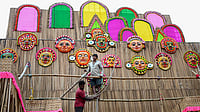
The multi-artist pavilion highlights India’s cultural diversity through contemporary works using traditional material like thread, bamboo and soil.
It is after a seven-year absence that India is returning to the Venice Biennale with a national pavilion, marking a comeback that reflects both India’s growing confidence and global ambitions. The Biennale opens to the public on May 9 and will run until November 22 of this year, with the previews having begun on May 6.
The return, announced during this year’s India Art Fair, comes through a partnership between India’s Ministry of Culture, the Serendipity Arts Foundation and the Nita Mukesh Ambani Cultural Centre.
Curated by Dr Amin Jaffer, the India pavilion titled Geographies of Distance: Remembering Home, responds to the Biennale’s overarching theme, In Minor Keys. Jaffer, whose career spans the Victoria and Albert Museum, Christie’s and now the Al Thani Collection, brings together five artists: Alwar Balasubramaniam (Bala), Sumakshi Singh, Ranjani Shettar, Asim Waqif and Skarma Sonam Tashi.
Outlook spoke with Jaffer about the pavilion, the idea of home and what India’s return to Venice signals.




Edited excerpts of the interview:
How did you come up with the title Geographies of Distance: Remembering Home?
Well, I've been working with the theme of home, identity, and the feeling of belonging ever since I was 18 or 19 years old, because I belong to the Indian diaspora. I really come from a background in which I was raised with Indian culture, language, food, music, values, and mentality, but my family has been in Africa for six generations. When I was growing up in Africa, there was political uncertainty for the Indian community there.
I always had this question of how families like ours, who were geographically distant from our home, India, still maintained Indian culture, value systems, beliefs, style, music, food, et cetera. The whole concept of home for those in India and the diaspora — the sense of belonging — was something I was raised with, and it became the basis of a lot of my academic work through my 20s and early 30s. I wrote a lot about furniture and the recreation of city and domestic life. My PhD was on furniture in early colonial India.
Why is furniture important? Because we have to remember that before Europeans arrived, Indians mainly sat on the ground. After the Europeans arrived, with the colonial presence, there was a complete transformation in body culture in India. For generations — and it is still continuing in some places — people began to sit on chairs. This whole concept of what home is and how you define home is something I’ve been thinking about for a very long time.
When I was asked to deliver the pavilion for the Ministry of Culture for the project in Venice, I was thinking about the theme of home, but I was also thinking about the rapid urbanisation of India. As you see, because of demographic pressure, economic growth, and technological changes, there is a real transformation happening in the urban landscape. Cities like Bengaluru, Visakhapatnam, Ahmedabad, and Dehradun are rapidly transforming.
I became very interested in the question of home within that context, particularly after I saw the project by the artist Sumakshi Singh, who has grown up all over India. In her childhood, one of the main influences was the house of her maternal grandmother, where she spent many of her holidays. After her maternal grandmother and grandfather passed away, the family decided to demolish the family home because land values had grown so high in Delhi. They could no longer maintain a one-storey home on land where they could instead build an apartment building.
Sumakshi was deeply affected emotionally by the loss of this house, which held many of her childhood memories. What she did was measure the house and recreate it completely in thread. And this is where the idea for the theme Geographies of Distance: Remembering Home came from, because the question is: how do you define your home when you are geographically far away from it, or when the home itself no longer exists?
Is there a reason why a multi-artist pavilion was decided upon rather than a single-artist pavilion?
Multi-artists pavilion seemed more appropriate for India, given the richness in the diversity of the country. India is the world most populous country. It's geographically, ethnically, linguistically and culturally very diverse. So we wanted to do a project which did not highlight just one artist, but which highlighted several artists that came out of different visual traditions, so this is why we have a Tashi from Ladakh, Bala from Tamil Nadu, Ranjani from Karnataka, Sumakshi who's been raised everywhere in India, but living in Delhi, and Asim Waqif who is from Hyderabad. So the idea was to show the audience to Venice that India has more than one visual culture. It has more than one voice.
What common thread did you see between Sumakshi Singh, Alwar Balasubramaniam, Ranjani Shettar, Asim Waqif and Skarma Sonam Tashi despite their very different practices?
There's a common thread between all of them. They all work with their hands. They all make projects using organic materials that are very indigenous to the material culture of India. So in the world, where artists manifest in many different ways, these are all artists who work organic materials that are part of Indian material, culture and civilisation.
What do I mean by that? I mean that thread, bamboo, soil, cotton paper, mash, et cetera, these types of things they're all materials that are very much using the visual culture and material culture in India over centuries and sometimes over millennia.
They are not new technologies that are generated or that are developed abroad like digital or AI or photography or canvas, know these are distinctly Indian and they're all united by the fact that their projects are made by themselves using their own hands, and this is very important in today's world were many artist conceptualise, and then the production is made by somebody else.

How did you decide on these artists? Were you given full curatorial freedom?
Well, I had to think about a creation in which we created visual harmony between the materials of the different artists. So obviously I didn't want to have two artists making things of the thread or two just making things out of soil. I want to have each artist working in different materials. And I wanted to have the artist bringing a different visual texture and a different visual offering to the pavilion. So this is how I gradually assembled the group of five artists.
Yes, I developed the concept and presented to the ministry and they liked very much. My original project had four artists and they asked me to add a fifth artist and they gave the list of few artists and made some suggestions and out of those suggestions came Skarma Sonam Tashi, who is the youngest of them.
I had a complete freedom. I'm always collaborative, so all along I was showing the project to the ministry and to all of the partners to make sure that they endorse the project.
Some of the selected artists work with thread, terracotta, bamboo, organic forms and local materials. Was this a conscious pushback against global aesthetics?
I would say that is why I chose these artists; it is because they work in the medium that is truly reflective of Indian civilisation, but which has got transformed by hand to speak a very contemporary voice.
Another point is that these artists use materials that are indigenous to India, but in the language that is very contemporary and so the whole project shows how Indians are the on one hand rooted to their civilisation and on the other hand there very, very comfortable in various situations in the contemporary world.
You describe “home” as both emotional and architectural. At a time of migration, displacement and urban redevelopment, why did “home” feel like the most urgent lens through which to present India now?
For me, it’s several things. One is because In my own travels in India and my own conversations in India there is the question of urban development and urban growth. It is a pressing and a very present issue, so if you drive around Indian cities, you see a real-estate boom all across the country from the north to the south to the east to the West. I felt it was pressing in the present, but also the question of home is one that we can all identify with. Every human being through their life, reflect on the question of their home, and when they are from. I felt that it was a thing that was universal.
How did you translate Venice Biennale 2026’s overarching theme In Minor Keys into an Indian context?
Well for me, minor keys suggested like a piano or the keyboard. I listen to music, so for me, it became a whole question of what do the minor keys mean.
I began to think about the major keys, which mean joyous, triumphant and positive and the minor keys which are meditative, contemplative, perspective and tender. I began to think about tender emotions and for me, the tender emotion is the emotion of childhood and the feeling of belonging or feeling of missing that sense. That took me to the subject of home. I have to say that minor keys are also reflected in the register of the materials used in the project. You know these are all organic materials.
India has been absent from Venice for several years. What does this return signal to the global art world?
I would say that it signifies the Indian government and the ministry of culture’s commitment to performing, to being present on the international contemporary stage. It’s a very big commitment. It's logistically complex to deliver a project of this dimension in Venice. And it shows that the government is committed to participating. In these major international cultural-dialogue platforms, it shows the fact that we have very strong support and partnership and that the government is open to private public partnerships. It shows that India has great private initiatives.
You recently said the comeback pavilion would “break stereotypes” about Indian art. Could you share what you had in mind when you said that?
Yes, absolutely because the artists have worked in a contemporary way which is international. They have used indigenous materials, but their forms of expression and the articulation of the work is totally international and contemporary. That is why I say that they break stereotypes. When people think about India, they still do not think of a contemporary Indian. They think about just a handful of boxes they can slot the country into - the ones that are known internationally. They think that India will deliver a project that's reflecting India's own culture and own civilisation. For example in 2019, we had a project about Gandhiji. It was very beautiful project. It just focused on India. It's focused on humanity.
While the subject is very relevant in India, we are engaging with the wider world. People will come to the pavilion and once they see, they will say that they didn't know this was what was happening in India today. It's internationalised.
What pressure comes with curating a national pavilion, where art inevitably becomes a form of cultural diplomacy?
No, there were no pressures. I mean, I was very conscious that I was delivering a project for a nation, and that I was, in a way, selecting artists who represented India at large. So I was very conscious about being true to Indian material culture. I was very conscious about choosing a theme that is truly reflective of India today.
I was also very conscious of the fact that, in order to deliver the project successfully, I would need to engage with the Ministry of Culture and our partners. So for all of those reasons, I chose the subject and selected artists whom I felt would really bring together a community. I was very conscious that it needed to be a selection of artists and themes that had a very wide appeal, and which would be understood and endorsed by a large range of people.
So the pressure was very much on myself to deliver a pavilion that could be understood by everybody who comes into it. When people come to Venice, they are seeing around 40–50 different pavilions in a day. So the point is that it has to be a project that can speak to every single person who comes through the door.

Is there a plan to bring the pavilion back to India? How important is it that the works return to India after being shown abroad?
Absolutely, and it's just something that we need for we first need to open it in Venice this week, and then we'll go from there.
Venice is not accessible to most Indians. So, how can people who are unable to attend the pavilion in Venice still experience and learn about it?
It is true that Venice is not accessible to most Indians, and that is why we’ve developed a very comprehensive website where people can really engage with the project. There will be video footage, interviews, press coverage, and downloadable content. We have also taken fantastic quality images of the pavilion, which will be uploaded so people can see them. This will give viewers a full experience of the pavilion and allow them to learn more about it.