Home Away From Home is an exhibit by Indian-French artist Mario D’Souza.
It has been presented at the Alliance Française de Delhi in March 2026.
Shaped by the artist’s life between France and India, the work brings together different textile traditions, from the French Toile de Jouy to Indian silk.
Home Away From Home is an exhibit by Indian-French artist Mario D’Souza that tries to question the idea and understanding of home. The works are in mediums of textile, with some drawings as well.
Presented at the Alliance Française de Delhi in March 2026, Home Away From Home (Le geste juste) explores the idea of the “right gesture”—the moment when thought becomes action and an idea takes material form.

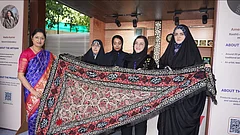
The pieces subvert form, with the use of mixed media in textile. The stitching has everything between silk, block prints and textures woven on top of them. The extravagant use of colours seems like a successful attempt at an amalgamation of ideas, feelings, forms and different artforms that the artist encountered while defining an idea of home(s).
Shaped by the artist’s life between France and India, the work brings together different textile traditions, from the French Toile de Jouy to Indian silk. Ultimately, the exhibition reflects on the idea of belonging—home not as a place, but as a state of openness.




On conceptualization of the pieces
D'Souza's titular concept crystallised amid personal upheavals around 2016-2018, as family ties and emotional fractures pulled him back to India after 25 years in France. "Suddenly started thinking of India more because my mom is 83. So, I want to spend time with her a little more," D’Souza shared, compounded by a breakup that prompted longer stays—three to four months annually in India while basing in Paris. This rhythm, evolving since circa 2016-18), birthed the theme: "How I can make both my home. I can't choose one because that’s very difficult." The concept kept repeating itself in his practice and now after 10 years of iteration, it anchors the show as a "celebration of work," balancing emotions and roots: "One plus one is equal to one... it is not two,” D’Souza said.

The use of textiles
Textiles anchor the show, symbolising D'Souza's bicultural existence. After studying at École des Beaux-Arts in Paris under Christian Boltanski, following a BFA in Bangalore and an MFA in Baroda, he spent 25 years navigating immigration's folds. "The textile came into it because it's only the form which can be folded and put into a box," he said, evoking his own experience of feeling like a "folded piece of textile" upon arriving in Europe, that “slowly unfolded”. Indian chintz, calico and his mother's cupboard of 300-400 sarees fuel this: "Everything is mixed and becomes a treasure of colours," he added.
In Home Away From Home, D'Souza has attempted to elevate the everyday labourers who shape our lives, transforming them into poetic icons. "I'm trying to celebrate the man who made my shoes, my belt, my trousers, my jacket, my rings," he explains, "These are the people who made me presentable."

The artist has invited artisans to embroider his drawings. This shift from line to stitch marks an important evolution in his work. The drawing is no longer solely the artist’s gesture but the result of collaboration, where craftsmanship is not a technical step but an essential dimension of the work itself.
Drawing from Indian masters like Somnath Hore and Ramkinkar Baij, whose works pulsed with "the truth of the famine" and raw vitality, D'Souza rejects art as a mere "marketing object." Instead, he insists on crediting everyone in the creative chain, sans hierarchies, just community. Pichwais from Ahmedabad inspire him, where artisans imbue statues with a "sublime" aura; without it, objects remain lifeless. His mixed-media textiles honour weavers, cooks, even rickshaw drivers: "I think each pearl has its own name, forming a garland of things."

The presence of hands
Hands are an important aspect of the works on display. They emerge as a potent motif in the exhibit, embodying the artisan's touch and D'Souza's own evolution from craft to high art. "The hand is the gesture of the artisan," he said, recounting his roots in block printing: "I started as an artisan; I used to make block printing. And then I became an artist." Rendered through embroidery, drawing and mixed media, hands recur as sensual artisan gestures, "I wake up in the morning, I kiss my hand because it does a lot of things".
The exhibition is a celebration of colours, immigrant life and mastery of artistic craft via textiles. It is also a visually stunning rendition of a deeply personal, yet relatable feeling of homeliness, its transient nature and its existence in people, places, and within.