Iran claims new Arash-e Kamangir system downed US MQ-9 drone
Analysts say mobile air defence could strengthen Iran’s Hormuz deterrence
Drone interception claim highlights tensions amid fragile US-Iran ceasefire talks
Iranian state media made an announcement recently that landed squarely in the middle of an already volatile situation. Iran said it used a new air defence system to shoot down a United States MQ-9 Reaper drone near the Strait of Hormuz. Iranian media said the drone was brought down near Qeshm Island, adding that the interception marked the first combat use of a locally developed system called Arash-e Kamangir.
The name is deliberate. As Al Jazeera noted, Arash-e Kamangir translates from Farsi as "Arash the Archer" — a reference to the mythological Persian hero who, in ancient folklore, fired an arrow so far that it drew the border between Iran and Central Asia.
Iran's Claims
Iran's semi-official Fars News Agency said the Arash-e Kamangir system was used to intercept the drone over the Strait of Hormuz. It described the system as having stealth-detection capabilities but gave few technical details. Mehr News Agency separately reported that residents on Qeshm Island heard loud sounds linked to active air defence operations late on May 25.
Fars quoted unnamed officials as saying "This operation, which was carried out using a system with hidden capabilities, is a clear and decisive message from Iran," with a warning that "no radar-evading drone shall ever again breach the skies of the Persian Gulf."
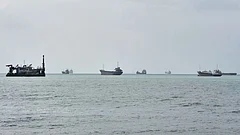


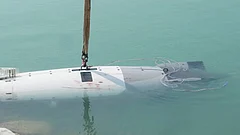
However, Iranian authorities did not identify where the drone came from or who owned it, and no independent proof of the claim was provided. Al Jazeera stated that there has been no independent corroboration of Iran's claim of a new interception system.
The US has not officially confirmed the loss of a drone in that location, though US-Iran tensions around Hormuz have continued to escalate. The US has reportedly carried out new attacks on an Iranian military site near Bandar Abbas, and Iran's IRGC said it had attacked an "American airbase" in retaliation.

What Analysts Say
The question that matters is whether Arash-e Kamangir represents a genuine capability shift or a well-timed communications exercise. Experts who spoke to Al Jazeera landed somewhere in between.
Alex Almeida, a security analyst at Horizon Engage, a New York-based strategic intelligence platform, told Al Jazeera that the system may be related to other Iranian short-range or loitering surface-to-air weapons. "I suspect it's a further development of one of those systems," he said. "It doesn't rely on fixed guidance from a traditional air defence radar site. It's probably using some kind of electro-optical or heat-seeking guidance — essentially a pop-up SAM system that is easy to set up and launch."
Traditional air defence networks built around fixed radar sites and large launch batteries are far easier for adversaries to detect and destroy. A smaller, mobile system that can be moved, hidden, rapidly set up, and replaced cheaply operates on a completely different logic. Analysts who spoke to Al Jazeera said the Arash-e Kamangir interception may be less a revolutionary new weapon than another step in Iran's wider shift towards mobile, lower-cost air defence.
Others also argue that Tehran may still need stronger medium- and long-range air defences, but added that mobile systems have a clear advantage. Analysts also noted that if the claim holds, it could force the US to rely more on expensive missiles rather than drones when operating near Hormuz.

Capability or Signal
Iran has a well-documented history of announcing defence systems whose actual capabilities are difficult for outside observers to independently assess. The broader question around Arash-e Kamangir is not just technical — it is political.
The announcement signals how Tehran wants the next phase of the crisis understood — not only as a missile-and-drone fight, but as a test of whether Iran can still contest US surveillance over Hormuz. With ceasefire negotiations fragile and ongoing, Tehran's ability to claim it shot down a high-end American surveillance drone near the world's most watched oil chokepoint is, regardless of the system's exact specifications, a message about leverage.
The incident has renewed questions about how much of Iran's air defence capability survived months of Israeli and US strikes — and whether Iran retains the resilience to withstand another round if negotiations collapse. Nobody outside Tehran knows. And Tehran is quite deliberately keeping it that way.