Prioritises roads, healthcare, irrigation, and connectivity; raising constituency-specific issues in Parliament and through local interventions.
Relies on incremental development and administrative follow-up, shaped by early political experience managing campaigns under pressure.
Positions herself as a voice for Muslim, OBC, and rural women, questioning how effectively policies like women’s reservation reach the most marginalised.
On most days in Kairana, politics does not announce itself in grand gestures. It shows up in requests for a road, a transformer, a railway stop; in a letter written to an official; in a visit to a tense neighbourhood. This is the terrain that Iqra Choudhary, one of the youngest and among the few Muslim women in the Lok Sabha, has chosen to occupy since her election on June 4, 2024.
At first glance, her politics might seem understated. There are no sweeping flagship schemes to her name yet, no headline-grabbing announcements. But look closer, and a pattern emerges: a deliberate focus on the everyday mechanics of governance in a constituency long marked by underdevelopment and communal tension.
The 31-year-old MP secured victory in the Gujjar-dominated Kairana seat in Uttar Pradesh’s sugarcane belt, a constituency closely tied to her family’s political legacy, having earlier been represented by her grandfather, Chaudhary Akhtar Hasan, and her father, Munawwar Hasan. She is also the second woman in her family to hold public office, after her mother, Tabassum Hasan, who stepped into active politics following her husband’s death in 2008.



Choudhary’s early months in Parliament reflect what might be called a grievance-redressal model of representation. Parliamentary data and records of her questions and interventions show her repeatedly raising constituency-linked concerns: gaps in healthcare infrastructure in Kairana, rural road connectivity under PMGSY, irrigation access through PM Krishi Sinchayee Yojana, women-led MSMEs, and adolescent nutrition under POSHAN 2.0.

These are not abstract policy debates, they mirror her campaign pitch on jobs, inflation, and access to education, particularly for girls in a region where mobility remains a constraint.
Her constituency work reinforces this grounding. From pushing for better rail connectivity from Shamli to flagging infrastructure bottlenecks with officials, her politics is anchored in tangible, incremental demands. Even her MPLADS spending reflects this approach; small, distributed works like roads, drainage, and electricity infrastructure rather than singular marquee projects.
Part of this instinct for on-ground engagement can be traced back to her political apprenticeship. Choudhary first stepped into active politics under pressure, managing an election campaign when her brother, Nahid Hasan, was jailed. The experience appears to have shaped her style: less rhetorical flourish, more administrative follow-up; less spectacle, more presence.
That responsiveness is visible during moments of tension. Whether attempting to visit violence-affected areas or acting against fake social media accounts misusing her identity, she has shown an awareness of how quickly local issues in western Uttar Pradesh can escalate.

If her constituency work is grounded, her political pitch is sharply defined. Across speeches, interviews, and documented parliamentary interventions, Choudhary has positioned herself as a voice for intersectional representation, particularly for Muslim, OBC, rural, and marginalised women.
Her critique is not of empowerment as an idea, but of how it is implemented. While supporting women’s reservation, she has questioned whether its design adequately reaches those at the bottom. In a letter to Om Birla, she called for a dedicated parliamentary day for women and child development issues, framing them as central to governance.
She has also flagged what she describes as “double exclusion”: Muslim women being underrepresented both within political parties and in policymaking spaces. This framing, often described as “strategic feminism”, focuses less on symbolic milestones and more on access: who benefits, who participates, and who remains invisible.
MORE FROM THIS ISSUE
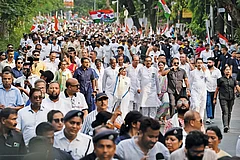


Kairana is a politically sensitive constituency, shaped by past polarisation and migration narratives. Choudhary’s response has been to emphasise coalition-building across communities–Dalits, Muslims, Jats, Gujjars—both in her electoral messaging and political positioning. For now, this approach, looks like this: a road laid, a demand raised, a presence maintained, not loudly, but persistently.