






Nearly two years into Parliament, Kangana Ranaut, Mandi MP, has drawn more attention for her public statements and controversial remarks, both inside and outside Parliament, than for any measurable action in the constituency, twice battered by natural calamities, prompting demands for her direct engagement on the ground that was regrettably missing.
Thus, it is more her absence from the scene that has curiously put the local Bharatiya Janata Party leadership—the opposition party, in the spot, than her celebrity status or her role as a star campaigner in the West Bengal polls even as her visibility practically overshadowed leaders like J.P. Nadda and Anurag Thakur, the party seniors and seasoned public figures from the Himachal hills.
The last time she addressed the Parliament on the women’s reservation bill, she drew criticism back home for her inaccurate claim about the number of women MLAs in the state assembly. While the actual number was three, one from the BJP and two from the Congress—she claimed it was just one.
"It is unfortunate that someone who does not even know how many women MLAs are there in the Himachal Pradesh Assembly is making such claims...Simply because she has to support a particular narrative rather than highlighting the genuine issues, for which she has no concern. What else can you expect from her (Kangana)?” said Vikramaditya Singh, the state’s PWD minister and Congress candidate in the June 2024 polls.

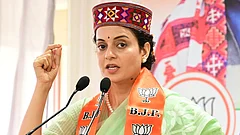

For Ranaut, a four-time National Award winner and Bollywood star, life seems to have come full circle. She was a role model for many girls in the hills hoping to carve out her place in the film industry. It was basically her celebrity status and the Modi wave that gave her an advantage, especially in a large rural constituency, to win her maiden electoral battle by 74,755 votes. Her local roots and constituency dynamics favoured her. She also had strong backing from the BJP’s national leadership and campaign machinery. Mandi has historically alternated between the BJP and the Congress, but the BJP has a strong presence due to former Chief Minister Jairam Thakur’s home district.
When Ranaut did not show up in the constituency on time after the monsoons that caused massive devastation in the area, questions were raised. She faced black flags and slogans like "You are late (Madam); go back."
“There’s no denying her strong presence in Parliament and participation in debates,” says Thakur, “But politics isn’t confined there. The real test is on the ground, and that’s where the criticism lies.” Officials in her parliamentary constituency admit that there is nothing much she has done till now to resolve basic issues, even public grievances.
She has been quite vocal in most national and critical political debates, from One Nation, One Election, the Women’s Quota Bill, and the new VB-G-RAM-G scheme. Even though her attendance in the Parliament is more than 85 per cent, not a single new project has taken off, including the most publicised scheme for revival of dying traditional crafts, i.e., handloom and handicraft sector, which has been a livelihood mean for 70 per cent of rural women, artisans, weavers, and loom workers.
“Simply wearing traditional attire, carrying a Kinnauri shawl, or wearing a Kangra miniature-inspired sari isn't enough; what truly matters is supporting local craftsmen and women through centrally funded schemes and opening up new global marketing, which has not happened so far," says Devkanya Thakur, a Kullu-born writer.
Nevertheless, Ranaut did use the parliamentary forum to draw government attention to critical infrastructure gaps in Mandi, particularly affecting tourism-driven economies. She raised the issue of strengthening connectivity, both rail and air, to key destinations such as Kullu-Manali and Leh.
Her other demands include the construction of tunnels on the lines of the Rohtang Tunnel to provide reliable all-weather road connectivity, as well as faster execution of railway projects. She has also pushed for a comprehensive disaster mitigation strategy, alongside expanded rural electrification in remote, high-altitude villages—areas that have historically remained underserved.
“She even took up the issue of poor maternal and adolescent healthcare access—a women-centric issue and an international-standard airport in the Mandi region," says Daleep Singh Thakur, the BJP MLA from Sarkaghat, which is next to her native village.
Last year, when confronted about her lack of interest in solving the problems of locals, Ranaut said, “People come with all sorts of problems, which ordinarily don’t relate to a member of the Parliament whose role is about larger policy-level matters, not resolving every local grievance personally."
About her delayed visit to flood-affected areas of her constituency, Kangana reminded a journalist at Manali, “You should know I am also from this area and a Himachali, not the Queen of England. I am also personally affected (by floods). My restaurant (at Manali) did business of only Rs. 50 yesterday. We pay Rs. 15 lakh in salaries. Please understand my pain, too.” She added, “I have no control over funds, nor do I hold any cabinet rank or disaster funds (to sanction relief).”

MORE FROM THIS ISSUE


Primarily, it’s her disconnect from the people that could worry the BJP when the next elections are held. Her predecessor at Mandi, Pratibha Singh, wife of six-time CM Virbhadra Singh says, “Unfortunately, she is not taking her parliamentary responsibilities seriously. People of Mandi, even the BJP, are regretting electing her."
















