



LPG supply disruptions across the hill states have hit families, students, vendors, dhaba owners and hotels, with many turning to electric burners, induction stoves or firewood to cook.
In Uttarakhand towns such as Nainital and Kathgodam, angry residents gathered at gas agencies in protests demanding a timeline for deliveries.
With commercial LPG scarce, restaurants reduced menu items, ashrams shut kitchens and workers struggled to find food, while many rural households returned to traditional mud stoves and forest wood.
For Ridhima, a young girl from Chopal, the war in West Asia had never been a matter of concern. As she moved to the state capital, Shimla, to pursue her nursing training, global conflicts felt distant. Even when the LPG cylinder in her rented room at Sanjauli ran out +early this month, it did not alarm her. She requested a refill. But as the week went by, the delivery never arrived. A much larger cooking crisis was unfolding, one she had never imagined in her village, where traditional kitchens remain a part of everyday life. Ravi, 25, who hails from Chamba and earns his living in Shimla with his family, was compelled to borrow an induction cooker from a relative to partially resume cooking after the LPG agency stopped bookings.
From the hills of Himachal Pradesh to Uttarakhand, the LPG crisis has hit families, students, daily wage earners, vendors, dhaba owners, hoteliers and those running “bed and breakfast” (B&B) units. When Manali experienced snowfall last week, driving tourists to places like Rohtang Tunnel, Atul Sharma, who owns Hotel Palchan, said the kitchen ran out of cylinders. “It was a desperate situation, as my rooms were already sold out. We arranged a few electric burners and induction stoves. But no LPG has arrived since. Now, with the tourist season starting, I don’t know how long we can manage like this. The hotel industry is bound to bear the brunt of the LGP crunch.”

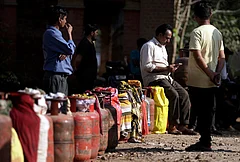

At Nainital in Uttarakhand, protests and public anger marked the ongoing LPG shortage. Delays in the arrival of LPG forced people to gather at gas agencies and distribution points and lodge angry protests demanding a timeline for deliveries. Similar protests also happened at Kathgodam, the main entry point to the Kumaon region.
Several restaurants in towns like Dehradun, Rishikesh, Haldwani, Tehri, Srinagar, Kashipur, Chamoli, Almora and Mussoorie have already reduced menu items and shifted to electric stoves and induction cooktops.

The industrial belts of Rudrapur, Selaqui and Haridwar also faced a shortage of commercial LPG cylinders, affecting the canteens, dhabas and food and tea outlets, leaving industrial workers struggling to find food. “We are left to sell only paan-bidi to our labourer-brothers,” says Vikas Tomar, a canteen owner.
More than a dozen ashrams at Haridwar have shut down kitchens that have been feeding hundreds of sadhus, pilgrims, students and visitors. This did not happen even during the covid lockdown, when many of the ashrams served meals to 800-1,000 persons and also provided them medical care.
Nearly 1,00 MBBS, PGs and nursing students at Haldwani’s Government Medical College, eating daily meals at official messes, faced a food crisis. The meals are currently being cooked over wood stoves.
The ongoing LPG supply disruption in Himachal Pradesh has also affected rural households in remote hill villages, forcing many families to use firewood and mud stoves for cooking. Locals at Pangi, a landlocked valley of Chamba district, say that since LPG supplies remain irregular, many a time, also due to road disruptions, they use forest wood as a cooking substitute. Raj Kumar Bhimta, an orchardist from Kotkhai, says, “Our kitchens are incomplete without a hearth. It is an old legacy from our forefathers. Since firewood is plentiful with us, LPG is used sparingly. A cylinder lasts nearly six months... During the snow days of winter months, the hearth also warms our wooden homes as the whole family gathers in the kitchen area.”
But a few had abandoned the traditional wood-fired mud chulhas. The government agencies sold LPG connections to rural families to reduce pressure on forests. The initiative was meant to create environmental consciousness and protect women from pollution and kitchen smoke. “Our governments also encouraged and incentivised the use of LPG, particularly in the tribal belts and remotely located villages, to save forests. The idea was commendable and also delivered well on its objectives,” says Prajwal Busta, a lawyer and women’s rights activist.
However, Busta highlights that traditional knowledge and practices have remained resilient during every crisis. Families in the hiils have turned back to traditional cooking as an alternative. Nevertheless, she asserts that LPG remains a viable option for healthy, and efficient cooking as it involves less effort like the collection and storage of firewood. “These days, if you go to our area of Jubbal-Kotkhai-Navar, you will see fuelwood stocks stashed for cooking,” she adds.
Chief Minister Sukhwinder Singh Sukhu maintains that domestic LPG stock remains adequate in the state but acknowledges supply disruptions in the case of commercial LPG, which are due to the global situation.
“The entire issue was discussed at a high-level meeting two days ago. The Chief Secretary has been instructed to keep a close watch on the situation and take appropriate steps. Moreover, as 90 per cent of the state’s population lives in rural areas, it continues to rely on traditional fuels,” he says. The situation is somewhat different in the lower hills, particularly in the industrial belt of Baddi-Barotiwala-Nalagarh and the Kala-Amb and Paonta areas of the two districts—Solan and Sirmaur—where the impact of the LPG supply disruption is very visible among migrant families and factory workers.
The region is home to thousands of migrant workers, who live in rented shelters or shared accommodations.
Baddi-Barotiwala-Nalagarh is the biggest hub for Asia’s pharmaceutical giants, textiles, packaging and manufacturing units. For many of the workers employed by these companies, cooking gas is essential for preparing quick meals. Though many migrant workers admit they don’t have regular LPG connections yet, the availability of the cylinders was never a problem here until the crisis erupted. Even those dependent on roadside dhabas and other eating outlets are struggling to find affordable cooked meals.
Some have begun rationing fuel and preparing fewer meals using electric/kerosene heaters and induction stoves or are being helped by their employers with cooked meals. The struggle for them is tough, affecting their daily work schedules and factory shifts.
Himachal Revenue Minister Jagat Singh Negi, who is an MLA from the tribal district of Kinnaur, admits that the shortage of LPG at some places is worrying. “If shortages continue, households could face serious problems in daily cooking. The hotel industry will also suffer,” he says.

MORE FROM THIS ISSUE


This article appeared in Outlook's April 1st, 2026 issue titled 'ParaDime Shift' which looks at how the US-Israel attack on Iran has come home to India with the LPG crisis and is disrupting the nation's energy ecosystem, exposing policy gaps and testing the limits of diplomacy.















