






Restaurants and eateries in Delhi’s Okhla are struggling to operate during Ramzan due to a severe LPG shortage.
With around 60% of LPG consumption met through imports, India’s heavy reliance on foreign supplies makes households and small businesses vulnerable to international crises.
Domestic users and small business owners face skyrocketing cylinder prices, long queues, and limited alternatives.
Alig’s Cafe, a small eatery nestled among several similar restaurant-cum-chai stalls at the bustling hangout spot of Okhla Head, is decked out for Ramzan, the holy month of Islam.
Since the first meal of the day during Ramzan is eaten at the break of dawn, people often stay awake through the night, spending time with family and friends at such eateries in Okhla, a Muslim-dominated area of the national capital, Delhi.
But the festive mood at the eatery has been muted. Its owner, Mateen, who goes by his first name, says he is struggling with Liquefied petroleum gas (LPG) shortage, a particularly difficult situation during Ramzan, which is usually the most profitable time of the year for business.
On March 15, Mateen had to bring an LPG cylinder from his hometown of Hapur in Uttar Pradesh, about 60 km from Okhla. Alig’s Cafe typically uses around 40 cylinders a month, procuring them through unregulated means; but amid the shortage they are now stretching a single cylinder to last two to three days.


“We turn it off very frequently and do not cook in continuation but in stock,” an employee said, adding that a cylinder that earlier cost them Rs 1,100 is now selling for Rs 3,300–4,000.

He said that while inflation has already made it difficult for them to make ends meet, the LPG shortage has further hurt their earnings during Ramzan. “We have one person from the team standing in the queue for the gas cylinder every day,” Mateen said.
Asked if he knew the reason behind the crisis, the employee said he had heard something about developments in Iran. “What do I have to do with Iran? Why is it affecting my earnings?” he added.
At the local café, which has a makeshift seating area, delays in orders have also begun to frustrate customers. Having just brought in a cylinder that was being fitted onto the stove as he spoke, Mateen said there was little alternative, they had to rely on LPG. “It is a desperate situation,” he said, with tired eyes and a forced smile.
The situation was worse for Mohd. Zaheer, who runs Qasmi Biryani in the popular food hub of Zakir Nagar. His shop requires three gas cylinders each day to operate. He had to shut his shop for four days after his cylinder supplier stopped responding to his calls. “I didn’t earn anything, on top of that I lost around Rs 50,000 every day in terms of rent, electricity, staff salary and other expenses,” he said.
Arranging a gas cylinder has now become a daily struggle. On March 16, Zaheer had to bring in three cylinders from Meerut.

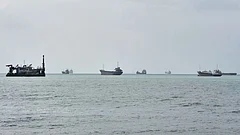
Since the war in West Asia began, India has been facing an LPG shortage as supplies were disrupted following the military conflict involving Iran, Israel and the United States, and its effect on the Strait of Hormuz, one of the world’s most critical oil transit chokepoints. In 2024, average daily exports stood at 20 million barrels per day, based on figures from the US Energy Information Administration.
The Strait of Hormuz lies between Oman and Iran, connecting the Persian Gulf with the Gulf of Oman and the Arabian Sea. It is the only natural sea passage from the oil‑rich Gulf to the open ocean, making it one of the most strategically important waterways in the world.
India relies on imports for roughly 60 per cent of its LPG consumption, with nearly 90 per cent of those supplies typically transiting through the Strait of Hormuz.
On March 13, India’s Union Minister for Petroleum and Natural Gas Hardeep Singh Puri said in Parliament that it is the first time in recorded history that the Strait of Hormuz has been effectively closed to commercial shipping. “Despite India having no role in causing the conflict, like many countries, India has to navigate through its consequences,” he added.
The crisis has taken over the country, with people standing in long queues for domestic and commercial supply of cylinders. It has also become a source of humour on the internet, with memes being generated that the crisis is reminding people of the announcement of COVID in 2020 by Prime Minister Narendra Modi, after which the country was on a lockdown for months. “Sama kuch 2020 jaisa hi lag raha hai (It feels just like 2020 all over again)” one of the commenters said.

However, the Prime Minister has assured the public that the government is making continuous efforts to overcome the obstacles in the supply chain.
“I have full confidence in 140 crore Indians that just like Covid time, we'll overcome this crisis too," he said.
Yet for small business owners living hand to mouth, such statements offer little comfort. Mukesh*, who runs a tea stall outside an office, had to raise the price of tea by Rs 5. “The customers are thinning due to the price hike, I will have to buy an induction,” he said.
But even buying an induction is no easy task. Feroz Chaudhury, an electric appliance dealer in Okhla’s Abul Fazl, said he has already run out of stock. Prices have surged by hundreds, and at least 25–30 customers visit daily to inquire about inductions. “Before the LPG crisis began, months would pass before I sold 1-3 inductions,” he said.
The domestic supply of cylinders is hit just as hard. Syed Mohammad Zia Uddin, 28, a food and brand photographer, is feeling the double impact of the LPG crisis. Many of the restaurants he works with now have limited LPG supplies, which affects their ability to schedule shoots with him. “Of course they will prioritise the customers over brand photography in times like this,” Zia said.
On top of that, his domestic cylinder has run out. Living with two flatmates who are also working, they are struggling to manage, as the lines at the gas agency stretch endlessly. “We are ordering food every day; it’s heavy on the pocket, but there is no other way,” he added.

Minister of External Affairs S. Jaishankar has described direct engagement with Iran as the most effective approach to resuming shipping through the Strait of Hormuz, in an interview with the Financial Times, also noting that there is no “blanket arrangement” for Indian-flagged vessels and that Iran has not been given anything in return.
“Certainly, from India’s perspective, it is better that we reason and we coordinate and we get a solution than we don’t,” he told the newspaper.
Parul Bakshi, a Fellow at Energy and Climate at the Observer Research Foundation, Middle East, said that when we talk about energy security, energy diplomacy also becomes a key potential that we need to look at. “Of course, we're talking about diversifying the source of energy imports, but that diversification also means that we need to diversify our diplomatic efforts and ensure that we have a largely stable relationship, which India historically has had with multiple nations,” she said.
She noted that the government is taking short term solutions like increasing the booking gaps for domestic cylinders from 21 days to 25 days, but the crisis opens up a broader question when it comes to the LPG sector. “We should look into how we want to strategise going ahead, something that possibly we should have done already to a certain extent,” she said, adding that we need to assess if we are ready for such disruptions in the near future because “geopolitics has been volatile for a while.”
Farhan Ali,* who runs a cloud kitchen in Johri Farm, said he was unable to fulfil an order for an iftaar gathering. He explained that he is currently relying on domestic gas supplies for his commercial kitchen, which is also a temporary hack since it could now take upto 45 days to get another domestic cylinder.
He added that even tandoors in Delhi largely run on gas rather than coal, and his roti supplier has raised prices by around 40 per cent, making it unaffordable for him. Ali, who started the kitchen on February 9 this year, is already finding it difficult to keep the business running.
On March 8, the Government issued an order to maximise LPG production. “Hence, in the last 5 days, LPG production has been increased by 28 per cent through refinery directives, and further procurement is actively underway.”
The country has 33 crore domestic LPG connections. As of March 12, 10.57 crore connections fell under Pradhan Mantri Ujjwala Yojana, a flagship government programme to provide clean cooking fuel to poor households.
However, for those on the margins, these measures have brought no relief. Living in a slum colony near the Yamuna, Qudsia, a mother of three, works as a house-help earning ₹2,500 a month. Her supplier, who provides LPG cylinders on the black market, has told her that prices have risen to between ₹3,000 and ₹4,000 per cylinder. It has been three days since her last cylinder ran out.
“My husband is a rickshaw puller. He gathers wood from different places, and we are using that to cook for the family,” she said. “It is especially difficult during Ramzan—we are fasting and cannot even cook properly.”
Bakshi reiterated that the extent of reliance on imports is very high. “But the real question still remains, how long will this war continue? How long does the choke point remain obstructed? And how soon can we get supplies?”
While appreciating the government’s quick short-term relief initiatives, Bakshi added that “from a long-term perspective, whether we might look at extending our domestic production is, of course, yet to be seen.”
*names changed to maintain anonymity.















