Certain stories challenge assumptions about society and force a reconsideration of what it means to be human.
Speculative fiction uses imagined worlds to reflect present fears, systems, and behaviours, offering alternative possibilities for humanity.
Utopian and dystopian narratives act as warnings, showing how existing social and political impulses can shape troubling futures.
When was the last time you read a story that well and truly blew your mind?
I suppose, in order to answer that question, you’d have to first consider what it means to have your mind blown? To me, it means coming upon a story that makes me reconsider the very foundations of society, and which challenges my assumptions about what it means to be human.
Because we live in a human body, and because we can see it, smell it, inhabit it and drink of it, we imagine that we know it. We certainly fall into the trap of thinking that we know what human culture is (or what it ought to be) because that’s how we already live, and we’d like to keep it this way. At most, we might need to stretch the frontiers of what we can achieve, how far we can travel, and the limitations of our bodies. That’s the kind of science, and also the kind of fantasy, we like to conjure up. But every once in a while, along comes a story that shakes our self-assurance, and forces us to reconsider humanity.


One of the first books that blew my mind was Ursula Le Guin’s 1969 novel The Left Hand of Darkness. I had read plenty of literary fiction before, hundreds of books that routinely feature on ‘classics’ and ‘must-read’ lists. But with this book, Le Guin took me beyond empathy, beyond descriptive prose and into the realm of visionary possibility. It was this novel that truly expanded my thinking about gender and the performance of it—what is ‘normal’ about gender norms, how is normalcy enacted and enforced, and why there is such an overwhelming emphasis on the fixity of sexual behaviour?

The Left Hand of Darkness is what we call speculative fiction. These are a subset of literature that includes science fiction and fantasy and it presents to the reader (or viewer) a world that reflects on our existing mess, our existing fears, but with a fresh vision for outcomes. Regardless of whether the ‘hero’ of the story is a man, girl, rabbit or alien, the protagonists’ behaviours, their systems of governance and infrastructure will be familiar, or their world will be presented as alternatives to our current systems.
Whether these stories unfold on earth or in another galaxy is irrelevant. The readers know that we live in this world and no other, and so, the stories are always about here and the heroes and villains are us. Even when characters are represented as aliens with an entirely different nervous system—as in Judith Octavia E. Butler’s Lilith’s Brood trilogy—they are still only versions of ourselves. They have similar foibles, fears, dilemmas. If they behave in different ways, it is only because something about their bodies or their social environment has changed, and thus the story opens up an invisible portal to fresh possibilities—what might we be, if we were not so adamantly ourselves?
Every once in a while, along comes a story that shakes our self-assurance, and forces us to reconsider humanity.
If fantasy and science fiction offer alternative visions for humanity in the form of a feminist utopias (think Begum Rokeya Sakhawat Hossain’s Sultana’s Dream (1905), where she creates Ladyland, a country where women rule), they also warn of the pitfalls of going in the opposite direction. In 1989, Suniti Namjoshi published The Mothers of Maya Diip, which describes a country where mothers don’t just run things, they bring up only daughters; sons were kept alive only to enable reproduction. Just a few years before, in 1985, Margaret Atwood had published her dystopic novel, The Handmaid’s Tale. Even though the novel is based on events that have actually occurred in human history, the plot unfolds before us as a future possibility, perhaps as a warning—this is what we have been, therefore this is what we can be again.
For contemporary readers of The Handmaid’s Tale, the most frightening thing is not that it presents a future dystopia, but that the discourse that girds the absolute subjugation of women’s bodies is back in the mainstream news. The very limited freedoms of women in Afghanistan have been snatched away, and their lives are being circumscribed in ways previously unimagined even within their own cultural traditions. Western women are losing hard-won freedoms such as abortion rights in the United States of America, and it seems as if they are now building up a sociopolitical discourse whereby it is acceptable for much older men to prey on the bodies of minor girls. Any government, or military, any tech oligarch could disable the lives of any targeted group, be it women or racial or religious minorities, without going to the trouble of mass murder—our bank accounts, our healthcare, our passports could actually be disabled, as they were in The Handmaid’s Tale.
Did Atwood foretell these events? She probably didn’t foretell as much as she forewarned, though it is not clear that the world heeded the warning. Any writer who pays attention to people’s best and worst impulses, and the political systems into which such impulses are plugged, can also see the range of possibilities that lie in wait for us. Based on such visions, they may create either a utopia or a dystopia. In their own time, George Orwell’s 1984 (1949) and Aldous Huxley’s Brave New World (1932) described events that may have appeared far removed from reality, but in our lifetimes, it is almost as if those books have come alive. Technology has developed to the extent that not only can Big Brother watch us and listen to us and intercept our conversations at all times, a significant number of us now welcome Big Brother into our living rooms, our kitchens, bedrooms and toilets. They are even capable of monitoring our body’s chemical processes and our neurological responses on a minute-to-minute basis. The technology that underpins the plot of The Hunger Games (2008) is also already here, and whether or not the author foresaw those games turning into reality, there is little doubt that in a world deeply committed to inequality, some version of The Hunger Games is inevitable.
Another book that has been blowing our collective mind for generations now is Mary Shelley’s Frankenstein. It continues to be adapted, retold and filmed for it holds out both temptation—what if humankind could reverse death? and ethical complexity—given human behaviour, should we have such power? With the latest stem cell research and organ transplants, at least part of Viktor Frankenstein’s efforts has crossed over from the realm of fiction to reality. Still, we require—as Frankenstein did—working parts from healthy bodies. We also know that prolonging life is an intensely political game, often underwritten by systemic oppression. We’ve read reports of women pressured to donate organs to male kin, and healthy people left with no choice but to start selling functional bits of themselves to the ailing bodies of the rich, and, as Manjula Padmanabhan’s 1997 play Harvest shows, this may well become a legit (legal) process in the future. Already, we know that organs are stolen from certain populations, such as Palestinians, with no consequences for the theft. The question must therefore be asked: How is the monster made? How do we address it? And then, the story of our choices and their consequences must be told.
Annie Zaidi writes across multiple genres, including fiction, non-fiction, plays and poetry. Her published work includes The Comeback, Bread, Cement, Cactus: a Memoir of Belonging and Dislocation, City of Incident, Prelude to a Riot, and Bantering with Bandits and Other True Tales
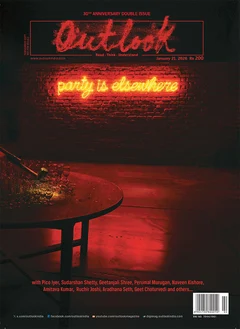
MORE FROM THIS ISSUE


This article appeared as "Because We Live In This World And No Other” in Outlook’s 30th anniversary double issue ‘Party is Elsewhere’ dated January 21st, 2025, which explores the subject of imagined spaces as tools of resistance and politics.