




Elsewhere: How Imagined Worlds Become Sites Of Resistance, Memory And Hope
We dedicate this issue to those who venture into the elsewhere, to people made of paper and to those who imagine and dismantle entire worlds for the sake of love.

Outlook Anniversary Issue: Our Unseen Sanctuary, Finding Calm Within Chaos
A hidden inner refuge guides us, preserving the clarity and calm the outer world cannot offer.

Outlook Anniversary Issue: Notes From An imaginary Notebook
In Dreams. There is no Alice. There is no Wonderland. There is wonder. And there is arousal. Of the imaginary. A tactility in the text that conveys the illicit and the unmentionable.

Outlook Anniversary Issue: Márquez’s Macondo And Gandhi, Still Undeciphered
Márquez’s Macondo And Gandhi, Still Undeciphered

Outlook Anniverary Issue: Excerpt from Premendra Mitra's 'Discovering Telenapota'
Despatches from the forgotten village
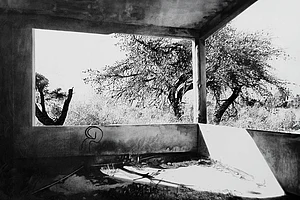
Outlook Anniversary Issue: Between Sky Above, Earth Below
It is difficult to discern the difference between real space and fictional space. The writer needs the artistic skill to fuse the two.

Outlook Anniversary Issue: The World And The Word
Amid aggressive public discourse and political pressure, literature survives as a quiet retreat—preserving silenced voices, resisting instant reactions, and allowing writers the freedom to wander, reflect, and reinvent meaning
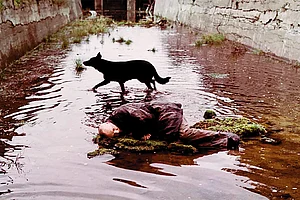
Outlook Anniversary Issue: Navigating The Nation Factory
Today, as we struggle to push back against poisonous ideas of the divine, even as we struggle to find love and sahanubhuti to navigate our very harsh realities, the film does what the very best art should–it presses sharply on our pain points and briefly manages to release them.

Outlook Anniversary Issue: Holding Breath In A City That Never Pauses
The acts of breathing in and out become compositional devices—intervals through which rhythm and exhaustion surface as material conditions for speaking and being.

Outlook Anniversary Issue: Sab Yaad Rakha Jayega
Violence is endlessly recyclable. Stop torture. Stop bulldozer injustice. Remember that we live in one world. Remember that the body forgets nothing, nor does the earth.

Outlook Anniversary Issue: House Of Shared Contemplations
Some homes break free from the linear passage of time, from codes that perform perfection, from everything that is a supposition or an assumption.

Outlook Anniversary Issue: The Seduction Of Elsewhere
True longing alchemises us. As the experience of incompleteness eats into our innards, it births us, gradually, into a new wholeness. And one day, it would seem, we no longer see any conflict between earth and sky, now and forever. The divide has been healed. We are home. Elsewhere is right here.

Outlook Anniversary Issue: Home ...A Conversation
A meditation on love, memory and migration, where the search for home becomes less about a place and more about building belonging through care and shared histories.

Outlook Anniversary Issue: Diary Of A Homeless Child
The piece explores displacement, resistance and the meaning of home beyond walls and land.

Outlook Anniversary Issue: Tracing The Memory Of Migration
An essay tracing lost memories of Bhojpuri women who migrated under indenture from Uttar Pradesh and Bihar to Suriname in the 19th century

Outlook Anniversary Issue: Well-Kept Ruins of Memory And Time
A hasty, forgetful walk through Osnabrück transforms streets where past and present meet in moments of reflection, and timelessness.

Beyond Plot: Why Great Reading And Great Fiction Begins With How And Where
This space which I want to create, unlike that of the real world, has to be open to possibilities, to dialogues, to alternate viewpoints, and defined by an underlying sense of respect.

Outlook Anniversary Issue: The Artifice Of Reality
In the end, a place in a story is true not because it exists on a map, but because it is the only place that specific character could have ever been born in.

Outlook Anniversary Issue: Known And Unknown Worlds Beyond The Visible
To engage with landscape today is to reject superficial beauty and cultivate inner vision — a deliberate peeling back of layers to reveal the stories of struggle embedded within.

Outlook Anniversary Issue: Life After Pralaya: Notes From Space Station 21B
Yousuf Saeed examines humanity, control, and hope among the last survivors of a ruined planet.

Because We Live In This World And No Other
Every once in a while, along comes a story that shakes our self-assurance, and forces us to reconsider humanity. If fantasy and science fiction offer alternative visions for humanity, they also warn of the pitfalls of going in the opposite direction.

Outlook Anniversary Issue: The Memory Of Fields
A glimpse of silverlings, small and sharply darting, in a rain-dark puddle, gone almost in the same moment they’re noticed.
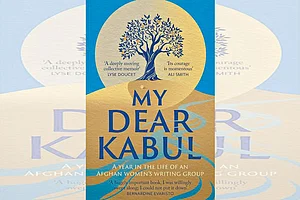
Outlook Anniversary Issue: Excerpt From Lucy Hannah's 'My Dear Kabul'
'My Dear Kabul: A Year in the Life of an Afghan Women’s Writing Group' was published by Coronet/Hodder in 2024. Translated by Parwana Fayyaz and Dr Negeen Kargar. 'My Dear Kabul' is an Untold Narratives project. Untold—a development programme for emerging writers in areas of conflict and post-conflict—was founded by Lucy Hannah.

Outlook Anniversary Issue: When The City Becomes A Witness
'In my wide-stanced shadow, against a white afternoon, I am without a middle. What then am I left to spare?'
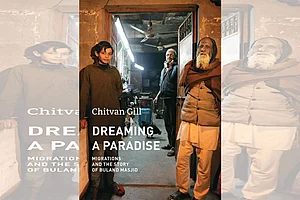
Outlook Anniversary Issue: Dreaming A Paradise
Buland Masjid emerges as a paradoxical space where hunger is constant, yet food is abundant, making it a daily feast shaped by migrant lives, labour and remembered cuisines.

Outlook Anniversary Issue: Eyes That Build Worlds
Imagination enables metamorphosis, and metamorphosis is what I’m after. Not just as a maker, but as a seeker, a spectator.

Outlook Anniversary Issue: A Dot In Soot
In ‘The Dot in Soot,’ Aakriti Kuntal turns the home into a space of memory, dreaming, and becoming.

Outlook Anniversary Issue: The Labour Of Historical Fiction
Slowly, this world, rooted in research, textured with historical detail and fragrant geographies, and shaped by its own social frameworks, became complete enough for me to dwell in it for years.
Outlook Anniversary Issue: A Country Penned By Writers
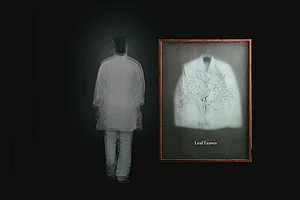
In modern times, when writers feel that imagination alone would not suffice to deal with the subject at hand, they take the aid of historical apparatuses such as the village of “Gangauli” in Rahi Masum Raza’s Aadha Gaon.

Outlook Anniversary Issue: How R.K. Narayan’s Malgudi Normalises Caste Of Words
In this essay, Antony Arul Valan examines how R.K. Narayan’s Malgudi embeds caste hierarchies in everyday language rather than explicit ideology
Outlook Anniversary Issue: The City That Remembered Us
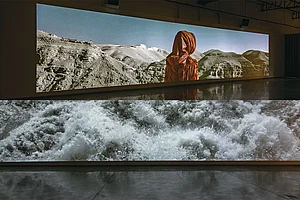
Artists, engineers, farmers―all exiles in our own land, carrying fragments of a country that no longer admits it is dying

Outlook Anniversary Issue: The Subterranean Shores of Goa
Most of the land’s original inhabitants and blue-collar migrant workers, labelled ‘economically unviable’ or Subterraneans, have been relocated to artificially created underground caverns: out of sight.

Outlook Anniversary Issue: Excerpt from Durs Grünbein's 'Porcelain'
An elegy blending history, memory, and reflection, Porcelain confronts the devastation of Dresden and its enduring, complicated legacy.

Outlook Anniversary Issue: A Day In The Life Of Jafar
Set in a world where bureaucracies and borders shape human relationships, Absolute Jafar is a poignant meditation on belonging and becoming.