Literature offers slowness and silence in an age of relentless public noise and political intrusion.
Writers today face pressure to produce immediate, legible responses rather than layered, reflective art.
Creativity depends on wandering, ambiguity, and intuition, not directives or urgency.
In fact, we live in garrulous times. That is not about talking as in conversations. It is loud, aggressive verbal noise to shout the other down. Jabber jabber, noise noise, deaf deaf. And that makes Literature in these times even more crucial, even if devalued by too many. It is a retreat, not as in running away, but as in being the space for silences that pick up the echoes and murmurs of quashed voices. A retreat not from the battlefield as it were, but one where the forgotten or sidelined voices can be restored and preserved. So that no one may forget that there is another narrative, there are other stories, there is another way of being, seeing, and loving, another worldview. A retreat where the writer continues a reflection, a dialogue, in quiet meditative focusing.
Easier said than done! In times so intrusive, where the distance between the public and the private is so narrow, the solitude a writer longs for to meditate and reflect is hard to find. But found it must be. I am here reminded of Arpita Singh’s paintings where gun-toting soldiers are rushing in full force on all sides and in their midst sits the yogi, in padmasan and dhyan. They storm forth in agitated action, the yogi meditates in calm repose, eyes closed. The eyes look closed. In fact, they open not just outwards but also inwards and in so doing take what is happening around into the inner space of reflection and re-looking. Troubled but unpanicked.




Slowness is important in literature. Stillness is its motor. Stare deep into the abyss, intent, meditative, and wait. For it will stir, the darkness will slowly part. The cauldron will send forth steam and furls which will wind their way up to the blank page and stories will find creative concretisation. Like revelations.
Slowness is important in literature. Stillness is its motor. Stare deep into the abyss, and wait. For it will stir, the darkness will slowly part. The cauldron will send forth steam and furls which will wind their way up to the blank page and stories will find creative concretisation.
So I had stared at the old woman’s back when she lay tired and done-with-the-world and she moved into Ret-Samadhi (Tomb of Sand). I saw her slowly open her eyes and bore a hole with her gaze in the wall into which, we thought, she wanted to bury herself in a death-wish. And come out on the other side into the wide-open world, shed the warp and weft of triviality, and reinvent life.
Even in these times of larger-than-life politics and society invading all our abodes, literature seeks precisely this quiet reinvention, repositions old alignments, and challenges the propagandist narrative. Even when it may not intend to deliberately do so.

Another time I was standing on a roof where a friend retreated to smoke a cigarette, away from the gaze of the family. Surrounded by activity of the kind there is on such roofs which are flung across many homes, allowing one to ascend from this end of the neighbourhood and descend at that end. There, quietly on the roof, flowed in scenes upon scenes, and a philosophical mood slowly wrapped itself around me. I looked, silent, meditative, and a meaning slowly unfurled. Down below are homes of walls and conservative thought, up here is the sky and no walls, all transgressions possible. Roofs are made to break walls. Come Makar Sankranti and the physical wall between two religious communities down below is leapt across on these roofs and kites fly high in the clouds. A lover runs up one end of the roof to meet his beloved waiting at another end. Love prohibited blossoms. What can you not do if you have the roof beneath your feet and the open sky above. A tale manifested to make me the author of another novel, Tirohit (Roof Beneath Their Feet)!
So it works. Time and time again.
I want to write the personal, the small, the everyday, the ordinary, and have almost an antipathy for the too loud, too visible, too dramatic. So much so that I have a secret desire to write about nothing! But I also know that whatever I write, the drama of life will step in from the most ordinary places. And the invasive outside of today with its over-impinging politics and society too will wind its way in by some unknown trajectory. It places me in a torn, tense position. On the one hand, I am relieved I am engaging willy-nilly with today and its concerns, but I am also a wee bit resentful that the seriousness of the times impinges on my play and irreverence and creative irresponsibility whether I want it to or not.
The Outside overwhelms! I was on my morning walk in the university area. Behind me walked educated ‘enlightened’ teachers. “They had it coming,” one said. “Non-vegetarians stink,” another said. We are the secularists, the liberals, I realised. The dialogues haunted me, my being stared dismally at them and my pen formed words—Hamara Shahar Us Baras (Our City That Year) came into being.

At some level it is okay. The tension between the outside and the inside is the rich site where creativity gets fuelled. But I worry that the immediacy of our concerns is getting overpowering. Literature is not about an instantaneous response to an immediate event, but about forays into longer, ongoing phenomenon encompassing past, present and future in a human, humane, artistic continuum.
I also don’t like the pressure I feel of the now and here as the all-important urgency of today.
This mental pressure hurts, even suffocates. It comes from adversaries who barge in to dictate what I may write. It also comes from allies who stand on my side but feel so troubled by what is going on that they, too, dictate what I must write. Literature is threatened by them both, for they want it mostly to turn activist and mostly in a very comprehensible direct way. Grapple simply with the history, politics, society of now. Today an ill occurred, respond immediately, highlight it, and also prescribe remedies.
They—the adversaries and the allies—don’t want opacity, layeredness, slowness. They are irate. Clarify, don’t confound; be loud, clear, quick, they demand.
Quiet… solitude… meditation… Play… Irreverence… amorphousness… ambivalence… contradictions… incertitude… where are these, my coveted companions? And the wanderlust which writers love—to get lost on uncharted paths and reach surprises. Where has the chance for that gone?

An Urdu couplet, my favourite, says:
Dayar-e-fan mein jahan manzilen bhi farzi hain
Tamam umr bhatakne ka hausla keejay…
(In the realm of Art there is nowhere to reach, all destinations are illusory,
Here, have the courage to wander about and get lost.)
What of that?
There is pressure on me to feel guilty about desiring this ‘bhatkan’, this irresponsibility, when times demand commitment and responsibility.
That is the tension I need to circumvent with creativity—deal with the immediate and still be the literature that transcends the immediate.
This, I dare say, is easier done than said ! Because creativity comes not from a conscious cerebral design. It has its own dynamic, even mysterious, and somewhat out of my control. Directives, fear, inner censor, outer censor, work that much and no further. How can I direct something not working just off my own volition?
If this sounds like glorification of my creative process, let me explain it is not. No Divine hand takes mine in its able grasp and guides it to write! I speak, instead, of an intuition, formed from more sources than I can know and tell. My history, geography, my society, my past and present, and all of these of yours too, a trove of our memories, yours and mine, waiting to be fired by imagination to coalesce in ever new shapes that fly out free as stories. This is the intuition that makes me write. Over the years, it has got honed and better tuned to breath, balance and aesthetics. All this guides me as the moving finger writes, making me fork this way or that and stop or change gait and let emerge an artistic presentation, evolving its design and choreography, finding its tune and cadence, its equipoise, its spirit and energy, indeed its architecture. And a new entity faces me at the end of my creative endeavour. I look at it with some trepidation, not fully sure what all it has done, what all it enfolds. It is a work of risk and faith, which I let go from my grip to garner its own appreciation in the vast, open world.

I am relieved and happy. And wonder what those two untamed restless beasts—Imagination and Creativity—have done this time, bounding out and about as they please, unbidden by me, and perhaps holding me on a leash at their heels! Have they made for me a proud thing, will it bring me love, camaraderie, fun, will it bring trouble…
The bottom line is it has to be done, because writing is as natural to me as breathing and you must breathe till you die.
Intezar Hussain said: Times good, times not, you can only keep doing what you do. So I keep writing…
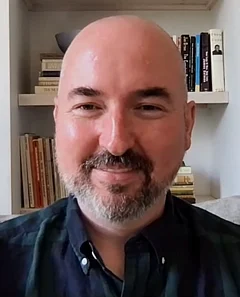
Geetanjali Shree is the author of five novels, including Tomb of Sand (translated from Hindi by Daisy Rockwell), which was awarded the 2022 International Booker Prize, and five short story collections. The English translation of Shree’s debut novel Mai by Nita Kumar won the Sahitya Akademi Translation Prize in 2002. Her work has been translated into several languages, including English, French and Korean.
MORE FROM THIS ISSUE


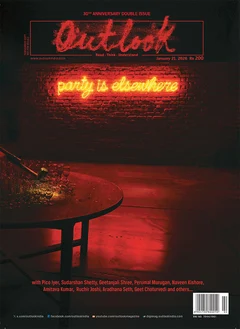
This article appeared as The World And The Word in Outlook’s 30th anniversary double issue ‘Party is Elsewhere’ dated January 21st, 2025, which explores the subject of imagined spaces as tools of resistance and politics.