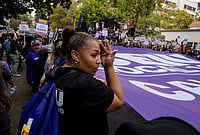
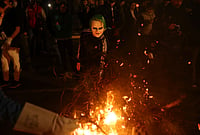
We scavenge at night, pockets full of broken futures
Libraries were demolished brick by brick
Books pulped into silence.
In the After-Nation, the greatest crime was remembering.
History was classified as combustible material.
Libraries were demolished brick by brick; books pulped into silence.
Every time a city drowned or burned, the Ministry of Truth simply removed its name.
Maps became fiction.
Memory—resistance.
We were Rubble-keepers.
We scavenge at night, pockets full of broken futures:
a shard of temple mosaic, scorched concrete from a dam-burst village, rusted rods from luxury towers swallowed by monsoon.
We didn’t know why we collected them, only that the rubble felt alive, like something unfinished, like a conversation interrupted mid-sentence.
Some of us were artists once. Some engineers. Some farmers who had forgotten the smell of rain. All exiles in our own land, carrying fragments of a country that no longer admits it is dying.
The sky that night glowed with the colour of open wounds, red and raw.
That’s when we saw it.
A structure where there had been barren land yesterday.
Not assembled, grown.
Concrete rose like bone.
Steel ribs curved like spine.
Glass glimmered like wet leaves.
Ghungroos threaded through the walls quivered as if sensing us, memory trembling.
We approached with the caution survivors learn.
Inside, everything disobeyed logic, ceilings breathed,


books wrote themselves when touched,
floors turned to rivers then back to tile like nothing happened.
In one room, rain fell upward. In another, walls peeled back like eyelids to reveal constellations no telescope had catalogued. It felt as though we had stepped into a building dreaming itself into being.
We named it The Archive of the Uninhabitable.
Not a museum.
Not a refuge.
A phenomenon.
A possibility…
Soon the displaced found us―
climate refugees, censored artists, dispossessed farmers, people whose hometowns exist now only as hashtags of disaster. They arrived barefoot, boat-wrecked, border-bruised; carrying nothing but stories.
When a Kashmiri grandmother stepped inside, the walls exhaled saffron and snow.
A boy from Basra brought water bottled from war, the floor smelled of burning oil.
A fisherman from Sundarbans entered, mangroves bloomed briefly, then vanished like a tide.
A young poet censored for the word freedom touched the staircase, and it recited her banned verses aloud, voice made of wind.
No one asked for identity proof.
The building already knew.
News drones hovered, confused.
A structure that archived human loss?
No category.
No legal framework.
So, the state did what it always does when confronted by the unprocessable―sent demolition.
War machines rolled in, metal insects with teeth.
Soldiers with blank eyes.
Orders: Erase.
We stood before the building, bare hands, racing hearts.
We weren’t fearless. Just unwilling to forget.
The Hearing Trees, those silent sentinels sprouted near old Archives, began to move.
Branches bent toward the Archive, like speaking.
Roots slithered into foundation cracks, a handshake or possession, we couldn’t tell.
A vibration rippled through the ground.
Concrete pulsed like a heartbeat.
Then, voice without sound:
You built me with your grief.
I will hold what you could not bear.
You carry the world inside you, I carry you.
When Earth is ash, I will still remember.
The soldiers advanced.
Ghungroos along the walls shook, like thousands of whispers.
The Hearing Trees burst golden spores, glitter raining like truth returned.
Soldiers gasped, coughing up memories.
A river they swam as children, now cracked mud.
A father lost during riots.
A land acquisition that swallowed home.
A beloved language banned in school.
Their guns fell like dead birds.
Some collapsed, sobbing.
Some walked into the Archive, becoming part of it.
Not imprisoned, absorbed.
The state called it mass psychological defection.
We called it healing.
Rumours spread.
People travelled for weeks through broken borders to reach us, guided by myth, hope, desperation. They carried rubble wrapped in cloth, offerings from vanished cities.
A brick from a coastal town now under water.
A roof tile from a burnt settlement.
A handful of ash from a demolished forest.
We placed them in the Archive.
Every stone became a room.
Every story, a corridor.
The building grew like forest after rain.
Outside, surveillance towers rust.
Inside, we write futures with bare hands.
We sew ghungroos into doorframes so they ring when new memory enters.
Children are born here; they learn history not from textbooks, but from walls that speak.
The Archive teaches them: not what to think, but how to remember.
Earth is tired.
Oceans climb.
Governments fall like diseased teeth.
Cities sink, migrate, dissolve.
And the Archive
the building that grew itself,
is no longer content to stay still.
It hums at night.
As if dreaming escape.
As if preparing to move, not across land…
…but across planets.
Scientists say rubble contains traces of ancient minerals suited for terraforming.
Architects whisper the building might one day uproot—become ship, colony, ark.
Perhaps the city will carry us
to Mars,
to Europa’s hidden oceans,
to a moon where memory might root in new soil.
Maybe we are not only rebuilding a city,
maybe the city is rebuilding us.
Maybe memory is not a burden,
but propulsion.
This story is only the beginning.
If you find the Hearing Trees, you are close.
Follow the ringing of ghungroos in windless air.
Bring a piece of your broken world, the Archive will drink it.
Enter quietly.
Leave a story.
Take a seed.
The city remembers.
And soon,
the stars will too.
Vibha Galhotra is a conceptual artist whose multimedia oeuvre—including sculptures, installations, photographs, videos, site-specific work and public art interventions—addresses the shifting topography of a world radically transformed by climate change, consumerism, capitalism and globalisation
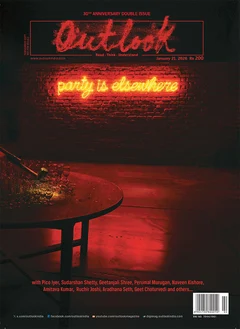
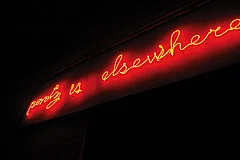
This article appeared as ‘The City That Remembered Us ...’ in Outlook’s 30th anniversary double issue ‘Party is Elsewhere’ dated January 21st, 2025, which explores the subject of imagined spaces as tools of resistance and politics.
MORE FROM THIS ISSUE


AUTHOR’S NOTE: The City That Remembered Us or ‘Rubble Keeper’ emerges from the same questions that shape my art practice: What do we rebuild from? Who remembers when structures fall, when landscapes burn, when history is deleted? I work with rubble, demolition waste, and ghungroos as material memory, remnants of cities that once stood and those still collapsing. The story imagines what happens when these fragments refuse silence, when debris becomes architecture and memory becomes resistance. It extends my ongoing exploration of climate grief, displacement and the politics of urban development, imagining a future building that grows, remembers, shelters and defies erasure. Fiction, like art, allows us to prototype worlds before they exist.