Across its sections, the speaker moves between city, desire and memory using elemental imagery to explore alienation and the tension between intimacy and detachment.
By invoking “hostile witnessing”, the work suggests that the city both records and erases lives, turning time, labour and desire into transient traces.
The poem maps sensorial and moral landscape, where smells, bodies, labour and decay bear witness to urban life’s violence, exhaustion and fleeting vitality.
On a Side Note
In this sterile moment asking:
Where is the life we came to live?
—Keorapetse Kgositsile, In the Mourning
In the humid lull that puts our seven islands under,
I can smell a fisherwoman’s metallic anklets count
To sunrise: iron, sulphur, mildew, and death’s fetor,
Only for us. She covers the market thrice to down
The quiet, then squats bored behind a scarlet crate
In a cellist’s pose. I hear her knife gut a thick trout,
Her hands lay out the grey lumps now rotting in wait,
But I am not on her street anymore. Tumult of scents,
Where’ve you gone? We waft with the dawn’s incense,
Eddies of cumin, sandalwood, kerosene, milk, sewage,
And we read time by it. We know noon as a stench


That rises from the chafing pits of need’s hostages,
Limp against walls stained with betel-quid or urine,
Bawling out the day’s final lull in their electric tongue.
Early in the evening, a veil of exhaust will begin
To smother the city’s vapours into an even nothing,
Leaving it deader than any city ever had been.
Orbital
Hack off a hawk’s head: its shape’s a dove’s.
—Dom Moraes, Hawkshead
In my wide-stanced shadow, against a white afternoon,
I am without a middle. What then am I left to spare?
The clocks tell their own grim time to those who care.
The roads each lead to Rome, but do you have the gall
To roam among these emerald towers of mirrored glass,
Steered by your meagre will and two centaurs in brass?
Come, man of the sky leant against a deciduous window,
Dream-drenched organ of hemp, silver, and whalebone,
What do you know? Where do you go, so long, so lone?
Leafless, what is a branch? Is that a root? A tree grasps
At the sheer clouds that yield to none. Smoke’s a tramp,
Winding up a goat’s head to settle on a watchman’s lamp.
She hauls a sack of grit, spilling a path down the indigo
For those who creep naked, hungry, and shackled to spite,
Their thrawn figures that once stood stark in the headlights
Melting as breath into the wind, into the unmeaning white.
Beauty of the Male
I. LUST AT LARGE
Under a roof where three pigeons patter in a circle,
He says to me, ‘You should put them in your poem,’
And I find their tiny forms whirling across his face,
In the still and amoral eyes he stole from a kestrel
Ten days ago. When it rains, I smell wet, wet loam,
Petrol, mossy gravel, herbs in bloom, and malaise
Swan like ten months’ odour about his equine torso,
His hooves, blue-black mane, and pelt of pure earth.

Our room is small, cold, and past the grasp of age,
But a window redeems it. We catch animals strike
Curious poses: squirrels chase, mount, and grope,
Rats straddle, lizards wrap, cats tussle, slugs braid,
Gawking at our limbs crossed sterile on either side
Of a table. A fat manatee floats above me. I probe
A hovering tree. When the tide comes in, I am towed
Back to myself, to him, into fields I no longer know.
We stand across the road from a pushcart of fruits
You find too dull for poetry. They croon, ‘Eat me,
Drink me, love me. Oh, come, make much of me,’
But you resist them. We trot down a zigzag route:
Six alleys and a roundabout to where I have to be;
I find your head white as a dove’s in my memory,
Already free of you. It is such a pity, such a crime,
These dark Caspian stallions eating each other alive.
II. AMID THE TIDEWRACK
Light, dark, and countless, coiling forever inwards,
I see them rise from his chest, sink into a shallow
Trough, and creep in ambush over the gooseflesh
Of his long, olive neck. I can barely hear his words,
Much less his pause battling the monsoon’s bellow,
But I follow the quiver of his mouth. Whose flesh,
Ever so tender, ever tamed these sudden hungers?
They flare out of me. They fester in my staid body.
Down the coast, white with evening’s misty ease,
I trace the timid ascent of green across his cheeks,
Along the fine bones and finer sinews of his face,
Pore by pore. I cannot tell his voice from a breeze,
Nor myself from the brine. What can I do but reek
With three years’ worth of desire, wild with wait?
But I see doubt in his hands, in those faint lines
Where a strand of hair shivers as though with life.

Head to knuckle, arm and arm, his knotted scripts
Reveal little to me. We listen to the tide in silence,
Both our mouths now pungent with a tepid coffee,
The past still so plain within us, still frail as a stilt
In water. He talks of mercy, dance, and the violence
Of unlived time. As we near a ledge, he sings to me,
And out to the windy beach, far from the twisted reach
Of crazy sorrow, we go, we go, we go, we go, we go.

Fruits for Rainer Maria Rilke
With half a peach in one hand, a knife in the other,
And a bowl in her lap, she sits looking at a cliff
Far behind me. When the downy ball rolls off her
Palm, knuckle, fingertip, swiftly out of her fist
And into the hot mud, she finds herself an apple.
She cuts a slim wedge and flings it past her lips,
Letting her arms sway off the chair’s like before.
Does she not fear herself, herself with a knife,
Herself eating a peach, herself in the afternoon
With little left to give? I am struck by the pride
Of her lean wrist, hacking and pitching to a tune
Silent but certain. She is no marble. In her wake,
The chair leers at me. She is survived by a baboon.
You must not let the fact of your past manacle you.
Alolika Dutta is a poet and photographer based out of Mumbai
MORE FROM THIS ISSUE


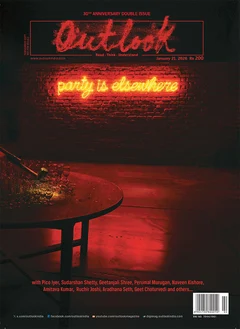
This article appeared as 'Orbital' in Outlook’s 30th anniversary double issue ‘Party is Elsewhere’ dated January 21st, 2025, which explores the subject of imagined spaces as tools of resistance and politics.