Citizenship, in this sense, belongs to readers who live free of doubt or fear of losing it—free to wander through Malgudi Days or take a leisurely stroll in García Márquez’s Macondo.
When the Vedas ascribed Indra as the most powerful god, his heaven was considered to be made of iron; it did so because iron had already been discovered and agriculture was directly associated with rain.
As soon as the world of writers collides with the real world, it triggers a sense of panic among the rulers of the real world.
To enter the country of writers, one does not need any visa or passport; one can cross the borders anywhere at any time to land themselves in the country of writers. Citizenship of this country inherently remains with the readers who are always carefree of any doubt or fear of losing their citizenship. If they wish to live in the world of “Malgudi Days”, they can do so, or if they wish to take a stroll in Gabriel Garcia Marquez’s “Macondo”, they are more than welcome to do that as well. If not either, they can wander in the lands of Narnia, Wonderland, Lilliput, and Hobbit, as the writers’ countries are not identical.
Some of the worlds are pure fantasy, while others create their own with a mix of real-world paraphernalia around them. But with all the differences in their world, there is one resemblance that cuts across all of the worlds—a capacity to offer a distinct meaning. At times, those meanings lay before our eyes, but at others, they are hidden.
When the Vedas ascribed Indra as the most powerful god, his heaven was considered to be made of iron; it did so because iron had already been discovered and agriculture was directly associated with rain. In time, the fall of Indra’s character and the rise of newer gods became interdependent with alternative sources of agriculture and water and further decline in the character of rulers at that time. This was indeed a parallel between reality and imagination. But Indra’s tale bestowed the real world with at least one meaning: Indra fears every worshipping citizen, as he believes the entire endeavour is for securing the throne of Indra. Symbolically, this fear is eternal for those in power.


For early writers, the world was comparatively linear, which made it possible for them to categorise good deeds and bad deeds and, based on it, the way for hell or heaven. As a genre, it was not much of a storytelling technique; rather, it was a form of faith. But today, the world has grown up to become complex, and so has the world of writers.

The phase of renaissance and enlightenment in the West brought with it a tremendous upheaval. In Dante’s Divine Comedy, the god asks the protagonist, “You are in a state of bliss in the heaven, but do tell me, do you wish for an even better place?” The protagonist replies he wishes to live with his lover, as there can be no greater joy than to live with one’s beloved in the mortal world. And so, he renounces all the joys and pleasures of heaven. It was a period of intellectual awakening in Europe that toppled a number of antiquated concepts. Over a period of time, nation-states expanded and strengthened themselves under strict conditions, leaving an impression of it in the world created by writers. Now, instead of people, an invisible system started playing the villain, and the heroes, instead of being mighty and powerful, started becoming humble and modest.
For early writers, the world was comparatively linear, which made it possible for them to categorise good deeds and bad deeds.
For example, the character of “M” in Kafka’s The Trial. It has been more than 100 years since this work was penned. Here, the antagonist has no name, as the system itself is the antagonist. On the other hand, “M” is not even aware of the crime he has committed, but the trial against him continues. Following the great resolve with which nation-states came to be constituted of their citizens as a nation, this unpleasant occurrence binds together the plot of the entire novel. It recurringly point towards the extent to which the rights of citizenship can be trampled upon by the state power on mere suspicion, without anyone being at fault. In the work, the name of the protagonist was deliberately made insignificant by the author because anyone could be in his place in any such country. As the meanings of this novel gradually unravelled, the novel made a steady rise to become a “great work”.
Similarly, the same could be said about George Orwell’s 1984 or Animal Farm; when one reads these works, they might find it difficult to believe these are a product of the imagination dating back 90 years. In any country with any regime that tries to impose ideological uniformity and adopt an authoritarian standard for monitoring its citizens, the citizens veer towards these works thinking that these works are about them.

At times, the meaning of a “country” or the “world” is not fully revealed when they are written about, but they become clear over a period of time. For instance, a work by Nobel laureate Polish writer Olga Tokarczuk narrates the story of the madness of a woman who cannot stomach the killing of animals in her country. When this work was first published, it was understood in a completely different context, but today the book is part of the political upheaval in Poland. Therefore, the world created by writers and the knowledge streaming out of it cannot cease for one nation. Because of these episodes, some writers have been exiled from their country, some have become victims of violence, while others were killed. This is where the matter becomes serious.
These occurrences lead us to a conclusion that there is something in the world of writers which affects the world we live in, i.e., the real world. What are those things? They are the spirit of justice and equality and the struggle for it, which unravel in the consciousness of the writer.
As soon as the world of writers collides with the real world, it triggers a sense of panic among the rulers of the real world. The writer’s world is free from injustice and exploitation. Even in their depiction of exploitation and oppression, the melody of liberation jingles in the background. The list of such works is quite long, including Yoknapatawpha County by Faulkner, Nexus, OZ, Middle-Earth, Westeros, the Wizarding World, and Panem, among many others.
In The Country of the Blind by H.G. Wells, a sighted person lands in the world of the sightless. In a dramatic turn of events, the sighted hero is crucified by the sightless citizens because they believed his words were a source of confusion and chaos among the masses who were fighting over what the hero said. In this country, being sighted was itself a crime. However, this story is symbolic of how diversity of thought and dissent leads to suppression in the name of the nation, and it is here that the story comes alive.

In recent years, the country of “Macondo” in Marquez’s much-discussed One Hundred Years of Solitude weaves a story of citizens suffering from collective amnesia to make crucial points about the precariousness of the time when a society is bereft of its own history. Marquez’s contemporary Mario Vargas Llosa, in his novel The Feast of the Goat, deals with the atrocities committed in the three-decade-long dictatorship in the Dominican Republic. He narrates its blood-stained history and the memories filled with guilt and resentment, foregrounding how a country can be clenched by dictatorship in the absence of intervention by the conscience of dissent and a moral compass.
The writer’s world is free from injustice and exploitation. Even in their depiction of exploitation and oppression, the melody of liberation jingles in the background.
Interestingly, both the authors are Spanish, both of them created a world against dictatorship, and both of them can be seen fighting for a democracy. The urge for justice and the desire to live a fulfilling life are the primal instincts of a person that emerge throughout history, often conflicting with temporal realities. In such a scenario, a few things—norms and standards emanating from the writer’s world—become an eternal moral compass for the temporal being.
In the Indian literary tradition, “Ram-rajya” has been accorded the greatest standard of all time, whereupon, after assuming the throne, Ram makes an appeal to the citizens: “If I speak anything unjust, O Brothers, stop me there without any hesitation.” Please note, Ram is the “emperor”, and he makes an appeal to the people of Ayodhya to stop him and rectify him without any hesitation. The hero of Tulsidas is loved by the people, and the citizens themselves are fearless. Disgruntled with the atrocities of the feudal era, Tulsidas suggested a token of advice to the rulers: “The leader should be like a mouth, providing without prejudice to everyone.”
It means that the welfare of people, without any injustices, should be the ultimate goal of the king, just as the mouth apportions the nutrition of food to every part of the body. In their work, Tulsidas repeatedly mentions the period of drought, while Surdas repeatedly mentions debt—issues of concern to their people. Who would not want a green pasture and a life without any debt? It is these desires that shape a writer’s world. In the same country at the same time period, two devout creators are crafting their own world with their own distinct style. One depicts a deity which upholds social norms, while the other depicts deities which are appealing and entertaining for the masses. Within these works, the authenticity of the time remains ever pure and useful, like water stored in the earth. The famous thinker Levi Strauss mentions that myths are born to make the world comprehensible (explicable) in a magical way.
However, at times, the people of the writer’s world become the subject of tragedy in the real world when their intended meanings are misinterpreted. For example, Malik Mohammed Jayasi’s Padmavat, whose central crux was the concept of “human love”. One could win kingdoms by force, but not someone’s love. Padmini is charred to death, and all Allauddin could get was burnt ashes. The narrator writes, “Allauddin tossed those ashes in the air and said this world is a lie.” It was love which made him see the limits of his empire and ambitions. The entire story of Padmavat is a mythical invention created 300 years after the death of Alauddin Khilji. Nonetheless, some people have made this story a part of their history, directly associating it with the Hindu-Muslim identity. Authors frequently adopt various narrative techniques to depict the events of a certain time and create their own unique world with it.
At times, the people of the writer’s world become the subject of tragedy in the real world when their intended meanings are misinterpreted.
In modern times, when writers feel that imagination alone would not suffice to deal with the subject at hand, they take the aid of historical apparatuses such as the village of “Gangauli” in Rahi Masum Raza’s Aadha Gaon.
Additionally, when writers feel human or systemic truth cannot be depicted through reality alone—they blend elements of imagination into that reality, as can be seen in Shrilal Shukla’s “Shivpalganj” in the book Raag Darbari.
Apart from the two mentioned paths, writers do carve their own path to craft their own world. For example, Vinod Kumar Shukla’s novel Deewar Me Ek Khidki Rehti Thi has no unpleasant occurrences or a villain. A plain, simple teacher named Raghuvar Prasad is all that there is in the book. The novel is set in a quiet town in Chhattisgarh amidst the chaos following globalisation in India, where the magical beauty of the protagonist Raghuvar Prasad’s world unravels steadily. In the rush, people here lose their true magical beauty, a beauty shaped by the pursuit of human movement. The work seamlessly conjures the opposite of ugliness without uttering a single word.

Science shows that animals and birds, not just humans, also dream. They have good dreams and bad dreams. But can animals and birds imagine like us humans? Science has no answer for this as of now. Humans can imagine, and based on the power to imagine, humans have become the masters of the world, prancing all over the place proudly. Within humans, writers are a distinct species. They are the creators of their own worlds, and therefore they are called the Brahmas of their own worlds. Considering the works writers have created, it seems that literature offers us as much insight into particular times and societies, art and technology as science.
Even though these claims are not forwarded by writers themselves, we believe one can understand the world around them through literature. This is irrespective of whether those emanate from a test tube in the forms of imagery, metaphors, symbols, figures of speech, implication or suggestion. In mathematics, terms such as “hence” or “suppose” are sometimes used in a similar fashion in Hindi forms of speech, calling it “Utpreksha Alankaar”; it uses words like “mano” (as if/suppose), for instance, “Kaikeyi spoke extremely harsh words, as if rubbing the salt on the wounds.” King Dashrath, upon hearing the words hurling out of Kaikeyi’s mouth, felt as if salt was being rubbed on his burnt body. On an emotional level, this is the kind of achievement that mathematics calls “proving something”.
(Translated from Hindi by Shashank Sourav)
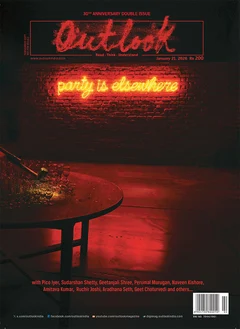
MORE FROM THIS ISSUE


Pravin Kumar is a writer and teacher, Delhi University.
Shashank Sourav works in the areas of research, writing, editing, and translation.
This article appeared as Visualising Fictional Landscapes in Outlook’s 30th anniversary double issue ‘ Party is Elsewhere ’ dated January 21st, 2025, which explores the subject of imagined spaces as tools of resistance and politics.