Lebanon and Israel have signed a landmark US-mediated agreement aimed at ending nearly eight decades of conflict
The deal requires Hezbollah's phased disarmament in exchange for a gradual Israeli military withdrawal from Lebanese territory
Political opposition, Hezbollah's rejection, and fresh Israeli air strikes have already cast doubt over the agreement's future
The signing of a landmark diplomatic agreement between Lebanon and Israel has brought one of the West Asia's longest-running conflicts to a pivotal moment. Intended to formally end nearly eight decades of a technical state of war, the breakthrough has been hailed as a major diplomatic milestone. But in Lebanon, it has also exposed deep political and societal divisions, with the deal sparking fierce debate over sovereignty, security, and the country's future regional alignment.
The announcement of the agreement has sparked intense political criticism and public protests across Lebanon, exposing deep internal fractures. Critics and opposition figures have denounced the agreement as a violation of Lebanese sovereignty, arguing that its strict disarmament mandates place an unfair burden on the state while offering insufficient guarantees against future external incursions. Public demonstrations have broken out in the Lebanese capital, Beirut, with people who have been deeply impacted by Israel’s war noting that the agreement “does not force the Israeli army to withdraw from the areas it occupies”, according to Al Jazeera.
The “controversial” agreement was officially finalised on June 26, 2026, during a high-level diplomatic assembly at the US State Department in Washington, DC. Mediated by the United States, the 14-point Trilateral Framework Agreement was signed by representatives from Israel and Lebanon. Designed as a structured, performance-based roadmap, the treaty explicitly states a "mutual ambition" to formally conclude the legal state of war that has existed between the two neighbours since 1948.


The geopolitical landscape separating Israel and Lebanon remains one of the most volatile friction points in West Asia, characterised by a complex history of border disputes, regional wars, military invasions, and the entrenched presence of powerful non-state actors. For nearly eight decades, the two neighbouring states have been locked in a legal and military impasse that has frequently erupted into wide-scale warfare, pulling in regional superpowers. The structural instability along the shared frontier has fundamentally shaped the domestic political systems of both nations, rendering long-term diplomatic normalisation a persistent challenge amidst a cycle of cross-border skirmishes and shifting regional alliances.
On May 15, 1948, just one day after the State of Israel was declared in historic Palestine, Lebanon entered a war alongside Syria, Egypt, Jordan, and Iraq. This coordinated pan-Arab military offensive was launched in response to Israel’s declaration of independence and the preceding months of systematic depopulation of Palestinian towns and villages by Zionist paramilitary groups. According to media reports, this turbulent period saw the displacement of roughly 750,000 Palestinians, with approximately 100,000 of them seeking refuge across the border in Lebanon.
Although the Lebanese military played only a limited role in the 1948 war, the conflict soon spilt into Lebanese territory. On the night of October 30–31, Israeli forces crossed the border and occupied several villages in southern Lebanon. The occupation ended with Israel's withdrawal under a UN-brokered armistice agreement signed on March 23, 1949. Similar armistice agreements were later signed with Jordan, Syria, and Egypt, formally ending the first Arab-Israeli War, though they stopped short of establishing lasting peace. Lebanon, unlike Egypt and Jordan in later decades, never signed a formal peace treaty with Israel, leaving the two countries technically in a state of war.
Why Israel and Lebanon Never Signed a Peace Treaty
The fundamental barrier to a formal peace treaty dates back to the conclusion of this 1948 Arab-Israeli War. While neighbouring states like Egypt and Jordan eventually signed formal peace treaties decades later, in 1979 and 1994 respectively, Lebanon only signed the 1949 Armistice Agreement. This document established a cessation of active hostilities and recognised a provisional border, but left both nations technically in a state of war.
In the late 1960s and early 1970s, the arrival of thousands of displaced Palestinians and the subsequent relocation of the Palestine Liberation Organisation (PLO) leadership to Beirut fundamentally altered the situation. The PLO established an autonomous political and military presence in Southern Lebanon, frequently launching cross-border operations. The central government in Beirut lacked the military capability to regulate these activities and was too weak to project its authority.

The 1982 Lebanon War
Tensions escalated heavily in June 1982 when Israel launched a full-scale military offensive, termed “Operation Peace for Galilee”. While seemingly aimed at neutralising the PLO infrastructure in Southern Lebanon and protecting northern Israeli towns from cross-border rocket fire, Israel invaded Lebanon. The military advance pushed past the border regions, culminating in a prolonged siege of West Beirut.
The invasion forced the PLO leadership to evacuate Lebanon and move its headquarters to Tunisia. In the aftermath of the active fighting, the Israeli military established what it called a permanent, 10-kilometre-wide “security zone” in Southern Lebanon, maintaining a direct military presence and supporting local proxy forces. This occupation persisted for eighteen years, deeply altering the socio-political fabric of the region until a unilateral military withdrawal was executed in May 2000.
According to media reports, one of the most devastating humanitarian crises of the 1982 conflict occurred between September 16 and September 18, 1982, in the Sabra and Shatila Palestinian refugee camps in Beirut. Following the assassination of Lebanese President-elect Bachir Gemayel, right-wing Christian Phalangist militia forces entered the camps, which were surrounded and controlled by the Israeli military.
Over a period of three days, the militia killed between 800 and 3,500 unarmed Palestinian refugees and Lebanese civilians. A subsequent independent inquiry, the Kahan Commission, concluded that the military leadership on the ground bore indirect responsibility for failing to anticipate and stop the atrocities, an event that remains a definitive point of collective trauma in modern Lebanese history.
The Rise of Hezbollah
The protracted military occupation of Southern Lebanon in the 1980s directly catalysed the formation of Hezbollah (“Party of God”). Organised primarily as a Shiite paramilitary resistance movement with substantial logistical, financial, and ideological backing from Iran's Islamic Revolutionary Guard Corps (IRGC), the group focused its efforts on ending foreign military presence in Lebanon.
Following the 2000 withdrawal, Hezbollah did not disarm. Instead, it integrated itself directly into the Lebanese political structure, operating as an official political party while maintaining an independent, highly advanced military wing separate from the state's armed forces. By establishing extensive parallel social services and an independent arsenal, the group grew into a dominant political and military force, effectively controlling security dynamics along the southern frontier.
In July 2006, in an operation into Israeli territory, Hezbollah killed three soldiers and captured two. Hezbollah demanded the release of Lebanese prisoners in exchange for the Israeli soldiers. However, the cross-border raid triggered a 34-day war. The conflict involved heavy aerial bombardments targeting Lebanese transport infrastructure and communication networks, alongside thousands of retaliatory rocket strikes launched into northern urban centres.
The war underscored the tactical complexities of modern asymmetric warfare, as intensive aerial campaigns failed to completely halt Hezbollah's mobile missile launch networks. The conflict resulted in severe civilian displacement and heavy infrastructure damage across Lebanon before a cessation of hostilities was brokered by the international community.
According to Al Jazeera, approximately 1,200 Lebanese people died and 4,400 were wounded, mostly civilians. Israel, meanwhile, reported 158 deaths, most of them soldiers.

UN Resolution 1701 Explained
To formalise the end of the 2006 war, the United Nations Security Council unanimously adopted Resolution 1701. The core mandate established a security buffer zone in Southern Lebanon, stipulating that the area between the UN-monitored Blue Line border and the Litani River must remain entirely free of any armed personnel, military assets, and weapons except for those belonging to the official Lebanese Armed Forces (LAF) and the UN Interim Force in Lebanon (UNIFIL).
However, the resolution faced significant structural enforcement limitations. The Lebanese state lacked the political consensus or military capacity to disarm domestic factions, and UNIFIL forces operated under a mandate that restricted them from actively policing private property without local military accompaniment. Consequently, the disarmament clauses were never fully realised on the ground, allowing for a gradual rebuilding of military infrastructure and subterranean networks south of the Litani River.
The New 2026 Trilateral Framework
Following severe recent regional military escalations, a ground invasion of Southern Lebanon in 2024, and months of active cross-border warfare, diplomats from Israel and Lebanon signed a binding 14-point “Trilateral Framework Agreement” at the U.S. State Department in Washington DC on June 26, 2026. The agreement, which came after five rounds of talks, explicitly states a mutual ambition to formally end the ongoing state of conflict, secure bilateral borders, and build structured, peaceful neighbourly relations between the two countries.
The 2026 framework establishes a conditional, performance-based timeline requiring the Lebanese government to rebuild its state monopoly on the use of force through the verified disarmament and dismantlement of Hezbollah and all other non-state factions. In return, the Israeli military will progressively execute a phased withdrawal from Lebanese territory as security conditions are verified. Critics note that the withdrawal of Israel is not unconditional. The transition begins with two designated “pilot zones” where the Lebanese Armed Forces will immediately assume exclusive security responsibility, backed by a U.S.-led trilateral Military Coordination Group for Lebanon (MCG4L) and an immediate $100 million international humanitarian relief fund in coordination with the U.N.
In a statement issued on Saturday, Naim Qassem, leader of Hezbollah, rejected the deal, labelling it “humiliating” and “a surrender of sovereignty” and saying his fighters would not leave the battlefield.
On the Israeli side, far-right national security minister Itamar Ben-Gvir criticised the deal, saying it hands Hezbollah a “lifeline” and dismissed the idea that Lebanon’s army could disarm the group. He said he had opposed the agreement in cabinet for weeks and would continue to do so.
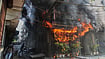
The agreement has already come under strain. Just two days after the framework was signed in Washington, Israel resumed air strikes on Southern Lebanon. According to Lebanon's state-run National News Agency (NNA), a series of Israeli attacks targeted the south on Sunday, a day after the Lebanese Ministry of Health reported the first fatality since the deal was signed. The renewed strikes have raised fresh doubts about the durability of the ceasefire and the agreement's implementation.