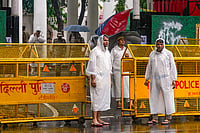
Women’s groups want the 33 per cent quota implemented immediately within the current 543-seat Lok Sabha.
Activists argue delimitation should be treated separately and not used to delay representation.
Several leaders warned the move could reduce the political voice of southern states.
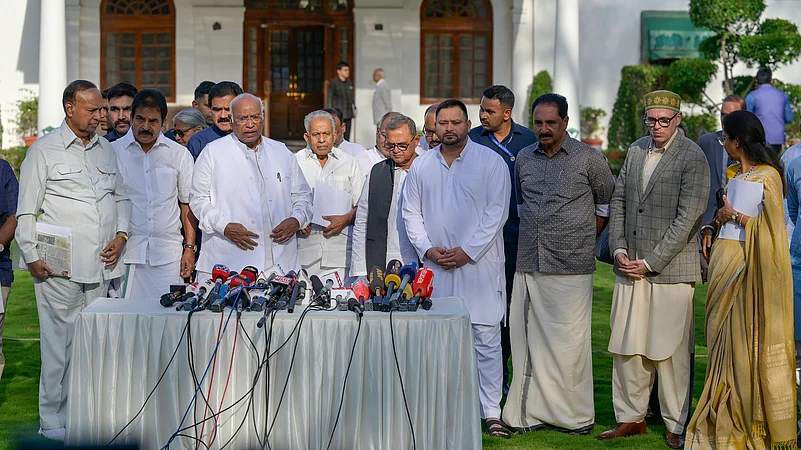
Opposition leaders and women’s rights activists on Thursday sharpened their criticism of the government’s latest push on Women’s Reservation Bill, accusing the government of using it as a political tool and to delay its implementation by linking it to delimitation. The central demand of women leaders was to implement the 33 per cent reservation in the present 543-member Lok Sabha without delimitation.
“How has the Prime Minister arrived at the number 50 per cent and why has it been linked to delimitation?” questioned Karnataka Congress MP Congress MP Prabha Mallikarjun while speaking at the press conference organised on Thursday by several women’s organisations. Calling the move unconstitutional, Mallikarjun argued that it would unfairly penalise southern states that had performed strongly on several parameters including GDP, GST contributions, farming, education, health and population control.
In a special sitting held between Assembly elections, the government on 16 April 2026 introduced three Bills in Parliament. Union Law Minister Arjun Ram Meghwal tabled the Constitution (One Hundred and Thirty-First Amendment) Bill, 2026 and the Delimitation Bill, 2026, while Home Minister Amit Shah introduced the Union Territories Laws (Amendment) Bill, 2026.


The main focus of the session is the Constitutional Amendment Bill, which aims to implement the 33 per cent reservation for women in the Lok Sabha and state assemblies. Although the law was passed in 2023, it has yet to come into force because it was tied to a fresh delimitation exercise.

The Bill was introduced after 251 members voted in favour and 185 against. Voting on its passage is scheduled for 4 pm on Friday.
Maharashtra Congress MP Praniti Shinde, speaking at the press conference, also challenged the move, saying the Prime Minister had “decided on 50 per cent” even while the census was still underway. She warned that the proposal could throw southern states into disarray and accused the government of using women as a cover to deepen divisions. She described the approach as anti-women and “despicable”.
Women were advancing in many spheres, said Nisha Sidhu, general secretary of the National Federation of Indian Women, but she accused the government of “hanging on the pallus of women” to push the Bill. She warned that linking reservation to population-based representation could deepen tensions between North and South India and discriminate against southern states. Her demand was straightforward: implement reservation immediately within the existing 543 Lok Sabha seats.
Speaking to Outlook, Congress MP Prabha Mallikarjun said the Women’s Reservation Bill had already been passed in 2023, and accused the government of now using delimitation to delay women’s rightful representation. She argued that reservation could be introduced under the current strength of the Lok Sabha, without waiting for any future expansion.
She also criticised the lack of consultation, saying MPs received the Bill only two days earlier, leaving little time for debate. At the same time, she raised wider concerns over tax devolution, claiming Karnataka receives only 14 paise for every rupee contributed, while states such as Karnataka and Kerala still lack an AIIMS.
Mallikarjun alleged the proposal had resurfaced because the BJP’s “400 paar” target of 2024 had failed. She said southern states felt increasingly insecure and accused the government of using women’s reservation as a cover for delimitation. In her view, the Prime Minister’s speech was designed to make an emotional appeal to women while blaming the Opposition.
Kunjamma Mathew, national president of the Young Women’s Christian Organisation, called for genuine public consultation with human rights activists and grassroots groups. She also demanded that reservation be delinked from delimitation and implemented immediately within the existing 543 seats.

CPI leader Annie Raja placed the current debate in historical context, saying resistance to women’s reservation dates back to the Constituent Assembly, where many believed women would naturally rise to leadership positions and political parties would voluntarily field them. Instead, representation remained dismal, with women holding just 5 per cent of seats in 1975 and 3 per cent in 1977. “Democracy failed women,” she said.
Raja noted that the Women’s Reservation Bill was first formally introduced in 1996, later passed by the Rajya Sabha in 2010, but never cleared by the Lok Sabha. She said successive governments consulted parties and stakeholders on the issue, but after Narendra Modi became Prime Minister there was not “a single word” on the matter until 2023.
The National Federation of Indian Women, said Raja, filed a petition in the Supreme Court in 2021 seeking the reintroduction of the Women’s Reservation Bill. She noted that in November 2022, a bench led by Justice Sanjiv Khanna recognised the importance of the matter and directed the Centre to respond within six weeks. “Then rumours started to circulate,” she said.
Raja further alleged that a party which believes in “Manuvad” could not genuinely support the Bill, accusing the government of attaching two conditions — a fresh census and delimitation — in order to delay its implementation.
She accused the government of using the census and delimitation as conditions to delay implementation, and said the Bill should be enacted immediately under the present strength of Parliament. Raja added that parties including the SP and RJD now support women’s reservation, and reiterated the CPI’s demand that the Bill be delinked from delimitation.
Radha Kumar, a writer, said women’s reservation should not be implemented through a lottery system modelled on the Panchayati Raj system. Instead, she called for special state committees to determine representation on the basis of vote share, arguing that this would ensure a more balanced outcome.
The draft Bill aims at strengthening the composition of the Lok Sabha from the current 543 constituencies to up to 850, after a delimitation process conducted based on the most recent published census. The Bill is also designed to allow for reservation of seats for women in State Legislative Assemblies.
The INDIA bloc parties have unanimously decided to oppose the delimitation provision contained in the Constitution (131st Amendment) Bill, 2026, even as they are in support of the reservation for women in the Lok Sabha and State Legislatures.