






M. K. Stalin invokes the anti-Hindi agitations of 1950s–60s while leading protests against the proposed delimitation amendment
The AIADMK and the BJP allege that M. K. Stalin is attempting to deflect public attention from pressing issues facing the state
At present, the southern states together account for 129 out of 543 Lok Sabha seats—roughly 24 per cent. However, projections suggest that their share could drop to around 19 per cent if population becomes the sole criterion,
In the final stretch of the campaign, the ruling DMK in Tamil Nadu has found itself energised by an issue that sits at the core of its political identity. Seizing on the proposed amendment to increase the number of Lok Sabha seats—linked to the 2011 Census and framed around enabling 33 per cent reservation for women—the party has sought to reframe the debate in ideological terms.
Chief Minister M. K. Stalin, in a symbolic show of protest, wore black and burnt a copy of the proposed bill, calling for sustained opposition to the Centre’s move.
The resistance is no longer confined to Tamil Nadu. States such as Kerala, Telangana and Karnataka have also voiced strong objections, signalling the possibility of a broader southern front. In a notable political gesture, Telangana Chief Minister Revanth Reddy urged Stalin to take the lead in coordinating a collective protest against the proposed changes.
This emerging alignment among southern states adds a new layer to the debate, potentially transforming it from a state-specific grievance into a coordinated regional pushback against the Union government.
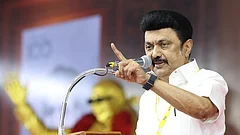


Projecting itself as the most consistent and organised force defending Tamil identity and political representation, the DMK has used the moment to sharpen its long-standing narrative against perceived central overreach. The prospect of delimitation, and its potential to alter the balance of parliamentary representation, has resonated strongly in the state, allowing the party to occupy a moral high ground and consolidate support around questions of federalism, linguistic identity, and regional autonomy.
The DMK chief and Chief Minister convened a meeting of party MPs and called for a coordinated protest, urging cadres and the public to hoist black flags against the proposed move. The decision underscored the party’s attempt to elevate the issue beyond routine electoral rhetoric and frame it as a larger democratic concern.
Addressing an election rally in Dharmapuri, M.K. Stalin launched a sharp attack on the Union government, accusing it of attempting to undermine the political weight of southern states, particularly Tamil Nadu. He warned that any move that reduces the state’s parliamentary representation would effectively dilute its voice in national decision-making. “When our MPs from Tamil Nadu lose voice in Parliament, we lose our voice,” he said, casting the issue as one that strikes at the heart of federal balance and equal citizenship.

Palanivel Thiaga Rajan, the DMK leader contesting from Madurai Central, described the proposed delimitation exercise as “a slap on the face of the southern states” and “a wound to the integrity of the Union.” Questioning the Centre’s intent, he said that pressing ahead with the move despite long-standing concerns from the South raises serious doubts about its political motives. “Years after the southern states expressed apprehension, if the government still goes ahead, it speaks a lot about their intention,” he argued.
Across the southern states, the dominant concern is clear: a fear of diminished political weight in Parliament if delimitation is carried out purely on the basis of population. At present, the southern states together account for 129 out of 543 Lok Sabha seats—roughly 24 per cent. However, projections suggest that their share could drop to around 19 per cent if population becomes the sole criterion, while the share of Hindi-speaking states could rise to nearly 60 per cent.
Political parties in the region argue that such an outcome would effectively penalise states that have successfully implemented population control measures over decades. With representation tied more heavily to population, states that stabilised growth early could see their influence shrink relative to those with higher population increases.
The current distribution of seats is still based on the 1971 Census, following a freeze introduced through the 42nd Amendment Act, which was later extended by the 84th Amendment Act until 2026. This arrangement was intended to ensure a more balanced approach, giving all states time to stabilise population growth before revisiting representation.

With most southern parties opposing the proposed move—barring NDA allies like the AIADMK and TDP—the issue has evolved into a broader political flashpoint. Critics warn that reduced representation for the South could weaken its influence in national policymaking, while states in the Hindi heartland, where the BJP holds significant sway, stand to gain—potentially reshaping the balance of power in Parliament.
The resentment in the southern states is not limited to delimitation alone. For years, they have voiced concerns over the devolution of central funds, arguing that the criteria adopted by bodies like the Finance Commission often work to their disadvantage. Indicators such as population, income distance, and demographic performance, they say, end up penalising states that have performed better in areas like education, healthcare, and population control—effectively disincentivising good governance.
This layered grievance is now feeding into the current political moment. The debate around delimitation has revived deeper anxieties about representation, resource allocation, and federal balance. In Tamil Nadu, the rhetoric has also taken on a historical resonance.
Chief Minister M. K. Stalin has invoked the memory of the anti-Hindi agitations of the 1950s and 1960s—movements that were pivotal in shaping the Dravidian political identity and ultimately brought the DMK to power. By drawing parallels between those protests and the current opposition to delimitation, Stalin is attempting to frame the issue not merely as administrative or electoral, but as one tied to identity, dignity, and state rights.
“DMK has a historical legacy in protecting Tamil identity, and with delimitation being made a poll issue, it is likely to benefit the party,” notes senior journalist Jayakumar. The comparison to past mass mobilisations adds emotional and political weight to the campaign, helping the DMK consolidate its narrative of resistance—one that blends questions of federalism with the enduring theme of safeguarding Tamil identity.
However, the BJP and the AIADMK have taken a markedly different stand, a position that many observers believe could have electoral implications in the closing phase of the campaign.
Senior BJP leader and former state president Tamilisai Soundararajan dismissed the delimitation plank as a political diversion by the ruling DMK. She argued that the party was attempting to deflect attention from more immediate and pressing concerns facing the people of Tamil Nadu.
“Price rise, corruption, and women’s safety are the real issues confronting the state. But to divert attention from these, the DMK is raking up non-issues and trying to stoke sentiments among the people,” she said.

This counter-narrative from the BJP and its ally, the AIADMK, reframes the electoral discourse back to governance and law-and-order concerns, setting up a sharper contrast with the DMK’s emphasis on federal rights and representation. As campaigning enters its final days, this divergence underscores two competing strategies—one centred on regional identity and political equity, and the other on everyday governance issues and alleged administrative failures.
However, if the Union government proceeds with the proposed delimitation exercise, it could once again sharpen a “Tamil Nadu versus Centre” narrative. Such a move risks reviving long-standing anxieties over federal imbalance, particularly in states that fear a reduction in their parliamentary voice in the Lok Sabha.
With backing from several southern states—barring Andhra Pradesh—the issue could quickly snowball into a major political flashpoint. What is now an electoral talking point may evolve into a broader inter-state and Centre–state confrontation, carrying significant implications for India’s federal structure and the future dynamics of Centre–state relations.
















