






Experts warn that mounting committed expenditure and rising debt could severely constrain the government’s fiscal space.
Even as Kerala remains one of the country’s fastest-growing economies, the growth has not translated into a corresponding rise in government revenues.
Nearly three-fourths of the State’s income is spent on salary, pension and interest payments.
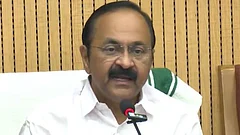
“We have to bring the economy back on track before announcing more benefits for ASHA workers and Anganwadi staff,” Kerala Chief Minister V D Satheesan said after the first Cabinet meeting, which decided to implement some of the ‘Indira Guarantees’ promised by the Congress during the election campaign.
As the leader of the opposition, Satheesan had repeatedly argued that the state exchequer was virtually empty under the previous government. Therefore, when the UDF came to power on the back of a string of welfare and populist promises, the immediate question before the new administration is how it plans to implement these measures amid Kerala’s continuing financial difficulties.
The Chief Minister struck a cautious note, indicating that restoring fiscal stability would be the government’s immediate priority before rolling out additional welfare commitments. Significantly, Satheesan has chosen to retain the Finance portfolio himself — an uncommon practice in Kerala — underscoring both the gravity of the state’s financial situation and the political importance the government attaches to economic management in its initial months in office.
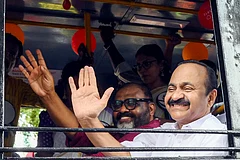
Among the key promises under the UDF government’s ‘Indira Guarantees’ is free travel for women in public buses. According to preliminary estimates, the scheme alone is expected to impose an additional burden of Rs 500–700 crore on the state exchequer every year.



The government has also promised a monthly stipend of Rs 1,000 for girl students, estimated to cost another Rs 700 crore per year. Taken together with the other welfare assurances made during the election campaign, the Finance Department may have to find an additional Rs 11,000–12,000 crore annually to implement the promises.
Economists and policy experts have cautioned that such large-scale welfare commitments could further strain Kerala’s already fragile finances, marked by rising debt, mounting pension liabilities and declining fiscal space. The challenge before the new government, therefore, is to strike a balance between fulfilling its electoral commitments and restoring fiscal stability.
Satheesan, who has retained the finance portfolio, has already indicated that reviving the economy and improving the state's financial health would be the government’s immediate priority before expanding welfare measures further. In one of its first major decisions, the government appointed an expert panel, headed by former Cabinet Secretary K M Chandrasekhar and comprising leading economists, to prepare a comprehensive white paper on the state of Kerala’s economy.
The urgency of the exercise is reflected in Kerala's fiscal indicators. According to Economic Survey reports, salary, pension and interest payments together accounted for nearly 78 per cent of the state's total revenue receipts in 2024-25 and around 77 per cent in 2025-26, leaving limited fiscal space for development expenditure. Kerala also remains among the states with a high revenue deficit. The fiscal deficit stands at 3.4 per cent of the Gross State Domestic Product (GSDP), while the revenue deficit is estimated at 2.1 per cent.

Yet, economists point out that the crisis is not necessarily due to a stagnant economy. “Kerala is one of the top economies in the country. In per capita consumption, it is number one, and in per capita income, it is among the top six or seven states," says Dr K P Kannan, economist and former Director of the Centre for Development Studies. “The economy is growing, but that is not reflected in the state’s finances. This is a strange phenomenon,” he adds.
According to Kannan, the core issue lies in the government’s inability to effectively mobilise tax and non-tax revenues despite economic expansion. “In the 1990s, nearly 10 per cent of the state's total income came from tax collection. Now it has fallen to around 7 per cent. Despite economic growth, the fall has been more pronounced during the left rule,” he says, arguing that successive governments have failed to adequately strengthen revenue collection mechanisms.
Experts point out that Kerala’s committed expenditure is significantly higher than the national average, severely restricting the government’s fiscal flexibility. Committed expenditure — which includes salary, pension and interest payments — consumes a major share of the state's revenue receipts. Interest payments alone account for nearly 22 per cent of the state's total income, compared to the national average of around 10–11 per cent. Pension expenditure too stands at roughly 22 per cent, substantially higher than in most other states, while salaries account for nearly 30 per cent of the total income.
Together, these obligatory expenses absorb the bulk of the state’s revenues, leaving very little room for capital expenditure and developmental investments

The dilemma before the new UDF government is, therefore, not merely one of expenditure but of restructuring Kerala’s fiscal model itself. For decades, the state has sustained a welfare economy on the strength of remittance-driven consumption and social sector investments. However, the mismatch between economic growth and public revenue mobilisation has steadily widened. While welfare commitments such as free bus travel for women and student stipends may provide immediate social and political dividends, they also risk deepening the structural imbalance unless accompanied by serious fiscal reforms. Economists argue that the challenge before the V D Satheesan government will be to expand the revenue base through improved tax compliance, rationalisation of public expenditure, better monetisation of state assets and renewal.
The proposed white paper is therefore likely to become more than a financial audit; it could shape the political and economic direction of the new administration by determining whether Kerala can sustain its welfare model without sliding deeper into debt.
“Kerala has to take some bold measures to tide over the economic and social crisis afflicting society,” says Jose Sebastian, former professor at the Gulati Institute of Finance and Taxation. Referring to his studies on the distribution of public resources, Sebastian argues that nearly three-fourths of government spending benefits socially and economically advanced groups concentrated in the Kochi-Travancore region. “A majority of government employees are from this region, and most aided colleges and schools are also concentrated there,” he says.
Sebastian argues that Kerala can no longer rely solely on borrowing and welfare expansion without undertaking politically difficult reforms. He advocates higher property taxes, better targeting of subsidies towards lower-income groups, and measures to widen the state's revenue base by taxing the wealthy more effectively. He also suggests revisiting the retirement age and rationalising pension liabilities, including proposals such as deducting pension amounts from salaries in certain cases. These suggestions, though politically contentious, underline the scale of the structural crisis confronting the state's finances.
His remarks also highlight a deeper debate emerging in Kerala’s political economy — whether the state's celebrated welfare model can survive without substantial reform. The challenge for the new administration, therefore, is not only fiscal management but also building political consensus for reforms that could prove socially sensitive and electorally risky.
The government is expected to spell out its broader economic strategy after the release of the white paper on the state's finances. The new administration is also likely to present a fresh budget next month, which will be closely watched for indications of how the V D Satheesan government plans to balance its expansive welfare commitments with Kerala’s mounting fiscal constraints. The budget is expected to provide the first concrete signals on whether the government intends to prioritise welfare expansion, fiscal consolidation, or a calibrated mix of both through revenue mobilisation and structural reforms.
















