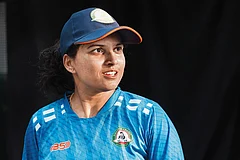
In a country where cricket is more than just a sport, where it is a dream shared by millions, Pratiksha Powar from Kolhapur dared to believe that this dream was also meant for her. This determined young cricketer’s journey is filled with sacrifice, setbacks, courage, family support, and an unquenchable love for the game.
Powar’s city, Kolhapur, is known for its culture and traditions. Like many children around her, her early life was simple and grounded in family values. Cricket was not a common path for girls there, and opportunities were limited. Later, her family moved to Turbhe in Navi Mumbai, where she spent a part of her childhood. It was here that her interest in cricket slowly began to grow, even though the environment around her was not designed to support that dream. “I didn’t know what the facilities were. I only knew I loved holding a bat. I used to believe that if my heart wanted cricket badly enough, one day the world would make space for me,” she says.
One of the biggest challenges Powar faced was not a lack of talent, but a lack of opportunity. Schools in Turbhe did not have cricket as a sport. There were no proper grounds, no structured coaching, and very few role models for young girls who wanted to play the game seriously. For many families, this would have been the end of the story. But for Pawar’s family, this challenge became a reason to take a bold step.
Recognising their daughter’s passion, her parents made a life-changing decision. They decided to move to Vashi, a place with better sports facilities and schools that offered cricket as a sport. This move was not easy. It meant adjusting to a new place, new routines, and new responsibilities. But her parents believed that dreams are worth fighting for, especially when they belong to a child with fire in her heart. “If my daughter has the courage to dream, then I must have the courage to support it. Even if the world is against her, her father will always stand with her,” says Mukunda Powar.



In a society where girls are often asked to compromise on their ambitions, Powar’s parents chose to stand by her. They ignored the negative comments, the doubts of relatives and neighbours, and the fear of uncertainty. For them, their daughter’s happiness and future mattered the most. “A daughter’s dream is not a burden, it is a blessing. If she wants to fly, our duty as parents is to give her wings, not fear,” Mukunda says.
Powar’s cricket journey truly began in the 6th standard. Like many great sports stories, it started not in a stadium, but in the simple surroundings of her building. She began playing cricket with her father and friends, using whatever space and equipment was available. Those early days were filled with laughter, practice, and learning. Her father was not just a parent, but her first coach, her biggest supporter, and her strongest pillar. These small matches laid the foundation of her discipline and love for the game. She learnt how to bat, how to keep wickets, and most importantly, how to enjoy cricket. Slowly, her talent became visible. She started participating in school-level cricket, and soon, she was representing her school in inter-school tournaments.
As Powar grew older, her commitment to cricket grew stronger. She began playing state and national-level inter-school tournaments, where she faced tough competition. These tournaments were not easy. She had to balance studies, training, travel, and physical exhaustion. There were moments of failure and disappointment, but she never allowed them to break her spirit. “Failures made me tired, but they never made me quit. Every loss taught me something, and every setback made me stronger,” she says. One of the most defining moments of Powar’s initial cricket journey came during her very first official school match at IES School. It was supposed to be a moment of excitement and nervous joy, but it quickly turned into a test of courage. While batting, Pawar suffered a serious injury when the ball struck her forehead. Blood started flowing, and she had to be rushed for medical treatment. The injury required multiple stitches, leaving her parents shaken and worried. Recalling that moment, Pramila, her mother shares with emotion, “That was her first-ever proper cricket match, and it ended in stitches on her forehead. As a mother, my heart was trembling. Seeing your child hurt like that is terrifying.”
Even while her stitches were still healing, Powar was eager to return to practice as soon as the doctors allowed it. The incident became a turning point, proving that her commitment to the game was far deeper than anyone had imagined.
And later, one of the most remarkable achievements in her young career came when she played in the Mumbai Indians Junior National Tournament. This tournament was a turning point. Competing against some of the best young talents in the country, Pawar showcased her skill, confidence, and mental strength. She scored two centuries, an extraordinary achievement that highlighted her ability as a right-hand batter.
Scoring centuries is not just about runs; it is about patience, focus, and belief. Those innings proved that Powar was not just participating, she was competing and excelling. As a wicketkeeper, she showed sharp reflexes, safe hands, and a deep understanding of the game. Balancing both roles is demanding, but she embraced the challenge with determination. “Cricket is not just my game, it’s my life. When I play, I feel free, fearless, I feel like myself,” she says.
Like every athlete, Powar has her inspirations. As a batter, she looks up to Harmanpreet Kaur, the fearless Indian captain known for her powerful strokes and bold mindset. Harmanpreet’s journey and attitude motivate Pawar to play with confidence and aggression. For wicket-keeping, she admires Alyssa Healy, whose energy, technique, and presence behind the stumps inspire Pawar to constantly improve her skills.
“When I watch Harmanpreet Kaur bat, I learn fearlessness. When I watch Alyssa Healy keep wickets, I learn confidence. They show me that women don’t just belong in cricket, we can rule it,” she says.
These role models remind her that women can dominate world cricket, lead teams, and create history. They fuel her belief that one day, she too can wear the Indian jersey.
However, Powar’s journey was not always upward. Like the rest of the world, she was deeply affected by the COVID-19 pandemic. Tournaments were cancelled, grounds were closed, and training routines were disrupted. For a young sportsperson, this sudden pause was emotionally difficult. Cricket was not just a sport for her, it was her identity.
At this time, she went through a depressed phase. The uncertainty of the future, the lack of matches, and the fear of losing form weighed heavily on her mind. But even in these dark moments, she did not give up. She found strength within herself and support from her family. “COVID took matches away from me, but it couldn’t take my dream. Even when I was mentally broken, my love for cricket kept me alive inside,” she says.
Instead of stopping or giving up, she adapted. She practised in her locality, worked on her fitness, and focused on improving her wicket-keeping skills. She used this time to become mentally stronger. While the world was at a standstill, Powar was quietly preparing for her comeback. This phase taught her patience, resilience, and self-belief, qualities that are as important as talent in sports.
Today, she stands as a symbol of hope for many young girls who dream of playing cricket. Her journey shows that success is not just about talent, but about support, sacrifice, and perseverance. It shows the importance of parents who believe, even when the world doubts. It shows that setbacks are not the end, but a part of the journey.
Powar’s dream is focused and powerful. She aspires to play for the Indian national team and represent her country in international tournaments. She dreams of standing on the world stage, hearing the national anthem, and inspiring the next generation of girls to pick up a bat and believe in themselves.
Her story is still being written. There are many matches to be played, many challenges to be faced, and many milestones to be achieved. But one thing is certain, Pawar has already won a big battle by choosing to chase her dream fearlessly.
From Kolhapur to Turbhe, from Vashi to national tournaments, from building matches to centuries on big grounds, her journey is a reminder that dreams know no boundaries. With the determination to work hard and hope in her heart, she continues to walk towards her goal, one run, one catch, one dream at a time.
And when she finally steps onto the international field, it will be a victory for every girl who dared to dream, and for every family that chose to believe. “One day, I will wear the Indian jersey, not just for myself, but for every girl who was told her dream was too big. I want to prove that girls from small places can reach the biggest stages,” Powar says.

MORE FROM THIS ISSUE



Jinit Parmar is a senior correspondent, Outlook. He is based in Mumbai