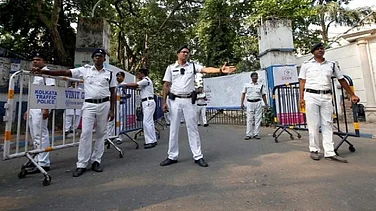
Many of those displaced identify as Ahomiya and indigenous Muslims and trace their displacement to the shifting course of the Brahmaputra
In regions such as Karbi Anglong and Dima Hasao nearly 1.5 lakh bighas have reportedly been transferred to corporations
As land use has not been changed in decades, though the population has increased, people buy occupation certificates for tribal land.
For hundreds of families in Assam’s Andherijuli, the eviction just ahead of elections has meant more than the sudden loss of homes and livelihoods, it has stripped away years of hard-earned stability.
For 38-year-old Farida Begum, it “felt like a nightmare”. She had moved there after marriage to the land that her husband’s family bought more than 30 years ago. With years of savings, they built a modest three-room house; her husband earns a living as a vegetable vendor. Now relocated to Bijoynagar, the family is still reeling. “My sister and we all have documents from 1923. So, how can they just come throw us,” said her brother Raul Ali.
Even temporary shelters offered no relief. Families who tried to rebuild with tarpaulin structures saw those demolished as well. “There were some people living in camps here; they have also been forcibly evicted,” Raul Ali added, noting that demolitions continued on the eve of Eid.
In Andherijuli in Kamrup district, around 300 families were displaced in a recent drive targeting over 700 bighas of land near Guwahati airport, as authorities moved against what they described as illegal occupation in the Azara revenue circle.
Residents, however, say the story is more complex. Many identify as Ahomiya and indigenous Muslims and trace their displacement to the shifting course of the Brahmaputra. The eviction followed a February 27 notice asking families unable to prove eligibility to vacate within 15 days.



A similar sense of loss runs through Shahbuddin Ali’s account. “We bought this land nearly twenty years ago. After years of saving, we built a pucca house and small shops. The shops, which were given on rent were selling grills, medicines, electrical goods, and there was a tailor too. Now everything is rubble,” said the 56-year-old. His family of five has since moved to Bijoynagar, where his brother was living.
Ali said they had submitted ownership documents to the circle officer at the Azara Revenue Circle, but received no response. “We had bought the land, but as of now nothing has happened.” After the demolition, they tried to salvage belongings under makeshift tarpaulin covers, only to see those torn down too. “This is our land… Why are they doing it?”
He also questioned official claims of protecting indigenous communities. “The government says they will not evict Assamese people. I am Assamese, a khilonjiya Muslim, where will we go?” he asked. “When the government wanted money from us, they took it, but now, to suit them, they are destroying our lives.” The timing added to the distress: “We sent my eldest son to a relative’s house so he could study and sit for his college exams.”
In July 2022, the Assam government, led by Chief Minister Himanta Biswa Sarma, moved to recognise five Muslim subgroups, Goria, Moria, Syed, Deshi and Julha, as ‘indigenous’ to the state. The decision triggered renewed debate over Muslim identity in Assam. The government maintained that the move aimed to safeguard the cultural identity of these communities and was based on a report submitted by a sub-committee on the “cultural identity of indigenous Assamese Muslims”, constituted in July 2021.
Many residents point to documents they say validate their claims. S.D. Ahmed, who works at a railway office nearby, said most families hold “Gorakhonya certificates,” issued to those displaced by Brahmaputra floods and erosion. Yet meant nothing. “Two of my relatives’ homes were demolished,” he added, despite their having lived there for over 25 years.
Observers argue these evictions are part of a wider pattern. Bonojit Hussain, an independent researcher on land and ecology, says the government has increasingly framed land issues in ethnic terms, often invoking the “Bangladeshi” narrative for political gain. At the same time, he notes, evictions cut across communities, affecting Muslims, tribals, and Ahoms, in places like Dhubri, Goalpara, and Lakhimpur.
He links the current crisis to deeper structural problems. Assam has never conducted a comprehensive land survey, leaving riverine islands (chars) largely unmapped and populations undocumented. Population has increased over the years as it should.
This ambiguity, Hussain argues, long allowed informal settlements but has now become a tool of eviction. “Especially after 2019, this government has turned that ambiguity into a weapon,” he said.
“Governments have played the politics of postponement. It’s a whole regime of ambiguity. People have settled on land which is described as wasteland and cultivating and farming it,” described Hussain. He underscores this as a “smokescreen” that enables the transfer of land to corporate interests. The area in Andherijuli comes under the Rabha tribal area and reportedly there are plans for an Adani Aerocity connected to this land bank.
The consequences extend beyond individual homes. In regions such as Karbi Anglong and Dima Hasao, traditionally held as tribal commons, large tracts of land, amounting to nearly 1.5 lakh bighas, have reportedly been transferred to corporations like Adani, Birla, and Vedanta. While not everyone is physically displaced as these are tribal land, many lose access to shared common land required for survival. Both Karbi Anglong and Dima Hasao fall under the Sixth schedule, which provides for the protection of tribal areas in the north-east.
Hussain explained that because land use has not been changed in decades, though the population has increased, people buy occupation certificates for tribal land. “This is an informal land market that everyone knows about. Especially in places like the Rani tribal belt, erosion-affected families often entered informal land markets and hold only occupation certificates. This has left them legally vulnerable,” added Hussain.
With the creation of a land bank in February 2025, reportedly of the 55,000 bighas of land earmarked, 49,000 bighas was tribal land, highlights Hussain.
Uncertain future: Nowhere to go
For those already displaced, the question remains immediate and unresolved, where to go next, and on what land to rebuild their lives. In Assam, evictions have been taking place since the early 2000s. “After the BJP came to power in 2016, they initially targeted one community, migrant Muslims or Miyas as they are called, and began giving the issue a communal colour,” said Santanu Borthakur, advocate of the Gauhati High Court said, adding that it has since been used as a political tool to polarise the state.
However, Borthakur emphasised that the threat of eviction is not limited to Muslims. It also affects tribal communities and indigenous Muslims. “If you look at the purpose behind these evictions, they are often linked to projects—cement factories, solar energy plants, power plants,” he noted, pointing to a clear connection with land acquisition in areas such as Umrangso in the hill districts of Karbi Anglong.
According to him, these evictions are frequently carried out to transfer land to corporations. “These are all places under the sixth schedule, so these lands should not have been given to corporations”
He added that tribal communities had, at one point, faced land alienation as some migrant Muslims had occupied tribal land, but all this is part of Assam’s history. “Chief Minister Himanta Biswa Sarma’s narrative of Miya Muslims captures the imagination of others,” he said, referring to narratives popularised by the Chief Minister.
But that dynamic is beginning to shift. As land in tribal areas is increasingly handed over to private interests, there is a growing realisation among communities. “We are now seeing a pushback from these groups in Upper Assam. Slowly but steadily,” he said. He added that in the current political climate, “they have not been able to impose the narrative of Miya Muslims versus Asomiya as much as they would like,” as more tribal communities have begun to recognise the broader implications of these policies.