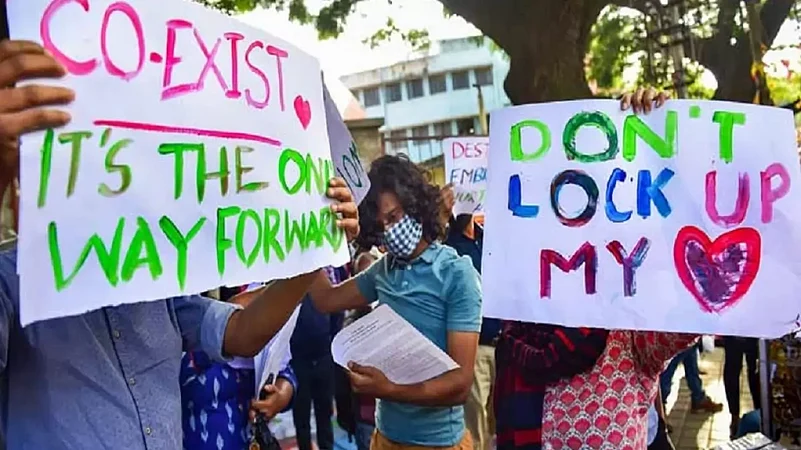
If “love jihad” is a systemic threat, then why has no concrete evidence of a coordinated conspiracy ever been presented
A concerning legal innovation made within these statutes is the shifting of the burden of proof.
Drawing parallels with the stringent provisions of the NDPS Act, these anti-conversion laws effectively presume guilt.
India is currently witnessing a quiet but profound legislative coup against the private bedroom of interfaith couples. While the Constitution and its framers envisioned that a citizen is free to love without a state licence, a highly spread network of 13 state laws has effectively turned the simple act of interfaith marriage into a bureaucratic surveillance and interrogation. From Chhattisgarh and Maharashtra’s newest draft bill to Gujarat’s marriage registration mandates, the State is no longer just a protector of rights but an intruder in the most intimate zones.
The Supreme Court is currently seized of challenges to anti-conversion laws. The litigation has evolved from a challenge to two laws into a massive, multi-jurisdictional constitutional battle. Recognising the national importance of overlapping petitions, the apex court in September 2025 transferred all pending petitions from various High Courts to itself, grouping them to address the validity of laws across states

These laws are frequently framed by ministers across such states as protections against "love jihad", a term coined around the year 2009, which lacks any specific legislative definition. Despite the political fervour, a critical question remains unanswered that is, if “love jihad” is a systemic threat, then why has no concrete evidence of a coordinated conspiracy ever been presented before presenting such legislation? A 2017 NIA investigation found no evidentiary basis for such claims of states, and the conviction rates under these laws remain abysmal. In Uttar Pradesh, of the 14 high-profile cases filed shortly after the law’s inception, only 2 were initiated by women themselves, and the remaining 12 were filed by relatives. This reveals a pattern of family grievances being turned into criminal threats where an adult relationship is the primary suffering. And in Uttar Pradesh, even after arresting around 1700 under the same law, almost none actually resulted in conviction for fraud, revealing the true nature and efficacy of the law, and it means the law was framed to demoralise couples from marrying outside their religion rather than controlling forced conversion.


A concerning legal innovation made within these statutes is the shifting of the burden of proof. Drawing parallels with the stringent provisions of the Narcotic Drugs and Psychotropic Substances Act, 1985 (NDPS Act), these anti-conversion laws effectively presume guilt. The person charged with facilitating or forcing the conversion must prove in court that it was not effected through "allurement", a term defined so broadly in states like Himachal Pradesh and UP that it includes intangible benefits like "divine pleasure" or a "better lifestyle", which a woman might presume to have after marriage.
The recent Gujarat government’s requirement for parental notification for marriage registration follows this same logic of surveillance. By requiring authorities to notify parents within ten days, the State effectively alerts the very individuals most likely to obstruct an interfaith union. This ignores the grim reality of "honour" violence and contravenes the Supreme Court’s directives in Lata Singh v. State of UP and Shafin Jahan v. K.M. Ashokan, which held that an adult’s choice of partner is a fundamental right and can't be taken away.

Dr. B.R. Ambedkar, the architect of our Constitution, rejected such gatekeeping. In defending the Hindu Code Bill, he insisted marriage is a secular contract, not a sacrament requiring community sanction or a parental veto. To subject intimate choices to state scrutiny betrays his vision of individual autonomy over caste and religious dictates, threatening to reinstate the very social hierarchies he spent his life dismantling. Also, he had declared that people should not be born into a religion but should be allowed to choose their faith, and that is being denied here in the name of fear.
Marrying a person of another faith does not mean that there is some imposition of force or fraud rather, having surveillance over them is violative of the directives of the Supreme Court and freedom to marry. If the aim were truly to prevent coercion, existing criminal laws against kidnapping and impersonation would suffice.
The Supreme Court now stands as the final arbiter between a surveillance state and the individual soul. If these laws are allowed to stand, the fundamental promise of the Constitution of India, that an Indian citizen is an adult capable of choosing their own destiny, will be replaced by a regime of mandatory suspicion. Ultimately, a democracy that requires its citizens to seek a government license for matters of the heart will lose its pulse.
Alokita Yadav is a lawyer and law graduate from Campus Law Centre, Delhi University,
Utkarsh Yadav is a final semester student at Dr. Ram Manohar lohiya National Law University.