Loud thuds tore through the silence of the night. Bombs exploded in rapid succession, lighting up the sky with relentless airstrikes, as automated warnings from Israel crackled through phone calls, ordering residents to evacuate before their buildings were reduced to rubble.
The scene unfolded in the wee hours of March 1 this year, when Zaynab Bourgi’s family received a chilling message: the home her parents had built together, brick by brick, in south Lebanon’s Deir Qanoun Ras al-Ain had suddenly been declared a “dangerous zone.” The warning did not come without precedent. Just moments earlier, a friend’s family had chosen to ignore a similar call, and within minutes, their house was flattened to the ground.
26-year-old Bourgi, who currently lives in Lebanon’s capital, Beirut, remained on the phone as her parents hurriedly gathered what little they could, some clothes, essential medicines, packing an entire life into a single suitcase before fleeing. It was Ramzan, and her parents were fasting as they began their journey toward safety, navigating fear, uncertainty, and hunger all at once.
The roads soon choked with traffic, as families from surrounding villages poured out with emergency belongings clutched in their hands. Chaos mingled with emotional overwhelm, most did not know where they were going, or whether they would ever return. “A journey that normally takes about 30 to 35 minutes ended up taking almost 24 hours,” Bourgi recalls.


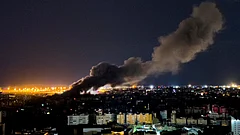
Since that night, Bourgi has been watching her town’s destruction unfold in fragments, through social media posts, breaking news alerts, and grainy videos, each one capturing another bomb, another building, another piece of home lost.
The latest data shows that at least 1,422 people have been killed and 4,294 wounded in Israeli attacks amid the invasion of Lebanon as of April 4. According to the Lebanese Health Ministry, more than 1.2 million people have been displaced, including 370,000 children, as per UNICEF, with numbers rising as strikes continue to flatten neighbourhoods in south Lebanon.
In a recent announcement, the Israeli government said displaced Lebanese would not be allowed to return to areas south of the Litani line until the “safety of Israeli border communities” is assured. Across the country, bridges over the Litani River, Lebanon's longest and most vital waterway, lie in ruins, cutting off entire civilian communities.

'Waiting for bombs to fall'
For Bourgi, the days after her parents fled were defined by urgency and fear. From Beirut, she scrambled to find them shelter, a process that took nearly two days. “It was very stressful… we did not know how long they would have to stay away from home,” she says, recalling the constant anxiety over their safety and the uncertainty of what lay ahead.
What weighs heavier, however, is the loss of home. Forced to leave with only essentials, she says, “everything else, your memories, your belongings, your sense of comfort, remains behind.” Even now in Beirut, she feels unmoored. “It feels temporary… South Lebanon is my real home,” she says, describing a lingering “emptiness” that displacement has brought.
Watching the destruction from afar has only deepened that grief. “These are not just buildings, they are people’s lives and memories,” she says.
On his birthday this year, Ahmed* spent hours not celebrating, but fleeing. An evacuation order near his home in Beirut forced him into his car, trapped in traffic and searching for safety. “I had to spend most of my day in the car… roaming the streets just to figure out where I had to run away,” he says.
By night, there was no rest, only anticipation, something that has become a pattern now. “There are nights where we wake up… waiting for the bombs to fall.”
Israel has moved beyond south Lebanon, increasingly targeting Beirut with repeated airstrikes. Often preceded by evacuation warnings and framed as strikes on Hezbollah-linked infrastructure, the attacks signal a sharp escalation, bringing the conflict deeper into Lebanon’s urban centres.
What began in the south eventually expanded, bringing “mass destruction, people leaving their homes, businesses being affected, supply chains not working,” says Ahmed, who is among those living in Beirut. The attacks that were once confined to southern Lebanon have now begun to spread to the city, bringing the war closer to the capital and into everyday life. “We are witnessing bombing every day and our lives and work has already changed a lot,” he says.
Living close to the strikes has altered how people process fear. The community, he says, has now started to differentiate between bombs, air strikes, and drone strikes, making the sounds of war “grimly familiar” while the daily life for people has lost all its structure. His office has been disrupted, with staff forced to relocate, and his restaurant has shut down entirely. Around him, Ahmed has seen friends lose homes and businesses, as the broader economy begins to unravel.
Now, even basic systems are under strain including a lack of basic essentials like medicines and baby formula, something now considered a luxury.
Despite the chaos, Ahmed clings to fragments of hope. Quoting Palestinian poet, Mahmoud Darwish, he says, “life will be measurable if there wasn’t a glimpse of hope,” adding that this “glimpse of hope” is what keeps him going each day. But emotionally, the toll is heavy. “What is happening to my country sickens me… any house that we lose is a house that we all own.”
From 1948 to now
Israel’s involvement in Lebanon traces back to the Palestinian displacement of 1948, after which refugees settled in the country, often confined to camps and facing legal and economic restrictions while remaining tied to the idea of return. Over time, southern Lebanon became a base for Palestinian armed groups, especially after the Palestine Liberation Organisation (PLO) relocated there in the 1970s, drawing repeated Israeli attacks, including the 1982 invasion that reached Beirut and a prolonged presence in the south until 2000, during which Hezbollah emerged as a force resisting Israeli occupation.
The conflict has since followed cycles of escalation, including the 2006 war, resulting in an Israeli withdrawal from southern Lebanon, but the current phase is closely tied to Gaza. After Hamas’s October 2023 attack and Israel’s genocide of Gaza, Hezbollah launched cross-border strikes in solidarity, prompting Israeli retaliation that has steadily expanded across Lebanon.
Hassan Nizar, a Lebanese organiser, researcher and podcaster based in Spain and co-founder of the progressive political movement LiHaqqi, traces Lebanon’s current vulnerabilities back to the arrival of Palestinian refugees. “The immediate impact was humanitarian, people arrived on foot and settled informally. Over time, the Lebanese state began regulating and restricting their presence, confining them to camps,” he says.
He says that the condition of Palestinians has remained precarious, “Crucially, Palestinians in Lebanon remain stateless. They are denied basic rights, restricted from many professions, barred from owning property, and are forced into informal economies.” At the same time, he notes that Lebanon’s political system has struggled to respond effectively amid external pressures, with governance shaped by competing international interests, leaving the country exposed as regional conflicts escalate.
Experts warn that this strategy reflects patterns seen in Gaza, widening strikes beyond border regions, targeting infrastructure and civilian areas, and raising fears of a broader attempt to reshape control.


'Shorthand for ethnic cleansing'
For many in Lebanon, this escalation reflects a familiar and deeply unsettling trajectory. Civilians describe a pattern of bombed homes, flattened schools and hospitals, and entire communities displaced, echoing the devastation seen in Gaza. “They literally said publicly that they are trying to apply to South Lebanon what they applied to Gaza,” says Ahmed, pointing to “systematic destruction of houses” and indiscriminate targeting.
For him, the conflict appears open-ended. In one of the recent statements, Israel’s Defense Minister Israel Katz has made Israel’s plans clear: implement the Gaza model of total destruction and ethnic cleansing. He said that “the model of Rafah and Beit Hanoun” will be implemented in Lebanon. Referring to such statements, Ahmed says the intent feels clear: “he [Benjamin Netanyahu] wants to make Greater Israel.”
Lebanese anthropologist and author, Maya Mikdashi says that Israel’s current approach in Lebanon cannot be understood in isolation, but as part of a continuum of military doctrines refined over time. She points to the “Dahieh doctrine”, Israel's military strategy of using disproportionate force, targeting civilians, and destroying infrastructure, from 2006 as an “intentional strategy of collective punishment of civilians,” targeting infrastructure and displacing large populations, and links it to later policies like “mowing the lawn” in Gaza.
These approaches, she argues, have culminated in what she calls the “Gaza Doctrine,” which “is now shorthand for total siege, ethnic cleansing, and genocide,” and are now being applied simultaneously: “Today; the Dahieh Doctrine, Moving the Lawn, and the Gaza Doctrine are all operating concurrently, at different scales, in Palestine, Lebanon, and Iran (and arguably, in Syria).”
Drawing parallels between Gaza and Lebanon, Mikdashi highlights a shared pattern in how civilian populations are treated, especially through the blatant use of “collective punishment” as a war strategy. “Mass displacement, the destruction of medical and other civilian infrastructure, the detonation and destruction of homes and entire neighborhoods, and the killing of medical personnel, journalists,” she says.
In an article she wrote in 2024, Mikdashi reflects on the deep, intimate ties between Lebanon and Palestine, tracing them back to a time before modern borders hardened. She writes that before 1948, “land ownership, marriage, railroads, labor regimes, baptisms, business, and trade practices welded us together as part of a larger, symbiotic region.” Capturing that enduring closeness, she adds, “We share the same sky, the same sea, and the same land. We share the same language, the same food, the same music, and the same families.”
She tells Outlook to how ceasefires function in practice, stating, in both Gaza and Lebanon the definition of the word ‘ceasefire’ is peculiar, noting that it means “you cease, and I continue to fire.”
While she cautions that the two contexts are not identical, she underscores the scale of the shift: “While parts of South Lebanon are being levelled according to the Gaza Doctrine,” indicating that tactics seen in Gaza are increasingly visible in Lebanon, raising concerns about how far this model may extend.
Hassan agrees that elements of the Gaza model are being replicated in Lebanon. He points to a strategy that goes beyond targeting armed groups, saying, “What we are seeing is a strategy aimed not just at targeting armed groups, but at reshaping the demographic and geographic landscape, through destruction, displacement, and making areas uninhabitable.”
According to him, the objective is long-term: “The goal appears to be creating zones where people cannot return, effectively depopulating them.” He adds that this is tied not only to military aims but also to geography and resources, noting, “Water is certainly one factor, the [River] Litani is a major freshwater resource. But beyond that, this fits into a broader pattern of territorial expansion and strategic control.”
He also situates this within a wider ideological framework, saying, “There’s also a broader ideological element, what some refer to as the ‘Greater Israel’ vision, which continues to influence political discourse, even among mainstream Israeli leaders.”
Bassel Doueik, Lebanon and Jordan researcher at ACLED (Armed Conflict Location & Event Data), warns that the escalation is placing immense strain on an already fragile state. “Lebanon is a fragile state… this escalation will only mean that ordinary people… will have a harder life in terms of access to food, electricity, healthcare, and basic safety,” he says, pointing to the state’s limited capacity to respond.
With growing displacement, he adds, “the Lebanese government is solely responsible… in a way that it doesn’t have the funds… political power [or] military capabilities to do that.”

Living in limbo
ACLED data shows that between 2 and 27 March alone, over 2,000 events of political violence were recorded, largely driven by Israeli military activity, including 318 air and drone strikes and 319 artillery shelling events, some involving white phosphorus. Israeli forces have also deployed roughly 50,000 troops, pursuing a strategy aimed at establishing a buffer zone and pushing Hezbollah beyond the Litani River.
While Doueik sees Gaza and Lebanon as “two different scenarios,” he points to overlapping patterns: “the IDF is not restrained at all when it comes to attacking civilian populations, paramedics, health workers, journalists.”
Regionally, he notes that Gulf countries remain preoccupied, limiting their response. Domestically, the consequences are severe: “the latest Israeli military attack… has triggered sectarian tensions,” he says, warning that “if the conflict persists, Lebanon risks moving from political fragmentation into sustained internal instability.”
For 25-year-old Gia Hajo from Tyre in south Lebanon, the war unfolds in real time, shaping every moment with fear, displacement, and uncertainty. As she begins speaking, her parents walk back into the house after a risky trip to retrieve belongings from their damaged home. Relief washes over her instantly. “They have just arrived back safely, and I felt such relief, All I could say was, ‘Alhamdulillah, you’re safe.’”
But even in that moment, the fragility of safety lingers. Since October 2023, and especially after the escalation in 2024, nothing has felt secure. “Our house was severely damaged, and we couldn’t return for 20 days,” she says, adding that even now, “we are never fully safe… and that sense of uncertainty continues.”
Her daily life is now reduced to essentials and structured around survival: eating, sleeping, working, and repeat. The psychological toll has been severe: “My depression has doubled, my anxiety has tripled, and my stress levels are extremely high.” She often cannot eat more than once a day due to stress. Even movement requires calculation, “before going anywhere, I think two or three times”, leaving her feeling “stuck, waiting for something to happen.”
She expresses frustration at the lack of meaningful regional support, hoping Arab countries would “stand together,” but feeling that solidarity has fallen short. For Hajo, her home is not a part of her life, but her entire life, yet all she has now are just the memories.
“If I could, I would carry my home in my arms and take it with me,” she says.
*Name changed on request