



Satheesan emphasises “Team UDF” unity, with no factionalism and smooth seat-sharing across allies.
He accuses the ruling front of fiscal mismanagement, rising debt, and failures in healthcare, welfare and education.
The UDF is pitching policy-backed solutions on jobs, education, infrastructure and governance as a people-centric alternative.
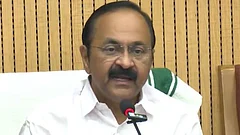
Hectic parleys are underway in the Capital to finalise the second list of candidates for the Kerala elections, and Leader of the Opposition V.D. Satheesan was here for the discussions. He believes the political tide is turning in favour of Congress and UDF.
As the United Democratic Front (UDF) gears up for the 2026 Assembly elections, he projects a united “Team UDF” despite rumours of factionalism and argues that the ruling CPI(M)-led LDF is in decline.
Edited excerpts of the interview with Outlook:
After the local body elections and by-elections, there was a kind of a wave in favour of the United Democratic Front. But now the momentum seems to have died down…
No, there is no slowing of momentum from our side. We have been maintaining this wave for the last four years. All the by-elections we won, except one, where they reduced their majority from 40,000 to 2,000. And we have a very good victory in the local body election, which is the biggest one in the last 30 years.
Now, it’s mission 2026. That is why it is no longer just the UDF, but Team UDF: united and cohesive.


But, there has been a delay in announcing seats? Was it because of factionalism?
There was no delay. All parties faced uncertainty due to the sudden announcement of the election date on Sunday. We had expected it later, but adjusted quickly.
Our plan was to announce 50 candidates within 24 hours, and we were fully prepared. However, our screening committee chairman was in Gujarat and returned only late in the evening. Despite this, we announced 55 candidates within 48 hours.
In the past there were groups within the party, but that is no longer the case. There is no group dominance now. We have a galaxy of leaders and we are proud of that. We have all reached the conclusion that we have to come back.
We had prepared our list in advance but held back briefly in anticipation of possible defections from the CPM. Announcing earlier would have limited our ability to accommodate them.
Will any MP be given a ticket?
No MP will contest. We decided that this time no MP will contest as otherwise everyone will want to contest.
What are the issues currently plaguing Kerala? And what has the CPI(M) done in 10 years?
The main issue is Kerala’s highly vulnerable fiscal situation, arguably the worst in its history. Kerala’s total debt is now around ₹6 lakh crore, up from ₹1.5 lakh crore when we left government 10 years ago. In a decade, it has risen fourfold, excluding other liabilities.
For example, the state has seen the highest price rise in India over the past 12 months. There has been little effective market intervention, and the Civil Supplies Corporation, which is meant to handle this, is burdened by huge government debt.
The electricity board, once profitable, is around ₹50,000 crore in debt. Tariffs have been increased four times, along with surcharges, and further hikes are being sought.
Public healthcare is in serious trouble, with shortages of medicines due to unpaid dues by the Medical Services Corporation, as well as lack of equipment and overcrowding, with sometimes three patients to a bed.
The Kerala Water Authority is also under ₹4,000 crore in debt. At the same time, the government owes around ₹1 lakh crore to employees, pensioners and teachers. Welfare boards, which rely on worker and government contributions, are struggling, and many beneficiaries are not even receiving pensions.
Higher education has also collapsed. There are no permanent vice-chancellors in universities, no principals in government colleges, and ongoing conflict between the Governor and the government has worsened the situation.
CPM is heading towards disintegration. In Bengal it took 33 years; here it has taken just 10. This is the beginning of that process.
Will anything change if the Congress comes to power? Would you do anything differently?
We told people that wherever the government has failed, we have alternatives—and we have worked on them. No opposition in India has done this. We began two years ago, did our homework, and held multiple conclaves.
On health, our narrative was that Kerala’s system is on a ventilator. We set up a health commission and produced a detailed policy document for the future of health care.
On brain drain and higher education, we warned that Kerala could become an ageing society within five years. Our key proposal is a global job watchtower to track changes in the global job market and align curricula accordingly
We identified two core issues: outdated courses and lack of opportunities. We will overhaul curricula in line with global demand. After graduation, students will have two pathways—jobs or support to start ventures. We will provide technical and management mentors, along with a revolving fund to support start-ups.
We also have major infrastructure projects. Kerala has a 600 km coastline along the Arabian Sea, two international seaports, one container terminal, and 17 mini ports. We will develop coastal shipping and logistics to create jobs.
The next phases include cruise shipping and integrating waterways and backwaters into a large tourism network. In aviation, with four international airports (including Kochi and Kannur), we have planned several projects—pilot training, crew training, aircraft maintenance and more—to generate employment.
Politically, we also take a firm secular stand: we will not appease either majority or minority communalism, and we will not compromise with communal forces.
What is the political stand you will take?
Nehruvian left - that is our position. Not a “new left”, but a socialist, Nehruvian tradition. In Kerala, the political centre itself is left, though not the Communist left.
There are many such fellow travellers in Kerala who supported the Left for 3–4 decades with hope, but are now leaving and moving towards us. Our narrative is that the current Left is no longer truly left or communist, but has moved to the extreme right—similar to the BJP. In contrast, we stand for a progressive, environmentally conscious, and gender-just politics.
That is our stand; we will not appease anyone. If there is a genuine issue, we will engage and help, but we will not be dictated to. If asked to sit on a chair, we will sit, not lie on the floor.
We will not allow communal religious leaders to put pressure us. But we will not compromise. I have said openly that if anyone tries to blackmail us with vote banks, they can keep them. We will not play communal politics.
Congress has given seats to a few former Left party members in the first list. Will that backfire?
We have carefully selected deserving candidates. The CPI(M) ignored A. Suresh, a close associate of former Chief Minister V.S. Achuthanandan; after joining Congress, he has been fielded from Malampuzha.
P. Aisha Potty, a former three-time CPI(M) MLA who switched to Congress, has also been given a ticket. P.V. Anvar, a former MLA who has distanced himself from the LDF, is being supported by the UDF as an Independent from Beypore.
We have also supported rebels in Payyanur (V. Kunhikrishnan), Taliparamba (T.K. Govindan), Ambalapuzha (Sudhakaran) and Ottapalam (P.K. Sasi). If we can make a dent in any of these seats, it is a win for us. Congress has not won any of these seats for more than two decades and in some cases more than 40 years.
Do you think CPI(M) in Kerala still follows its ideological roots or has it gone Right?
They are no longer the Left. They are Right extreme.
What about the BJP in Kerala? Do you think they will expand their power in the state?
It remains a marginal player. Its vote share has declined in local body elections and is not growing. The party is also facing internal issues, with factions and leadership conflicts in several places.
There is also an unholy nexus with the CPI(M). For example, in Palakkad by-elections we won the seat, with the BJP second and the CPI(M) third. Now the CPI(M) is fielding a candidate in Palakkad (hotel owner NMR Rasak) in a way that helps the BJP. A similar pattern was seen in the Parliamentary election, where they aided a BJP win in Thrissur.
How many seats do you think Congress and UDF is likely to get?
We expect more than 100 seats. Now in almost all the national surveys, it is between 80 and 90. During the election campaign, we will increase the seats. We will cross 100.















