The US–Israel attack on Iran signals a shift in global politics where war is normalised, and the language of dominance replaces diplomacy.
A conflict in West Asia travels rapidly across borders—through energy routes, supply chains, and economic shocks—making the global deeply personal.
The LPG crisis exposes how geopolitical faultlines translate into domestic vulnerability, raising questions of preparedness, policy, and dependence.
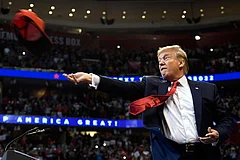
A coin is a small thing—until it isn’t. Until it begins to say something about power. To mark 250 years of the United States, a new dime quietly drops the olive branch—the oldest emblem of peace. In its place is something harder, stripped of pretence. This is not just design. It is, in fact, a declaration. A world where restraint is no longer virtue, where diplomacy hesitates, and where war is not the last resort but an easy expression of power.
The US-Israel attack on Iran is not just another geopolitical episode in a distant region. It is an event that collapses distance. What begins as a strike in West Asia travels swiftly across oceans and enters homes elsewhere—through disrupted trade routes, energy shocks, and the anxiety of scarcity. In India, that journey has been literal.
The war has arrived not through headlines alone, but through empty gas cylinders, long queues, and kitchens struggling to function. The Strait of Hormuz, a narrow maritime corridor most people rarely think about, has suddenly become central to everyday life. A disruption thousands of kilometres away now dictates whether a household can cook a meal.


But the crisis is not merely about supply chains or energy dependence. It raises deeper questions—about the fragility of systems built on distant dependencies, about the human cost of wars justified in the language of security and morality, and about the choices nations make when confronted with violence. It also forces a reckoning with diplomacy: not just what is said, but when it is said, and what silence signifies.

In Outlook’s April 1 issue, ParaDime Shift, we examine how the US-Israel war on Iran is reshaping global politics, unsettling long-held assumptions, and reverberating through India’s economy, society, and foreign policy. From kitchens to corridors of power, from religious rhetoric to strategic hesitation, this issue maps the many ways in which a distant war becomes a crisis at home.
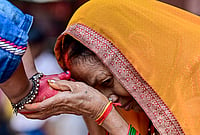
Outlook’s reporters Zenaira Bakhsh and Mrinalini Dhyani bring a ground report from Delhi and beyond, documenting the lived reality of the crisis—long queues, black markets, and families forced to return to firewood and coal, as everyday survival becomes a struggle. Priyanka Tupe reports from Mumbai on how the shortage is pushing workers, migrants, and small vendors to the brink, collapsing informal economies and reviving memories of past crises like the pandemic. Ishfaq Naseem writes from Kashmir, where dwindling supplies and power cuts have disrupted daily life, evoking older histories of scarcity and conflict, and revealing how deeply energy insecurity can unsettle routine existence.
Mohammad Ali traces how a geopolitical chokepoint like the Strait of Hormuz has translated into a domestic energy crisis, exposing structural vulnerabilities in India’s LPG ecosystem and raising questions about preparedness and policy gaps.
Snigdhendu Bhattacharya examines the dangerous resurgence of religious rhetoric in the war, where political leaders across countries invoke faith to justify violence, turning conflict into something that claims divine sanction.
Seema Guha analyses India’s diplomatic response to the crisis, questioning delays, silences, and the apparent recalibration of foreign policy, and asking whether this moment marks a shift away from the country’s long-held commitment to strategic autonomy.

Our commentary piece on diplomacy by Manoj Jha reflects on the deeper moral question confronting India: not just how it acts in moments of global crisis, but whether it speaks with clarity when it matters most—and what it means when it does not.
Even as war redraws maps and disrupts lives, politics at home rarely pauses. It finds new vocabularies to translate distant crises into local anxieties—into identity, belonging, and power.
In the states heading to the polls—Tamil Nadu, Assam, and West Bengal—elections are not merely about governments returning or regimes changing. They are about the terms on which citizenship is imagined and contested. Across these regions, identity is no longer a subtext; it is the text. Cultural pride, ethnic belonging, linguistic assertion, and religious demarcation have all moved to the centre of political mobilisation, often at the cost of material questions that once shaped electoral debate. What emerges is not a uniform story, but a pattern: of politics turning inward even as the world grows more volatile; of voters being asked to choose not just between parties, but between competing definitions of who they are.
N.K. Bhoopesh reports from Tamil Nadu, where the long-dominant Dravidian order faces an inflection point. With shifting alliances, internal fractures within legacy parties, and the emergence of new political actors like actor Vijay’s Tamilaga Vettri Kazhagam, the election could mark a significant reconfiguration of the state’s political landscape.

Agnideb Bandyopadhyay examines West Bengal’s shifting political terrain, where ‘Bangla ashmita’ has become both shield and weapon. As the Trinamool Congress and the BJP battle for narrative control, the contest increasingly turns on culture—on who defines Bengali identity, and who is left outside its boundaries.
Ashlin Mathew writes from Assam, where elections unfold amid eviction drives, contested citizenship, and the steady hardening of identity lines. Through stories of lives uprooted and erased, the piece captures how the question of who belongs has become central to both governance and politics.
In his column, Suman Nath argues that Bengal’s politics is trapped in a cycle where identity eclipses economy. As parties mobilise voters around culture and community, deeper structural crises—industrial decline, unemployment, and systemic corruption—fade into the background.
In his column, Nizam Pasha examines the controversy over new NCERT textbooks, arguing that selective history and pedagogical bias risk embedding a divisive narrative in classrooms. He contends that the Supreme Court’s intervention may be crucial to safeguarding constitutional values and academic integrity. And we have a column by Tanweer Ejaz.