The simmering rebellion within the TMC appeared to gather fresh momentum on Monday, with rebel leader Ritabrata Banerjee portraying veteran Rajya Sabha MP Sukhendu Shekhar Ray's resignation from the party and the Upper House as a sign of widening dissent against the official leadership.
Banerjee, who now heads the breakaway faction in the West Bengal Assembly, described Ray's departure as more than an individual act of protest, calling it a "unity of will" among a section of dissatisfied leaders within the party.
Ritabrata, who was recognised as the leader of opposition in the Assembly by Speaker Rathindra Bose after securing the support of 58 of the TMC's 80 MLAs, said he expected more parliamentarians to publicly distance themselves from the party in the coming days.
His remarks came amid contrasting political scenes unfolding in New Delhi.
While TMC supremo Mamata Banerjee, national general secretary Abhishek Banerjee and several senior MPs attended a meeting of INDIA bloc leaders, reports surfaced of around a dozen dissident TMC MPs gathering at the Motilal Nehru Marg residence of Union minister and BJP's West Bengal election in-charge Bhupender Yadav.
The meeting, viewed by many as a sign that the revolt within the party's legislative ranks is now spilling into Parliament, was attended by Ray.
Chief Minister Suvendu Adhikari, who is in the national capital on official work, and former Tripura chief minister Biplab Deb, the BJP's former co-in-charge for the recently concluded West Bengal elections, reportedly also paid a brief visit to Yadav's residence.
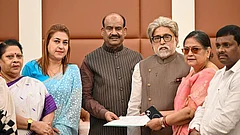

Against this backdrop, Ritabrata suggested that Ray's resignation was only the beginning of a larger political realignment.
"Ray is a senior leader, and his resignation marks the unity of will among us and a significant section of party leaders who are outside the state Assembly. Kolkata's distance from Delhi is barely 1,435 km, and the number of disillusioned TMC parliamentarians is very likely to go up. That development can happen with each passing hour from now," he told reporters outside the Assembly.
He added that he was in touch with several MPs who share similar grievances.
Although Banerjee said he had not spoken to Ray before the latter took the decision to resign, he expressed complete agreement with the veteran parliamentarian's criticism of the party's internal functioning.
According to him, concerns about dissenting voices being ignored and frustrations over the party's conduct in the Rajya Sabha are not isolated sentiments.
Banerjee also drew upon his own experience as a parliamentarian to underline what he described as a culture of favouritism within the party.
"I sat in the last bench in the Parliament for 15 months and witnessed junior leaders and RTI activists being awarded front seats. Parliamentary performance was never the yardstick of judgement. I felt terrible for Sukhenduda, who also allotted the last bench," the rebel TMC MLA said.
He then sharpened his attack on the party's Rajya Sabha leadership, taking oblique aim at Derek O'Brien, the TMC's leader in the Upper House.
"The seat allocations for MPs are decided by the leader of the House, and the person in-charge in this case, is a quizmaster who is more focused on managing the affairs of the Diamond Harbour football club. Such buffoonery may be permitted in quiz contests and elsewhere, but not on the floor of the Parliament," he added, without naming O'Brien.
The reference was to O'Brien's background as a quizmaster and to the Diamond Harbour Football Club, which is set to compete in the Indian Super League during the 2026-27 season and has Abhishek Banerjee for its president.
With one of the party's most senior parliamentarians stepping away and rebel leaders openly predicting further defections, the battle for influence within the TMC appears to be entering a more volatile phase, one that could reshape both its legislative strength in Bengal and its presence in Parliament.