Rebel TMC legislators led by Ritabrata Banerjee elected Arup Roy as party chairperson, challenging Mamata Banerjee's leadership.
The rebels argue the move is valid under the party constitution, while Mamata loyalists insist she remains the legitimate chief.
The Election Commission will now examine rival claims and decide which faction can officially claim the TMC name and symbol.
The power tussle between TMC and its rebel faction intensifies, as the rebels, led by Leader of the Opposition Ritabrata Banerjee, convened in a special session and elected senior MLA Arup Roy as party chairperson, effectively removing Mamata Banerjee from the post.
This political shift is the most recent culmination of growing undercurrents of crisis in the TMC since the party lost the state elections to the BJP, marking the end of a 15-year rule. Ever since, dissatisfaction within the party towards Mamata Banerjee has heightened.
What Exactly Happened Inside The TMC?
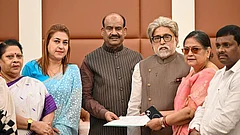
Losing its united front in both the parliamentary and assembly wings, a group of rebel MPs has openly challenged party chief Mamata Banerjee's leadership, claiming the support of nearly 20 parliamentarians and has written to the Speaker of the Parliament, Om Birla, announcing that they have joined the Nationalist Citizens Party of India (NCPI), a Tripura-based political outfit, in a move aimed at avoiding disqualification under the anti-defection law. The faction has not immediately joined the BJP but has extended support to the NDA.
Meanwhile, in the Assembly, a faction of 58 MLAs has already managed to install its leader, Ritabrata Banerjee, as Leader of the Opposition, replacing the candidate chosen by the party leadership. In a special session held in a hotel in Kolkata, Ritabrata Banerjee and the rebel MLAs formed a new national leadership hierarchy and a new chairperson, excluding Mamata and Abhishek Banerjee.


The internal crisis has triggered a bitter battle within the party and raised questions about its future.
Can A Party Founder Be Removed?
In the 31-minute special meeting, the rebel MLAs elected Arup Roy, the veteran MLA from Howrah Central, as the new chairperson of the TMC, replacing Mamata Banerjee in a voice vote.
The meeting also approved a 10-member national working committee comprising Arup Roy, Firhad Hakim, Aroop Biswas, Biplab Mitra, Akhruzzaman Ansari, Sabina Yasmin, Sandipan Saha, Rathin Ghosh, Javed Khan and Ritabrata Banerjee, before expanding it into a 30-member body.
Former minister Biswas and MLAs Hakim, Ghosh and Yasmin were appointed vice-chairpersons. Ritabrata Banerjee, Khan and Saha were named general secretaries, while Akhruzzaman Ansari was appointed treasurer.
Regarding whether this change in leadership can be considered legitimate, Ritabrata Banerjee asserted that the EC will be given a list of the new officials. "It is not about what is real or not real. We are TMC and will inform the Election Commission about today's special session proceedings," he said.
"We have functioned and convened this special session as per the norms. It is for the EC to decide what is wrong or right," he said.
The LoP added that the newly constituted leadership would soon move to establish organisational units at various levels. "We will soon constitute the district committees, the state unit and a panel of spokespersons," he said.
Striking back, Mamata Banerjee loyalists have sent a fresh list of their office bearers and national working committee members to the Election Commission (EC), asserting that Mamata Banerjee continues to head the party.
What Does The TMC Constitution Say?
The Leader of the Opposition used the TMC constitution to justify the special session and the reassembling of the national committee, claiming that there is a “constitutional crisis”.
Ritabrata Banerjee argued that the party's constitution mandated the formation of a national working committee every three years and that the last such panel had been constituted in February 2022. Such is listed in the party’s constitution under Article XVI.
"The organisational structure was not renewed after the expiry of its tenure. Therefore, it became necessary to initiate the process of reconstituting the party's national leadership," a leader present at the meeting quoted Banerjee as saying.
The gathering swiftly moved to constitute a new national working committee, beginning with an initial panel of leaders that includes Arup Roy, Firhad Hakim, Arup Biswas, Biplab Mitra, Akhruzzaman Ansari, Sabina Yasmin, Sandipan Saha, Rathin Ghosh, Javed Khan and Ritabrata Banerjee.
The committee subsequently expanded to 30 members.
What happens next?
The final verdict on who constitutes the “real TMC” lies with the Election Commission of India. As of now, both factions claim to have informed the ECI with their versions of the list of officials.
For now, the battle has moved beyond party meetings and into the institutional arena. The Election Commission will have to examine the rival claims, party constitution, organisational support and legislative strength of both camps before deciding which faction can officially claim the TMC name and symbol. Until then, the party remains divided between the Mamata Banerjee-led leadership and the rebel bloc, with the outcome likely to shape not only the future of the TMC but also the political landscape of West Bengal.