China's latest missile test highlights its growing long-range military capabilities and strategic ambitions
The launch has raised security concerns across the Indo-Pacific, including for India, despite not being directed at it
Experts say India must strengthen deterrence, defence partnerships and military modernisation in response
China's latest long-range missile test over the Pacific has once again brought the Indo-Pacific's rapidly evolving strategic landscape into focus. While Beijing described the launch as a routine exercise, defence analysts believe it reflects China's growing ability to project military power well beyond its immediate neighbourhood.
The test is being viewed not simply as a signal to Taiwan but as a message to regional powers, including the United States, Japan, Australia and India, that China's strategic reach is expanding.

What exactly did China test?
China's People's Liberation Army Rocket Force (PLARF) recently conducted a test of an intercontinental-range ballistic missile (ICBM), which flew across the Pacific before landing in a designated impact area.
According to China's Defence Ministry, the launch formed part of its annual military training programme and complied with international law. While Beijing did not disclose the missile's identity, military experts believe it was likely one of China's latest long-range nuclear-capable systems designed to demonstrate its ability to strike targets thousands of kilometres away.


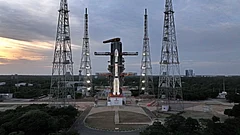
The test showcased not only the missile's range but also China's improving command, control and launch capabilities, reinforcing the country's efforts to modernise its nuclear deterrent.
Why is this test different from previous ones?
Unlike most earlier Chinese missile tests, which remained within domestic testing zones or western deserts, this launch crossed the Pacific Ocean, making it a far more visible demonstration of strategic capability. It was also among the few occasions in recent decades when China publicly acknowledged such a long-range test.
Experts say the launch signals growing confidence in the operational readiness of the PLARF and reflects China's transition from regional military power to a global strategic force. The timing is equally significant, coming amid heightened competition with the United States and continuing tensions over Taiwan and the South China Sea.
Why should India care if the missile wasn't aimed at it?
Although India was not the intended target, the implications are difficult to ignore. China's expanding missile capabilities strengthen its overall deterrence posture and could allow Beijing to allocate more military resources across multiple theatres, including the Himalayan border.
Indian security planners increasingly view China's military modernisation as a comprehensive challenge rather than one confined to the Line of Actual Control. Improvements in China's missile, naval and space capabilities enhance its ability to sustain operations across the Indo-Pacific, indirectly affecting India's security environment.
The demonstration also underlines the importance of India's own strategic deterrent, including the Agni missile series and sea-based nuclear capabilities.
How does this change the military balance in the Indo-Pacific?
The test reinforces China's ambition to become a military power capable of operating across the entire Indo-Pacific. Combined with its rapidly expanding navy, advanced hypersonic weapons, anti-satellite systems and growing nuclear arsenal, the missile launch contributes to a shifting regional balance.
Countries such as Japan, Australia and the Philippines have already strengthened defence cooperation with the United States, while NATO has shown increasing interest in Indo-Pacific security. The latest demonstration is likely to encourage further investment in missile defence, intelligence-sharing and military interoperability among regional partners.
What options does India have to respond?
India is expected to continue strengthening its own credible minimum deterrence while accelerating modernisation of long-range missiles, ballistic missile defence systems and maritime surveillance capabilities. New Delhi is also likely to deepen cooperation within the Quad alongside the United States, Japan and Australia, while expanding partnerships with France and Southeast Asian countries.
Military experts argue that investments in cyber warfare, space-based surveillance, artificial intelligence and indigenous defence production will be equally important as conventional military capabilities.
Is this about Taiwan—or something much bigger?
Taiwan remains a central factor behind China's military preparations, but the implications extend well beyond the Taiwan Strait. The missile test reflects Beijing's broader objective of reshaping the Indo-Pacific's strategic order and challenging long-standing American military dominance across the region.
For India, the launch serves as another reminder that the Indo-Pacific's security environment is becoming increasingly interconnected. Developments in the western Pacific can directly influence strategic calculations in the Indian Ocean and along India's northern borders, making China's missile modernisation a regional issue with global consequences.