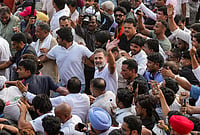
Several Opposition MPs, including Congress president Mallikarjun Kharge and former party chiefs Sonia Gandhi and Rahul Gandhi, staged a demonstration on Wednesday.
Members of the Congress, DMK, TMC, Left parties, and others assembled near the Makar Dwar, holding posters and placards criticising the new labour policy framework.
The Centre had notified the four labour codes last month, bringing to completion reforms pending since 2020.
Several Opposition MPs, including Congress president Mallikarjun Kharge and former party chiefs Sonia Gandhi and Rahul Gandhi, staged a demonstration on Wednesday in the Parliament House complex, voicing strong opposition to the recently notified labour codes and calling for their withdrawal.
Members of the Congress, DMK, TMC, Left parties, and others assembled near the Makar Dwar, holding posters and placards criticising the new labour policy framework. They raised slogans demanding that the Centre scrap the codes altogether.
Along with Kharge, Rahul Gandhi and Sonia Gandhi, the protest saw the participation of Congress general secretary Priyanka Gandhi Vadra, TMC leader Dola Sen, DMK MPs Kanimozhi and A. Raja, CPI(M) MP John Brittas, and CPI(ML) Liberation MLA Sudama Prasad, among several others. The group also displayed a large banner that proclaimed: “No to Corporate Jungle Raj, Yes to Labour Justice.”
The Centre had notified the four labour codes last month, bringing to completion reforms pending since 2020. The Congress has argued that 29 existing labour laws have been consolidated and presented in the form of these four codes — the Code of Wages (2019), Industrial Relations Code (2020), Code on Social Security (2020), and the Occupational Safety, Health and Working Conditions Code (2020).


The codes introduce several measures, including mandatory appointment letters for workers to promote formalisation and job security; universal social security benefits extending to gig, platform, contract, and migrant workers through PF, ESIC and insurance; statutory minimum wages and timely wage payment across sectors; enhanced safety and work rights for women, including permission for night shifts and compulsory grievance committees; as well as free annual health check-ups for workers aged 40 and above.
However, trade unions have previously criticised the codes, pointing to ambiguous provisions on retrenchment and the possibility of inconsistent implementation by central and state authorities. One of the major concerns is the revised threshold for requiring government permission for closures, layoffs, or retrenchment. The new Rules raise this limit from establishments with 100 workers to those with 300. Working hours have also been increased from nine to twelve hours in factories, and from nine to ten hours in shops and commercial establishments.
With PTI inputs