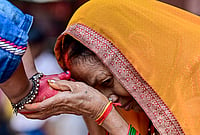
The gruesome Pahalgam attack halted a record tourism boom, triggering massive cancellations and losses.
Livelihoods across the Valley, from hoteliers to ponywallahs, were hit hard as optimism turned to uncertainty.
Locals hold on to cautious hope as tourists slowly return and recovery begins again.
“This is the most beautiful place on earth,” says Nivi Shrivastava. “But there's a strange sadness in the people. You can feel it everywhere.”
She is in Pahalgam. One year ago, 26 tourists were killed here.
Shrivastava, a Delhi-based media professional originally from Jabalpur, had long wanted to visit Kashmir. She made sure Pahalgam was part of her itinerary when she finally came this week. The experience, she says, was layered and affecting.
What struck her most was not the landscape but the people she encountered along the way. “I was so touched by the innocence and hospitality of the Valley,” she says. “There are so many stories I have to share, and my eyes just well up as I bring myself to narrate them.”
The stories are not dramatic ones, but about warmth offered to strangers, and about a place she feels is widely misread. “They are just about the way the place and its people are, and how misunderstood the place is.”
That quiet grief is something the Valley’s residents carry alongside their work, and it surfaces in pauses.



Ask hotelier Asif Burza, Managing Director of Ahad Hotels & Resorts, about the impact of the past year, and he captures this discomfort: “This might not be an appropriate time to talk business,” he says. For him, this week is first about remembering the lives lost. The tragedy, he suggests, should not be flattened into an economic narrative.
In early 2025, Pahalgam was in the midst of one of its busiest tourist seasons in years. Hotels were full. Ponywallahs moved steadily along the Lidder river. Markets thrived on a constant flow of visitors, and mornings began with the hum of arrivals. By afternoon, cafés and trails overflowed with tourists chasing the Valley’s spring.

The surge in footfall had brought with it something more valuable than revenue. A sense of certainty that the tourism economy was finally finding its footing after years of volatility.
Then came April 22. The attack in Pahalgam’s Baisaran meadow, in which 26 innocent civilians, most of them tourists, were killed by terrorists, marked a sudden and devastating rupture. What had been a season of expansion turned into one of cancellations and retreat, overnight.
Within weeks, industry estimates suggest over 80 per cent of bookings were called off across the Valley. In Pahalgam alone, cancellations reached nearly 90 per cent. Annual tourist arrivals dropped from a record 2.36 crore in 2024 to around 1.78 crore in 2025, a fall that erased years of hard-won progress in a single season.
For those who had invested in the boom, the fallout has been immediate and, in most cases, devastating.
Nida Shah (name changed), a banker-turned-entrepreneur, had taken out loans to set up a homestay, timing her investment to ride the momentum she had watched building for several years. “I had planned everything around the season,” she says. “When the bookings disappeared, I had no way of paying back.”
Across the Valley, people who had read the signals correctly, who had seen the filling hotels, the surging foreign arrivals, the growing confidence, found themselves trapped by the very optimism that had driven their decisions.
Like Zahoor Ahmed (name changed) and his wife, who had sold family jewellery and taken a loan to buy a vehicle to run as a tourist taxi. He had spent years working in various cities in India before deciding that the time had come to build something at home.
“Like several of my friends, I thought this was the best time to start something back home,” he says.
“This is something we had always wanted. And now, as I took a leap of faith, it never worked.” He pauses, then adds: “Having said that, I haven’t given up. I believe thing will get better for us.”
That refusal to give up runs through nearly every conversation here. Not bravado, but it’s the particular resilience of people who have lived through enough cycles of hope and disruption to know that neither is permanent.
Farooq Kotru, owner Best View Group of Houseboats, speaks of a season that should have been thriving as this is the time that usually sees high footfall from Gujarat, Maharashtra, and Bengal, but not many are coming. He remembers how last year, around this time, his properties were full. Right now, he says, only two rooms are occupied. In the years leading up to the attack, there had been film shoots at houseboat properties, a visible symbol of a Valley being discovered and celebrated, and it gave investors confidence. “We believed that was it,” he says. “That this was finally the moment.”

Kotru also points to the conflict in West Asia as an overlooked factor weighing on the industry. The international tourist arrivals, which had been growing steadily, have slowed, partly because of the broader reluctance to travel to the region at a time of geopolitical turbulence. “Not many international tourists are coming the way they have been,” he says.
Hotelier Mushtaq Chaya, Jammu & Kashmir Tourism & Allied Business Forum (JKTABF) speaks with the measured candour of someone who has invested too much, emotionally and financially, to afford cynicism. He laments what tourism could have meant for Kashmir’s economy, had it come with any reliable certainty. The sector, he argues, could be the backbone of livelihoods across the Valley. But it demands stability, and stability here has always been conditional.
“The unfortunate tragedy that happened here has definitely caused a deep scar that would take years to heal. The messaging that went out at that time was wrong and misplaced. We are glad that tourists who are trickling back are witnessing the true nature of Kashmir themselves. That gives us satisfaction,” he says.
He pauses, then adds with quiet conviction: “We have faith that time will heal.”
Beyond investors and hotel owners, the deepest impact was felt by those at the margins of the tourism economy like the pony handlers, shikara operators and guides, many of whom depend entirely on seasonal tourism for income. Income losses of up to 80 per cent were reported. Some hotels reduced staff or shut down operations temporarily.
The ponywallah community, the informal backbone of high-altitude tourism around Pahalgam, lost an entire season’s earnings. For many, recovery has been slow, uneven, and uncertain.
Abdul Waheed Wani, president of the local ponywallah association and among the first to reach Baisaran on the day of the attack, says Pahalgam is no longer the same.
“Before April 22, it was a different place,” he says. “Tourists would stay at least two nights. Now, with key sightseeing spots shut, most leave for Srinagar by evening.”

“When tourists don’t come,” one local worker says simply, “it’s not just a bad day at work. It’s about how we will eat tomorrow.”
The Amarnath Yatra, which has resumed, offers some comfort to the administration, but industry insiders are measured about its impact on commercial tourism.
Pilgrims, they note, come with a specific purpose. They travel to the shrine and back, largely bypassing the hospitality infrastructure that depends on leisure visitors. The Yatra is welcome, but it is not a substitute for the kind of tourism that filled hotels and hired guides and kept ponywallahs busy through a full season.
A year on, efforts to rebuild are visible, if cautious. The administration has introduced a QR code-based identification system for tourism service providers in Pahalgam. Pony operators, hawkers, vendors, and business establishments are now police-verified and digitally identifiable, an attempt to formalise an ecosystem that has long operated informally. Over 7,000 service providers have been registered under the system. It is a meaningful step, though stakeholders are careful not to oversell its impact on visitor confidence.
The recovery in Kashmir is never just administrative, it’s also psychological. A single incident can reshape global narratives, undoing years of careful work.
Farooq Ahmad Kuthoo, former president of the Travel Agents Association of Kashmir, states: “If you’re not visiting Kashmir, you’re playing into the hands of terrorists. They don’t want tourism here.”

According to Chief Minister Omar Abdullah, compared with last year, tourist numbers are still low, but the sector is recovering. The evidence is visible on the ground: taxis are back on the roads, tourist buses are running again, and hotels are getting bookings…
The Valley, for now, remains what it has long been. Resilient, hopeful, and fragile.
“You come for the place. But you leave thinking about the people,” Shrivastava says.