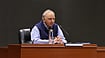
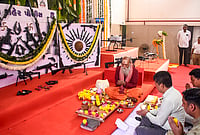
During the nine-judge bench hearing, Justice B.V. Nagarathna stated that courts have the right to intervene when "social evils are branded as religious practice."
The Solicitor General argued that the restriction on women of menstruating age is based on the deity Lord Ayyappa's celibate nature, not on notions of impurity.
The verdict in this case will have far-reaching consequences beyond Sabarimala, potentially impacting related issues such as Muslim women's entry into mosques, Parsi women's access to fire temples, and the legality of practices like female genital mutilation.
As a nine-judge Constitution bench commences hearings on the Sabarimala women entry case, Justice B.V. Nagarathna observes that the judiciary has the right to distinguish between genuine religious faith and social evils disguised as religious practice.
The Supreme Court's nine-judge Constitution bench on Tuesday began hearing the politically sensitive review petitions challenging the 2018 verdict that allowed women of menstruating age into Kerala's Sabarimala temple, with Justice B.V. Nagarathna making a crucial observation that courts can intervene when "social evils are branded as religious practice" .
The observation came on the first day of hearings before the bench headed by Chief Justice Surya Kant, as the Solicitor General Tushar Mehta, appearing for the Centre, argued that matters of religious faith lie beyond the scope of judicial review .
"If there is a social evil branded as a religious practice, court can certainly distinguish between the two," Justice Nagarathna told the bench . The statement encapsulates the central tension in the case: where does the constitutional right to religious freedom end, and the right to equality begin?


A decade-long legal battle
The case traces back to a 2006 Public Interest Litigation filed by the Indian Young Lawyers Association challenging the centuries-old custom that barred women between the ages of 10 and 50 from entering the Ayyappa shrine in Sabarimala, Kerala.
In September 2018, a five-judge Constitution bench delivered a landmark 4:1 majority verdict striking down the ban, holding that treating women as "children of a lesser god" was unconstitutional and violative of Articles 14, 15, and 25 . Justice Indu Malhotra, the lone woman on that bench, had dissented, arguing that "issues of deep religious sentiments should not be ordinarily interfered [with] by the court" and that "notions of rationality cannot be invoked in matters of religion."