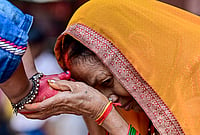
As India stands on the brink of enacting a dehumanising amendment to its transgender rights framework, none of the actors, who have played trans characters, have the courage to speak up against it.
If the film industry can inhabit transness for profit, the least it can do is stand up in solidarity for those whose lives are now under threat.
Jaya Bachchan and Sonam Kapoor are the only two prominent faces who have voiced their disapproval in any capacity until now.
Amitabh Bachchan has done it. Akshay Kumar has done it. Kamal Haasan and Vijay Sethupathi have done it. Even Vaani Kapoor, Sushmita Sen and Adah Sharma did it. Across decades and industries, they have slipped into sarees, modulated their voices and performed femininity or transness. Sometimes they did it for laughs, sometimes for prestige. Sometimes this acclaim came along with capital and cultural prestige. Sethupathi actually won the National Award in 2021 for Best Supporting Actor for his portrayal of a trans woman in Super Deluxe (2019). But as India stands on the brink of enacting a dastardly and dehumanising amendment to its transgender rights framework, none of them have had the courage to speak up against it.
Most Bollywood stars have categorically proven in the past few years that they have no skin in the game when it comes to standing up to oppressors. They will rather chase box office glory and fleeting fame by appeasing the authorities. They do not speak up when minorities in India are discriminated against or lynched; not even when bombs are dropped on innocents in Palestine or Iran. In fact, they build their brand identities on being vacuous idols, here to make bank, whether the world around them survives or evaporates to nothing but dust. They do not seem to care if no one is left to clap for their faux-heroics and damsel acts; their visions blinkered by naked greed, short-term ambitions and abject cowardice.


The Parliament has already passed the Transgender Rights Amendment Bill. Right now, only the President’s approval stands between it being rejected or becoming a law. From invasive identity verification processes and weak enforcement of anti-discrimination protections to inadequate safeguards in housing, employment and healthcare, this is a bill that is heinously attempting to reduce lived identity to paperwork, panels, undue medical intrusion and bureaucratic scrutiny. And yet, those who have most visibly occupied these identities on screen have, by and large, declined to use their platforms to challenge the bill. The film industry may not be where policies are made, but cinema is what shapes the conditions under which policy is received. If the industry can so effortlessly inhabit transness for profit, the least it can do is stand up in staunch solidarity for those whose lives are now under threat.
A Few Good Women
Jaya Bachchan and Sonam Kapoor are the only two prominent faces from the Hindi film industry who have voiced their disapproval in any capacity until now.
Kapoor re-shared a post on Instagram urging people to reject the bill—a small gesture, perhaps, but one that at least acknowledged the stakes. More substantively, Jaya Bachchan spoke in the Rajya Sabha, questioning the very framework of “determination” by medical bodies. She called it invasive, insensitive and fundamentally misaligned with the lived realities of trans individuals. She pushed for representation from within the community itself—a fundamental insistence that policy cannot be made about people without them.

This is not new for Bachchan. During debates around the 2023 Women’s Reservation Bill, she had warned against imagining gender justice in caste-neutral terms, arguing that such flattening erases the structural inequalities that shape women’s lives. She has also spoken about manual scavengers, another community rendered invisible time and again. Her interventions stand out not because they are radical, but because they are rare.
On the contrary, we have women like Vaani Kapoor, Adah Sharma, and Sushmita Sen.
Vaani Kapoor in Abhishek Kapoor’s Chandigarh Kare Aashiqui (2021) and Sharma in Abir Sengupta’s Pati Patni Aur Panga (2020) both stepped into trans roles framed as “progressive,” but that ultimately remained tethered to the same old motifs of cis bodies performing transness for shock, conflict and eventual moral resolution. In both cases, the narratives leaned on tropes of deception and bodily “reveal”, treating trans bodies like tired old plot devices.

The creative process in such films itself replicate the story of exclusion, where trans characters, written, performed and mediated almost entirely by cis creators, sideline trans performers and storytellers. This is a pattern Sen is also guilty of. In Ravi Jadhav’s Taali (2023), she stepped into the role of Shreegauri Sawant, a trans activist who survived being sold to sex trafficking to become a beacon for the community. This role could have marked a shift, but alas it became yet another performance in inclusivity. It is no surprise then that Kapoor, Sharma and Sen have also stayed mum.
Where Have All The Macho Men Gone?
Hindi cinema has long extracted value from the margins. They have dramatised differences and marginality into marketable projects. The trans body, in particular, has been a site of extraction and exploitation.
“Nothing is funnier than a man in a sari…and a woman who gave up her dick privileges” is an idea Hindi cinema has believed to be comic law. For decades, cross-dressing in mainstream Hindi films has not been an exploration of gender, identity or even performance; it has been shorthand for ridicule.

From Kishore Kumar in Kalidas’ Half Ticket (1962) to Amitabh Bachchan donning a saree and bindi in Prakash Mehra’s Laawaris (1981), in the popular song "Mere Angne Mein"—the trope evolved into a reliable comic gag. By the 1990s and early 2000s, this device hardened into something more insidious. Kirti Kumar’s Aunty No. 1 (1998) hinges entirely on Govinda impersonating a woman. The Me Too-accused Sajid Khan’s horrendous excuse of a film Humshakals (2014) had Saif Ali Khan, Riteish Deshmukh and Ram Kapoor not only cross-dressing, but also making a mockery of mental illnesses.
Contemporary talk shows like Comedy Nights with Kapil (2013-2016), The Kapil Sharma Show (2016-2023), and The Great Indian Kapil Show (2024-ongoing) have seen the likes of Sunil Grover, Ali Asgar, Kiku Sharda and Krushna Abhishek continue with these same gags. Kamal Haasan’s turn in Chachi 420 (1997) is often remembered more fondly, even celebrated for its emotional core. But at the end of the day, the comedic grammar of such films depends on one premise: femininity, when performed by a male body, is inherently ridiculous.

Directed by Tanuja Chandra and written by Mahesh Bhatt, Ashutosh Rana’s chilling antagonist in Sangharsh (1999), Lajja Shankar Pandey folded transness into psychopathy. The character’s gender expression became shorthand for moral corruption. Even in Akshat Sharma’s Haddi (2023), where Nawazuddin Siddiqui attempted something more layered, the marketing ultimately leaned heavily on the “shock” of gender transformation.
In Akshat Verma’s Kaalakaandi (2018), Saif Ali Khan’s Rileen finds out he is dying and goes on an acid-fuelled night of reckless abandon. In a long list of bucket lists is his wish to see what is in the “southern hemisphere” of a transgender woman (played by Nary Singh). Sheila (and Singh by extension), thus, is not simply a person here, but a site of curiosity—the punchline to a gaze Bollywood refuses to outgrow.
Even when they thought they were doing something great, the caricature of trans bodies remained the height of their performances. Raghava Lawrence’s Laxmii (2020) saw Akshay Kumar’s Asif get possessed by an avenging spirit of a transgender woman. Kartik Aaryan cross-dressed in Anees Bazmee’s horror-comedy Bhool Bhulaiyaa 3 (2024) and got lauded for it being his “bravest” role yet. However, neither thought it right to show up in allyship for the trans community when they were asked to.
One might argue that holding actors accountable or even looking to entertainers at such a time is mere distraction; a futile endeavour indeed. But those who have profited off trans lives in India—lives already marked by disproportionate levels of violence and social exclusion—do deserve to be questioned. Legal frameworks that fail to protect trans lives compound their existing vulnerabilities. So, it is befitting and important to remind the film brigade that to remain silent now is to endorse a system that continues to deny dignity to those whose identities they have long excavated for selfishly personal gain.