Twenty rebel TMC MPs have claimed a merger with NCPI and sought separate recognition in the Lok Sabha.
The dispute centres on whether two-thirds support among MPs is enough for a merger under the Anti-Defection Law.
Speaker Om Birla’s decision could shape the future of the rebel MPs, TMC’s parliamentary control and party merger rules.
Twenty Trinamool Congress MPs have claimed they have merged with the Nationalist Citizens Party of India (NCPI), but the move has triggered a larger legal question: can a group of MPs establish a valid political merger merely by crossing the two-thirds threshold, or must the original political party itself first merge with another party?
The dispute comes ahead of the Monsoon Session of Parliament, with the rebel MPs seeking separate seating in the Lok Sabha and recognition as a separate bloc. The Mamata Banerjee-led TMC has opposed the move, filing disqualification petitions and arguing that the MPs have voluntarily given up the party’s membership. The Speaker’s decision will determine whether the MPs receive separate parliamentary recognition, while any legal challenge could eventually test how the Anti-Defection Law is interpreted in such cases.
Why are the rebel MPs seeking separate seating?
The controversy began when 20 of the TMC’s 28 Lok Sabha MPs claimed they had merged with the NCPI, a little-known Tripura-based political party. The MPs, led by Sudip Bandyopadhyay and Kakoli Ghosh Dastidar, met Lok Sabha Speaker Om Birla and requested permission to sit separately from the remaining TMC members in the House.

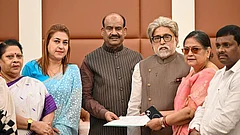
The rebels also discussed seating arrangements and the allotment of a party office in the new Parliament building. The meeting took place as the process of seeking parliamentary recognition for the NCPI and its association with the BJP-led NDA was underway. However, sources said the issue of the disqualification petitions filed by the TMC did not come up during the meeting with the Speaker.
Has the Lok Sabha Speaker recognised their merger?
The rebel MPs argue that their numbers satisfy the requirement under the Anti-Defection Law for protection from disqualification.
“We 20 MPs, who were elected from the AITC, have met the Speaker and given him a letter urging him to allow us to sit as a separate bloc. And these 20 MPs, who are more than two-thirds (of the strength of the AITC), this faction, is with the Nationalist Citizens Party of India. We will work for the country and work with the NDA under the leadership of the Prime Minister,” TMC MP Kakoli Ghosh Dastidar told reporters.
Sudip Bandyopadhyay also said the MPs had completed a valid merger with the NCPI. He said it would ultimately be decided through legal proceedings which group represented the ‘real TMC’.
“We have merged with the Nationalist Citizens Party of India. It is a political party. It is a recognised regional party. We have merged with it,” he said.
Does separate seating mean official recognition?
However, separate seating or parliamentary facilities do not by themselves establish that a breakaway group has received legal recognition as a separate political entity. The Speaker has to examine whether the merger claim satisfies the requirements of the Tenth Schedule and consider the arguments of both sides.
The TMC has challenged the rebels’ claim. Trinamool Congress leader Abhishek Banerjee met the Speaker and submitted 20 separate petitions seeking the disqualification of the MPs under the Anti-Defection Law. He argued that the MPs had voluntarily given up their membership of the party by joining another political organisation.
Banerjee also urged the Speaker not to provide recognition, status or facilities to any group claiming to be a separate faction of the TMC.
“The legislative party in the Lok Sabha derives its very existence from, and remains an emanation of, the political party. There is in law only one AITC, one Leader of the Party in the House, and one Whip, all of whom hold office by authority of the political party and its competent organisational authority. No member or set of members can, by their own volition, carve out a parallel ‘group’ or ‘faction’ of the same party and claim independent recognition within the House,” he wrote.
What does the Anti-Defection Law say?
The legal dispute centres on the interpretation of the Tenth Schedule of the Constitution, which deals with the disqualification of legislators who leave their parties.
Under Paragraph 2 of the Tenth Schedule, an MP can be disqualified if they voluntarily give up membership of their political party or vote against the party whip. The law earlier allowed protection for one-third of legislators who split from a party, but the 91st Amendment Act of 2003 removed this provision after it was frequently used to encourage defections. Since then, legislators have had to rely on the merger provision rather than a simple split to avoid disqualification.
At present, Paragraph 4 of the Tenth Schedule provides protection in cases of mergers. The provision protects members from disqualification in case of a merger, provided the conditions under Paragraph 4 are satisfied. One of those conditions requires the agreement of not less than two-thirds of the members of the legislature party.
Why is the merger rule being disputed?
The dispute between the TMC and the rebels is over how this provision should be interpreted. The rebel MPs argue that since 20 of the 28 TMC Lok Sabha MPs support the move, the two-thirds condition has been met.
The TMC argues that Paragraph 4 contains two requirements: the original political party must merge with another party, and two-thirds of the legislature party must support that merger. According to the party, MPs cannot create a merger merely by relying on their strength inside Parliament.
The distinction between a political party and a legislature party is central to the dispute. A political party is the organisation registered with the Election Commission and operates beyond Parliament, while a legislature party consists of the elected representatives of that party in a particular House.
The TMC has relied on the Supreme Court’s 2023 judgment in the Shiv Sena split case. The court held that the political party, rather than the group of legislators with majority support in the House, has the authority to appoint the whip and leader. The TMC argues that this means legislators cannot create a separate identity by relying only on numbers.
The rebel MPs can rely on the Goa precedent. In 2019, 10 Congress MLAs in Goa joined the BJP after claiming support from two-thirds of the Congress legislature party. The Bombay High Court upheld the Speaker’s decision rejecting disqualification petitions, holding that the two-thirds threshold was enough to establish the merger.
The Speaker’s role is crucial in the present dispute. The Supreme Court’s judgment in Kihoto Hollohan v Zachillhu held that the Speaker acts as a tribunal while deciding disqualification matters under the Tenth Schedule. However, decisions can later be challenged through judicial review.
How could this affect Mamata Banerjee and the INDIA bloc?
The political consequences extend beyond the Lok Sabha benches. For Mamata Banerjee, recognition of the rebel MPs as a separate group could weaken the TMC’s claim over its parliamentary wing and strengthen the rebels’ position. It could also affect the party’s role within the INDIA bloc, where the TMC remains an important regional partner.
For the rebel MPs, recognition would allow them to function independently in Parliament, seek separate facilities and establish a separate parliamentary identity while aligning themselves with the NDA. For the TMC, preventing such recognition is central to its argument that the MPs are defectors rather than a legitimate parliamentary group.
What happens before the Monsoon Session?
Before the Monsoon Session begins, the immediate questions are whether the Speaker accepts the merger claim, how the seating issue is handled and when the disqualification petitions are taken up. The decision will determine the status of the 20 MPs and test the limits of India’s Anti-Defection Law.