Experts say the two-thirds threshold alone may not protect the rebels from disqualification.
The NCPI provides a vehicle for the rebels to realign politically without directly joining the BJP.
The arrangement could help the BJP secure support in Parliament while allowing the rebels to distance themselves from a formal BJP entry.
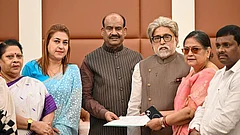
Walking out of a meeting with Lok Sabha Speaker Om Birla on Sunday evening, 20 rebel Trinamool Congress MPs announced they were merging with an obscure political party. Rebel MP Kakoli Ghosh Dastidar, one of the chief architects of the mutiny, declared: “We, the 20 members, will now merge with the Nationalist Citizens Party of India and work with the NDA under the leadership of Prime Minister Narendra Modi and Home Minister Amit Shah.”
The Nationalist Citizens Party of India (NCPI) is a three-year-old party with no sitting MP or MLA. It reported a total funds of just Rs 1.13 lakh and once campaigned under the slogan: “Reject political turncoats.”
Why would 20 sitting MPs choose to merge with a virtually unknown party rather than directly join the BJP?

What the Law Says
The Tenth Schedule of the Constitution disqualifies lawmakers who voluntarily give up membership of their party or vote against the party whip. When it was introduced in 1985, it also recognised a “split” if at least one-third of a legislature party broke away. However, the 91st Constitutional Amendment scrapped that provision. What remains is the merger provision, under which at least two-thirds of a legislature party must support a merger in order to seek protection from disqualification.

While the rebels appear to be relying on this provision, according to former Lok Sabha Secretary General and constitutional expert P.D.T. Achary, the two-thirds figure may not be enough.
“This number makes sense only when there is a merger between the TMC and another political party. If that is not taking place, this number has no significance at all,” he says.
According to Achary, the rebel MPs cannot independently invoke the merger provision merely because two-thirds of the parliamentary party has switched sides.
“Twenty MPs out of 28 have left the party and defected, so they are liable to be disqualified under the Tenth Schedule. These MPs cannot take any independent action unless their original party, the TMC, merges with another party.”
In other words, the legal battle may hinge not on the number of MPs involved but on whether the requirements of Paragraph 4 of the Tenth Schedule have actually been met.
Trinamool national general secretary Abhishek Banerjee made a similar argument in a letter submitted to Speaker Birla shortly before the rebels met him. He wrote that after the 91st Amendment, “the only lawful route” available is a merger in which the original political party merges and two-thirds of the legislature party supports that decision.

What Is the NCPI?
The NCPI was conceived in late 2022 and is registered in Hatgacha, in West Bengal’s Howrah district.
According to its financial disclosures, the party reported an income of Rs 1.13 lakh for the financial year ending March 2023, generated entirely through donations.
The party contested four seats in the 2023 Tripura Assembly election, winning none and securing a combined total of 822 votes across all constituencies.
Yet it is this little-known outfit that has now become the political vehicle for 20 sitting Lok Sabha MPs, including former Trinamool parliamentary leader Sudip Bandyopadhyay and four-term MP Dastidar.
The move appears to have surprised even some within the party. NCPI organisational secretary Shantanu Dey publicly objected to the merger, saying he was uncomfortable with inducting MPs who had faced allegations in major financial scandals.
Why Not Directly Join the BJP?
While BJP leaders have ruled out a formal merger, political observers say a direct move into the BJP would have complicated the rebels’ attempt to invoke the merger provisions of the anti-defection law and made the BJP’s role in the split far more visible.
Political scientist and author Dr Maidul Islam argues that the BJP’s interest lies less in formally absorbing the rebels and more in securing support in Parliament.
“Why should the BJP accept them? The BJP has enough MLAs in the West Bengal Assembly. The question is about Parliament. The BJP doesn’t have numbers there. So the MPs join a different party, and when votes come they vote for the government at the Centre,” he told Outlook.
According to Islam, the arrangement could benefit both sides. The BJP gains potential support during important parliamentary votes, while the rebel MPs align themselves with the ruling establishment at the Centre without immediately becoming BJP members.
Islam also points to the government's need to secure support for major legislative initiatives in the future, including the proposed delimitation exercise. In that context, a group of 20 MPs willing to back the government could become politically valuable.
A Relationship of Convenience
Political scientist Biswanath Chakraborty believes the BJP’s objective is not necessarily to integrate all the rebels into its organisation.
“Many BJP workers themselves are not comfortable with several of these individuals because they come from very different political traditions and carry their own baggage,” he told Outlook.
Instead, Chakraborty argues, the BJP gains by weakening the Trinamool Congress while simultaneously securing potential parliamentary support when required.
“The first objective is to weaken and destabilise the Trinamool Congress by encouraging dissent, creating uncertainty and projecting an image of division. The second is parliamentary. Even if these leaders are not formally integrated into the BJP, they can become useful allies during crucial votes and facilitate the passage of important legislation.”
Chakraborty also believes many of the defectors are motivated by uncertainty about their political future.
According to him, some may be concerned about legal challenges, while others may be worried about their standing within the party and are looking for alternative centres of power. He argues that the influence of several defectors is often overstated, as many derive their strength from the Trinamool Congress rather than from an independent support base.
“Only a few among them command significant personal political influence, while the rest may struggle to win elections or secure nominations on their own,” he said.
Trinamool MP Sougata Roy was even more dismissive of the move.
“Once you betray the party on whose symbol you were elected, how will you face your constituents? Who knows the NCPI? Can they go to their constituencies and tell people that they are now part of NCPI? This merger reflects the desperation of the traitors,” he said.