







Trump's proposal stemmed from the broader battle between Washington and Tehran over who controls the Strait of Hormuz, with both sides claiming responsibility for securing the vital waterway.
The US president later abandoned the fee proposal in favour of trade and investment agreements with Gulf states.
This comes amid concerns that the move could legitimise Iran's claims over the strait.
US President Donald Trump's proposal to charge a 20% fee on cargo transiting the Strait of Hormuz has drawn legal and practical objections, with the United Nations' shipping agency saying there is no legal basis for mandatory tolls on international straits.
The proposal, announced alongside Trump's pledge to make the US the "guardian" of the strategic waterway, also raised concerns over its impact on global shipping, oil markets and energy importers such as India. Trump has since dropped the fee plan in favour of trade and investment agreements with Gulf states.
Trump made the announcement in an interview with Fox News and in a post on Truth Social on Monday, hours after the US and Iran exchanged a fresh wave of attacks. Iran claimed it had targeted US military facilities in Bahrain, Kuwait, Oman and Jordan, while American forces continued strikes on Iranian port cities.
“We are reinstating the THE IRANIAN BLOCKADE, so named because it is only stopping Iran’s ships or customers from entering or leaving,” Trump had writted on Truth Social.
UN Shipping Agency Rejects Proposal for Hormuz Transit Fee
The United Nations' shipping agency opposed any proposal to impose mandatory charges on vessels transiting the Strait of Hormuz.


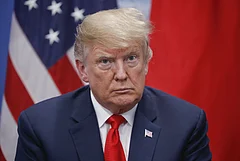
“We have always been consistent on our stance on fees – IMO stands firmly against charging fees for passage through straits used for international navigation,” the International Maritime Organization (IMO) said.
“There is no legal basis through which to introduce mandatory tolls simply to transit through a strait.”
The IMO's position is consistent with the United Nations Convention on the Law of the Sea (UNCLOS), which guarantees uninterrupted transit passage through international straits.
Under Part III of UNCLOS, ships and aircraft have the right to continuous and expeditious passage through international waterways, and such passage "shall not be impeded."
While Article 34 recognises the sovereignty of coastal states over their territorial waters, it specifies that this sovereignty must be exercised in accordance with transit passage rules.
Articles 37 and 38 extend transit rights to all ships and aircraft using international straits, including the Strait of Hormuz, while Article 39 requires vessels to proceed without delay, comply with international safety regulations and refrain from threatening bordering states.
Can Countries Charge Ships To Cross the Strait of Hormuz?
Trump argued the fee would reimburse the US for securing one of the world's most strategically important shipping lanes.
However, this is not legally possible. The Strait of Hormuz is an international strait governed by UNCLOS, which guarantees the right of transit passage. The IMO has also reiterated that there is no legal basis for mandatory tolls merely for transiting such waterways.
Unlike man-made canals such as the Suez or Panama canals, natural international straits generally cannot be subjected to unilateral transit fees, The Indian Express reported. Although the United States and Iran have not ratified UNCLOS, many of its navigation provisions are widely regarded as customary international law.

Why did experts question Trump's proposal?
Shipping and legal experts raised several concerns about the lack of explanation of how the 20% fee would be calculated, whether on the value of cargo, shipping costs or another benchmark. The proposal appeared to contradict Washington's long-standing support for freedom of navigation. The US would also have struggled to guarantee complete security for commercial shipping in an active conflict zone. As per The Indian Express, the plan could have forced shipping companies to choose between complying with US or Iranian demands, exposing them to retaliation from either side.
Why is the Strait of Hormuz so important to India?
The Strait of Hormuz carries roughly one-fifth of global oil and LNG supplies, making it one of the world's most critical maritime chokepoints, including India. India imports about 60 percent of its LPG consumption and out of these imports about 90 percent come through the Strait of Hormuz, which has been impacted due to current happenings.
India imports the majority of its crude oil, with a significant share arriving through Hormuz from Gulf producers.
Any disruption to shipping through the strait could increase India's import bill, raise fuel prices and put pressure on inflation and the rupee. The effects of the war in West Asia has already disrupted the market in India, causing shortage and spike in price of LPG in India, leading to domestic and commercial cooking crisis, affecting households and business both.
How would transit fees affect oil prices and shipping costs?
A transit charge would increase the cost of transporting crude oil, LNG and other commodities through the Strait of Hormuz. A higher freight charges, insurance premiums and potential delays would likely be passed on to buyers, increasing fuel prices and input costs for industries worldwide. For India, even a modest rise in crude prices significantly increases the country's annual import bill because of its dependence on imported energy.

Why did Trump later back away from the proposal?
A day after announcing the plan, Trump said he would replace the proposed 20% reimbursement fee with trade and investment agreements involving Gulf states. Although he did not provide a detailed explanation, analysts cited several possible reasons, including the international laws that would disallow the President to take such steps.
Trump's proposal was rooted in the wider contest between Washington and Tehran over who effectively controls the Strait of Hormuz. Since the outbreak of the conflict, Iran has asserted operational control over the strategic waterway, requiring commercial vessels to seek permission, follow routes designated by Tehran and, at times, threatening ships that did not comply.
The United States, meanwhile, has maintained that the strait is an international waterway open to free navigation and has sought to challenge Iran's claims by escorting vessels and reimposing its naval blockade.
By announcing that the US would become the "Guardian of the Hormuz Strait" and charge a 20% fee for safe passage, Trump undermined Washington's long-standing position on freedom of navigation and risked legitimising Iran's own claims. Iran’s paramilitary Revolutionary Guard said Tehran controls the strait. “We will not allow a rogue and child-killing army from the other side of the world to continue its illegal interference in it,” the Guard said Sunday.















