Iran plans Hormuz transit fees after 60-day fee-free period.
Strait of Hormuz handles nearly 20% of global oil trade.
Higher Hormuz shipping costs could raise fuel and LPG prices.
Just three days after Donald Trump declared the Strait of Hormuz would reopen "permanently toll-free," Iran said the opposite. Tehran's chief negotiator Mohammad Bagher Ghalibaf said on Iranian state television on Thursday that Iran would begin charging ships for using the waterway once a 60-day fee-free window from the peace deal expires.
"We have responsibility and sovereignty over there. Naturally, there are services there and in return, there is a fee for this work," he said.
That single line has reopened a fight that could quietly hit petrol pumps everywhere from Mumbai to Manchester.
Why Strait Matters So Much
Before the war that began on February 28, between 120 and 140 ships passed through Hormuz every day, about half of them oil tankers, according to an Al Jazeera report. Roughly a fifth of the world's oil and LNG exports moved through this single channel. There is no alternative sea route for Gulf producers like Saudi Arabia, Iraq, the UAE, Qatar and Kuwait to ship their oil to the open ocean. That is what makes Hormuz the world's most consequential chokepoint, not just a regional shipping lane.

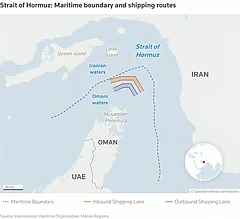


Fee or Toll, Someone Pays Anyway
Iranian foreign ministry spokesman Esmail Baghaei said Tehran is "not seeking to levy transit tolls, however, fees will be charged in exchange for the services that are provided.” The distinction matters legally. As James Holmes, chair of maritime strategy at the US Naval War College, told the New York Times, international law has no provision allowing a coastal state to charge vessels merely for passing through a natural waterway. A toll on transit passage is generally illegal. A fee for an actual service is a greyer area.
But for the ship paying it, the label barely matters. Al Jazeera noted that Iran had already been charging up to $2 million per vessel for authorisation to pass during the worst of the standoff. Economist Nader Habibi told the outlet that paying Iran was still cheaper than leaving a tanker anchored and bleeding money on crew wages and war-risk insurance, even though it is, in his words, "not politically feasible" for most governments to openly accept that arrangement.

Who Pays What & When
On who picks up the bill first, Discovery Alert, in its analysis of Hormuz transit fee mechanics explained that under standard voyage charter terms, the shipowner technically bears the initial cost of navigation, making transit fees a shipowner liability at first. But the same report noted that these costs are rapidly passed through to charterers under freight rate adjustments, and from charterers to buyers under cost, insurance and freight pricing mechanisms. In other words, the fee does not stay with the shipping company. It travels down the chain.
Rystad Energy's Artem Abramov told CBS News that a Hormuz toll would also push up insurance costs, since insurers would need time to grow comfortable with an unprecedented charging model, keeping both freight rates and premiums elevated. "They're adding to the cost of oil, and all these costs are being transferred to consumers," he said. South Korean refining industry sources, cited by Bloomingbit, said analysts there believe refiners cannot absorb the entire fee themselves, making it likely that both the refining industry and consumers end up sharing the burden.
Capital Economics chief economist Neil Shearing told CBS News that the fee alone "wouldn't add much to the cost of production" given that the marginal cost of Gulf oil production is roughly $20 per barrel, though he added that oil prices would likely stay elevated for months regardless of whether a formal toll is imposed, simply because of Iran's continued grip on the strait.

Where It Could Actually Hurt
The International Maritime Organization warned charging tolls for passage through Hormuz would set a "dangerous precedent," since states bordering international straits are not permitted to do so under the law of the sea.
Experts say that any potential toll system on Hormuz would be felt by consumers, since reduced efficiency or higher transit costs could put upward pressure on freight rates and, potentially, energy prices, though he added the scale would depend on how restrictive the arrangements turn out to be in practice.
If Hormuz fees become standard and oil prices firm up again as a result, the knock-on effects in import-dependent countries like India would be familiar. Petrol and diesel prices would face upward pressure since crude is the core input cost. LPG would be affected too, since a large share of India's cooking gas comes from the Gulf and travels through this very strait. Airfares would likely rise gradually because jet fuel tracks crude closely. And food prices could edge up as well, since fertiliser production in the Gulf, particularly urea and ammonia, depends on the same shipping routes and energy inputs.
None of this is locked in yet. The peace deal's 60-day fee-free clock is still running, the exact size of any future charge has not been announced, and shipping firms, insurers and governments are all watching to see whether the ceasefire even holds. But the fact that Tehran is already talking about fees, days after the US insisted there would be none, tells this fight over who controls Hormuz, and who pays for that control, is far from over.