Bhagwant Mann's remarks linking SIR verification with welfare benefits have sparked a debate over electoral rolls and government schemes.
The Election Commission says SIR is only a voter list revision exercise and not a citizenship determination process.
While voter documents are used for some welfare scheme applications, there is no direct legal link between electoral rolls and benefits.
Punjab Chief Minister Bhagwant Mann's appeal asking people to complete the Election Commission's ongoing voter verification exercise has raised a broader question: can access to government welfare schemes be linked to inclusion on the electoral roll? Mann has urged eligible voters to complete the Special Intensive Revision (SIR) process, saying it would not only safeguard their right to vote but also help them continue receiving benefits under various state government welfare schemes.
The remarks come as the Election Commission of India (ECI) carries out the Special Intensive Revision (SIR) of electoral rolls in Punjab, where Booth Level Officers (BLOs) are conducting door-to-door verification of voters ahead of next year's Assembly election. As The Indian Express reported, the debate centres on what the SIR exercise is, whether enrolment on the electoral roll is legally linked to welfare schemes, what the Election Commission's position is, what could happen if an eligible voter does not complete the verification process, and why the issue has become politically contentious.
What is the Special Intensive Revision?
The Special Intensive Revision (SIR) is a voter list verification exercise being conducted by the ECI to update and verify electoral rolls.


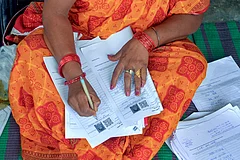
In Punjab, the exercise began on June 25. More than 24,000 Booth Level Officers (BLOs) have been deployed to carry out door-to-door verification of over 2.14 crore electors across the state.
During the exercise, BLOs are visiting households to verify voters' personal details and collect prescribed enumeration forms along with supporting documents, wherever required. Election officials have said the objective is to prepare an accurate and updated electoral roll for future elections.
The house-to-house verification will continue until July 24. A draft electoral roll will be published on August 3, claims and objections can be filed until September 2, and the final electoral roll will be published on October 1.
Why has Bhagwant Mann linked SIR to welfare schemes?
Mann initially alleged that the BJP could attempt to remove genuine voters during the revision exercise and urged Aam Aadmi Party workers to remain vigilant.
More recently, however, he has urged eligible voters to participate in the SIR process, saying it was necessary not only to safeguard their right to vote but also to continue receiving benefits under various state government welfare schemes. Karnataka Chief Minister DK Shivakumar has made similar comments.
Mann specifically referred to the Mawan Dheeyan Satkar Yojana, under which eligible women receive Rs 1,000 a month through Direct Benefit Transfer (DBT), while eligible Scheduled Caste women receive Rs 1,500 a month.
Schemes targeted at women beneficiaries have been electorally important for political parties in recent years.
Can welfare benefits legally be linked to voter verification?
Beyond West Bengal's mandate, there is no direct link between the electoral roll and government schemes and services.
Before Mann's remarks, the Suvendu Adhikari-led BJP government in West Bengal explicitly said that electors deleted during the SIR exercise would not be provided rations and access to other government welfare schemes.
However, as The Indian Express reported, a voter identity card or inclusion in the electoral roll is commonly accepted as a supporting document for welfare schemes such as the Mawan Dheeyan Satkar Yojana.
Officials in Punjab's Social Security Department have also said that voter identity cards are accepted for the Mukh Mantri Sehat Bima Yojana, under which eligible beneficiaries can receive free medical treatment worth up to Rs 10 lakh.
Other schemes where a voter identity card or electoral roll serves as an important proof of identity, age or domicile in Punjab include:
Old Age Pension Scheme (Rs 1,500 per month for eligible senior citizens).
Widow and Destitute Women Pension Scheme (Rs 1,500 per month).
Punjab Ashirwad Scheme, which provides a one-time financial assistance of Rs 51,000 for the marriage of eligible girls from Scheduled Caste, Backward Class and Economically Weaker Section (EWS) families.
Registration under the Punjab Labour Card.
National Family Benefit Scheme, which provides a one-time assistance of Rs 20,000 to families after the death of the primary breadwinner.
What do the Election Commission and the Supreme Court say?
The ECI has maintained that the SIR is a revision of electoral rolls and not a determination of citizenship.
While defending the exercise before the Supreme Court last year, the Commission said the exercise was limited to updating electoral rolls.
In May, while upholding the ECI's authority to conduct the SIR, the Supreme Court said:
"The consequence of such a determination is correspondingly limited. It affects the individual's entitlement to be included in the electoral roll, and thereby their right to participate in the electoral process. It does not, however, operate to divest the individual of claims of citizenship, nor does it foreclose a determination of that question by the Competent Authority under the Citizenship Act."
Why has the issue become politically contentious?
The citizenship debate resurfaced recently in the case of R Rajagopal, former editor of The Telegraph, who was allegedly unable to renew his passport after his name was deleted from the West Bengal electoral rolls during the SIR exercise.
Punjab is due to hold Assembly elections next year, making welfare schemes politically significant for the ruling Aam Aadmi Party. As The Indian Express noted, a potentially large number of voters losing access to welfare because of the SIR could pose a political challenge for the government.
The ECI's position remains that the Special Intensive Revision is an exercise to revise electoral rolls. The Supreme Court has also made clear that exclusion from the electoral roll affects a person's right to participate in elections but does not determine citizenship.