Assam CM Himanta Biswa Sarma said on July 10, 2026, that artists wishing to paint a 'revolutionary' in Assam should paint Paresh Baruah.
Paresh Baruah, 70, co-founded ULFA in 1979, rejected the 2023 peace accord that ended the insurgency for the pro-talk faction, and continues to lead ULFA-I from exile in China's Yunnan province.
Critics including activists and legal scholars have questioned whether the CM's remark sits within the limits of the same UAPA under which his government has prosecuted others for far more oblique expressions of sympathy with banned outfits.
On July 10, 2026, Assam Chief Minister Himanta Biswa Sarma held a press conference that was supposed to be about a singer's mural. Sarma was explaining the controversy surrounding the partial erasure of a portrait of the late Assamese music icon Zubeen Garg at in Guwahati, saying the government had not ordered the removal and that the decision was taken by the painters themselves.
He then turned his attention to the frequency with which artists paint Che Guevara on Assam's public walls, and asked what connection the Cuban revolutionary had with the state. 'If you want to draw a revolutionary,' he said, 'then draw Paresh Baruah. He has been continuing his struggle for 30 years, whether it is for good or bad is a different matter. He has to live away from his family. Draw pictures of Parag Das.
Paresh Baruah is not a name a sitting Chief Minister drops casually. He is the commander-in-chief of ULFA (Independent) — a faction of the United Liberation Front of Asom classified as a terrorist organisation under the Unlawful Activities (Prevention) Act.



What Was The Zubeen Garg Mural Row?
Zubeen Garg was an Assamese singing legend who died in 2025, leaving behind a massive following that extended far beyond the state. Months after his death, artists began painting his portrait on public walls and flyovers in Guwahati as a tribute. One such mural appeared under the Ganeshguri flyover. During a government-run beautification drive, workers partially erased the mural, setting off a fierce public reaction.
The original mural had been painted by artist Marshall Baruah, who has said the phrase 'Comrades Never Die' was planned for inclusion but had not yet been added — a phrase that some interpreted as a left-wing political statement, drawing comparisons between Zubeen and Che Guevara for the singer's outspoken, people-first persona.
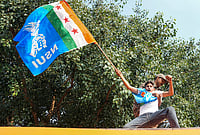
Sarma picked up on those comparisons and inverted them: the mural looked less like Zubeen and more like Che Guevara, he said. He then accused the painters of being associated with the SFI, the student wing of the Communist Party of India (Marxist), and said organisations like SFI would no longer be permitted to paint on government flyovers.
Who Is Paresh Baruah?
Paresh Baruah was born circa 1957 and co-founded the United Liberation Front of Asom in 1979, initially as a movement to restore what adherents viewed as Assam's pre-colonial sovereignty. He became the organisation's military wing commander. His insurgency at its peak in the 1990s and 2000s was responsible for hundreds of killings.
When ULFA's pro-talk faction under Arabinda Rajkhowa pursued ceasefire negotiations and eventually signed a peace accord in December 2023 — resulting in the surrender of over 8,200 cadres and the disbandment of the organisation — Baruah refused to join. He established ULFA-I, the anti-talk splinter, and continued insurgency operations from Myanmar, later relocating primarily to China.

Why Did Sarma Name Baruah — And What Did He Mean?
Sarma's stated logic was straightforward: Che Guevara, the Cuban-Argentine revolutionary whose face adorns the walls of left-leaning student hostels and protest spaces across India, has nothing to do with Assam. If artists want to paint a revolutionary connected to the state's own history, they should paint someone from that history. His clarification, offered in response to immediate criticism, was that he was not endorsing ULFA's ideology — 'whether it is for good or bad is a different matter' — but acknowledging Baruah's personal sacrifice and decades of commitment to a cause, however misguided.
Critics, including legal observers quoted by India Today NE, were not satisfied. Advocate Hazarika pointed out that by naming Baruah as Assam's answer to Che Guevara, the CM 'effectively elevated him to the status of a revolutionary — deserving of murals, of public memory, of the kind of visual reverence usually reserved for figures a state wants its citizens to admire.'
In 2022, police arrested 19-year-old Barshashree Buragohain under the UAPA over a poem that never named ULFA-I but was read by investigators as implicitly sympathetic to the outfit. If a poem without a single reference to the organisation could draw scrutiny under the same law that bans it, critics ask, what would the law make of a Chief Minister explicitly proposing a mural of its commander-in-chief on a public flyover.