Operation Hard Ball, announced on July 7, 2026, unsealed three federal indictments charging 37 defendants linked to three India-based transnational crime syndicates.
RCMP Deputy Commissioner Lisa Moreland confirmed that the Indian government cooperated with the investigation and that the operation found no evidence that Indian officials were involved in any of the crimes alleged.
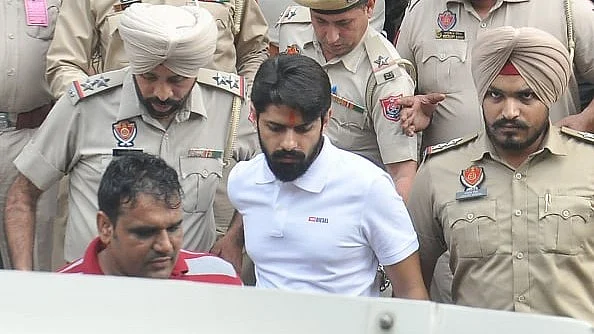
Lawrence Bishnoi, jailed in India, now faces formal US extradition proceedings under RICO racketeering law.
On July 7, 2026, eleven people were arrested in southern California by the FBI. By the time the day's joint press conference was held, 24 people had been arrested across the United States, Canada, and Europe. Three separate federal grand jury indictments had been unsealed by the US Department of Justice, charging 37 defendants across three distinct India-based transnational organised crime syndicates.
Investigators carried out raids at more than 50 locations, seizing around 1,000 kilograms of cocaine and heroin, firearms, and large amounts of cash. The operation was codenamed Hard Ball. It was the product of a multi-year investigation. And, in the words of Canadian Justice Minister Sean Fraser, it was 'an extraordinary day' — one that would, he said, send a message to crime bosses at the top of these organisations.
What Is Operation Hard Ball?
Operation Hard Ball is a coordinated international law enforcement offensive spanning multiple continents, spearheaded by federal prosecutors and the FBI in Los Angeles in conjunction with the Royal Canadian Mounted Police and European authorities.


The operation exposed deeply entrenched criminal networks executing complex cross-border narcotics logistics, brutal extortion plots against the South Asian diaspora, and state-side violence including direct connections to high-profile political assassinations.
Three separate indictments were unsealed simultaneously. The first targets the Lawrence Bishnoi enterprise and directly charges Bishnoi and Goldy Brar with ordering the 2023 assassination of Hardeep Singh Nijjar in Surrey, British Columbia. The second targets the Ravinder Singh Dhanda smuggling network. The third targets the Jaggu Bhagwanpuria syndicate. It is important to note that the three Canadians charged under the Dhanda indictment are accused of drug trafficking, not of involvement in the Nijjar killing.

What Role Did India Play?
RCMP Deputy Commissioner Lisa Moreland confirmed that Indian agencies cooperated with the investigation, saying enforcement bodies had worked closely alongside the FBI and its partners. This is a significant diplomatic development. India–Canada relations have been severely strained since Prime Minister Justin Trudeau alleged in September 2023 that agents of the Indian government were involved in Nijjar's killing, a claim India rejected as unsubstantiated and politically motivated.
The US indictment charging Bishnoi and Goldy Brar did not allege any role by the Indian government in Nijjar's killing. Moreland said the operation found no evidence that Indian officials were involved in any of the crimes under Operation Hard Ball. Canada's own investigation into the Nijjar killing has also reportedly found no direct evidence linking Indian government officials to the shooting itself.
In a benefit to Indian agencies, the investigation could help Indian authorities access financial records, digital evidence, and intelligence gathered by international partners. It may also strengthen cooperation on extradition requests, money trail investigations, and future joint operations.
Who Are Lawrence Bishnoi And Goldy Brar?
Lawrence Bishnoi, 33, is a native of Punjab who has been in custody since the mid-2010s. According to the indictment, he continued to run his crime syndicate from behind bars using smuggled mobile handsets and voice-over-internet devices, personally directing killings, kidnappings, extortion, and human-smuggling operations carried out by associates around the world.
The indictment also alleges he cultivated a public image as a nationalist and religious figure through social media, which he used to draw in recruits even as he oversaw the syndicate's darker operations in private.
Satinderjeet Singh, better known as Goldy Brar, is identified as Bishnoi's North American operations chief. He is believed to be based in Canada and is currently a fugitive. The FBI has issued a reward of up to $50,000 for information leading to his arrest and extradition. Brar is charged in the US indictment with co-ordering the Nijjar assassination.

What Evidence Did Indian Agencies Provide?
The US indictments draw on evidence gathered over a multi-year investigation involving intercepted communications, witness testimony, financial records, and cross-border intelligence sharing. Indian agencies' specific contributions have not been detailed in public filings, as is standard in ongoing prosecution.
However, Moreland's confirmation of Indian cooperation signals that India provided at least some of the intelligence that enabled US prosecutors to build their case including, most likely, information about Bishnoi's communications from inside Indian prisons and the internal structure of his network.
One of the most striking elements of the indictment is the allegation that in April 2026, a Bhagwanpuria syndicate member residing in Stockton, California, used a corrupt official inside India's Punjab State Police to falsely frame the victim's overseas family members for a January 2026 homicide they did not commit. That allegation, if proven, would demonstrate the reach of corruption within Indian law enforcement that these networks have exploited.
Why Did India And The US Step Up Coordination?
The partnership behind Operation Hard Ball did not emerge overnight. Canada had officially designated the Bishnoi enterprise as a terrorist entity in September 2025 a step that placed it in the same legal category as groups like the Taliban and ISIS under Canadian law and significantly expanded the tools available to law enforcement. That designation changed the legal basis on which allied agencies could share intelligence and coordinate enforcement.
For India, cooperation with the FBI carries a dual benefit. It helps clean up a reputational problem while simultaneously giving Indian agencies access to evidence gathered in foreign jurisdictions that would otherwise be unreachable. The Nijjar context is uncomfortable for New Delhi, but the operation's finding of no evidence of Indian government involvement is diplomatically useful for India, and the successful cooperation demonstrates that India can be a reliable law enforcement partner even on politically sensitive cases.
What Happens Next?
Formal extradition proceedings for Bishnoi are likely to be a protracted affair, given the scale of the charges and the diplomatic sensitivities involved — not least the unresolved question, raised repeatedly by Canadian officials, of whether elements within the Indian state had any hand in directing violence attributed to the Bishnoi network. New Delhi has previously rejected such suggestions as unsubstantiated.
The extradition of a sitting prisoner from India to the United States would require both a formal US extradition request through diplomatic channels and a decision by Indian courts. India and the US have an extradition treaty, but its use for high-profile Indian nationals has historically been contested and slow.
Bishnoi's brother, Anmol Bishnoi, remains wanted in India in connection with several high-profile killings including that of Maharashtra politician Baba Siddique, with Mumbai Police having separately pursued extradition proceedings against him after he was tracked to the United States. Those proceedings will likely be accelerated in the wake of Operation Hard Ball.