Three workers were killed after heavy rain triggered a landslide at the tunnel construction site, with the Kerala government calling it a “man-made” disaster.
The PWD says repeated warnings about stockpiled excavated soil and slope instability were ignored despite inspections and review meetings.
Environmentalists and opposition groups argue the tunnel should never have been approved in a landslide-prone region, while the government reviews its future.
Hailed as one of Kerala's most ambitious infrastructure projects, the Wayanad tunnel is now under scrutiny after another landslide hit Meppadi on Tuesday. The tragedy, the third major landslide in the area, has reignited questions about whether the project should have been undertaken in one of the Western Ghats' most fragile landscapes.
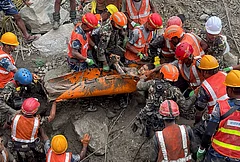
Just 24 hours before the landslide, Wayanad received around 265 mm of rainfall, the highest recorded this monsoon season. On Tuesday, the slope near the Kozhikode–Wayanad tunnel construction site collapsed, sending a torrent of mud and debris crashing downhill. Three workers were killed and around 10 others were rescued.
The Kerala government has described the incident as a "man-made" disaster, placing the spotlight on the construction of the Anakkampoyil–Kalladi–Meppadi twin tunnel project, better known as the Wayanad tunnel.
A preliminary inquiry into Tuesday's disaster suggests that large quantities of excavated soil had been stockpiled along one side of the construction site. The debris is, according to sources, 20 feet deep.



Following the landslide, the state Cabinet reviewed preliminary reports and ordered an inquiry into the factors that led to the disaster. It will examine whether the contractors complied with the conditions attached to the project's environmental clearance, including reports of a landslide above the accident site.
The government said construction would remain suspended until the investigation is complete and potential risks have been fully assessed, after which it will decide on the technical and legal action to be taken.
The Pinarayi Vijayan-led LDF government approved this project before the 2026 Assembly elections. Funded by the Kerala Infrastructure Investment Fund Board (KIIFB) at a cost of ₹2,134.5 crore, the project is being executed by Konkan Railway Corporation Limited (KRCL), which has been appointed as the Special Purpose Vehicle (SPV).
It involves the construction of an 8.17-km twin-tube, four-lane road tunnel, along with a four-lane approach road, linking Anakkampoyil, Kalladi and Meppadi in Kerala's Kozhikode and Wayanad districts.
A tripartite agreement for the project's implementation was signed by KRCL, the Kerala Public Works Department (K-PWD), and KIIFB following approval of the Detailed Project Report (DPR).
Bhopal-based Dilip Buildcon secured the construction contract, and work began earlier this year. As the SPV, KRCL is responsible for supervising construction, monitoring quality and ensuring compliance with contractual conditions.
Questions Over Safety Measures
Kerala Public Works Minister P.K. Basheer questioned both the project's location and the scientific basis on which it received environmental clearance. "We cannot issue certificates for Wayanad while sitting in offices. We are not against infrastructure, but projects in fragile regions must be based on scientific studies," he told Outlook India.
Basheer argued that officials had failed to adequately assess the area's geology before approving the project. According to him, Wayanad's clay-rich, unstable soil, coupled with widespread deforestation and the region's long history of rain-triggered landslides, should have raised serious concerns during the planning stage. Had detailed scientific studies been conducted, he suggested, permission for the tunnel may never have been granted.
After assuming charge of the Public Works Department, he said he first convened a review meeting on June 1. On June 25, a high-level PWD team, including the Chief Engineer and the Wayanad District Collector, inspected the tunnel project along with officials from the District Disaster Management Authority, the State Environment Impact Assessment Authority (SEIAA) and KRCL, the executing agency.
According to sources in the PWD ministry, the excavated soil posed a significant risk of soil erosion (piping) and ground instability. The retaining wall, net and tarpaulin installed by the contractor were deemed inadequate to prevent water seepage.
The minister underscored that at the third review meeting held on July 1 after he took charge, officials directed the company to remove the excavated soil, relocate six nearby families, and suspend construction work during the monsoon. He added that KRCL maintained at the meeting that adequate safety measures were already in place.
The minister alleged that excavated soil at the construction site had not been cleared despite repeated warnings. “It was only because we stopped the construction work that the loss of life has been limited. Three of those who have died are workers who went to examine the project status,” said Basheer.
Basheer said Chief Minister V.D. Satheesan would hold detailed consultations with the relevant departments before deciding the future of the project. He added that the state environment committee and a high-powered panel of experts would also examine the circumstances leading to the disaster.
The minister maintained that the exact cause can only be established after detailed geological and geotechnical investigations examining factors such as rainfall intensity, excavation methods, soil and rock conditions, slope stability, drainage systems and the adequacy of protective measures. Officials have also said it must be determined whether the excavated earth was handled in accordance with engineering standards.
Dilip Buildcon, however, has rejected suggestions that construction practices alone were responsible. The company attributed the landslide primarily to exceptionally heavy rainfall and Wayanad's known susceptibility to monsoon-induced slope failures.
Opposition From Environmentalists
Environmentalists have long opposed the project, warning that it cuts through the ecologically sensitive Western Ghats. They pointed out that the tunnel passes close to areas devastated by landslides in 2019 and 2024. Geologists have repeatedly cautioned that the Kalladi region consists of loose and unstable earth.
The ends of the tunnel are at Maripuzha in Thiruvambady village panchayat (Kozhikode) and Kalladi in Meppadi panchayat (Wayanad). Kalladi is only 4 kilometres away from Chooralmala, the site of the July 2024 landslide which killed 298 people. Environmental groups as well as the Opposition Congress had opposed the project, which will require blasting for construction in the fragile Ghats.
The State Environmental Appraisal Committee (SEAC) had, on March 1, 2025, given approval accompanied by 25 conditions, including that the tunnel threatened four tribal hamlets. However, the committee chose to overlook it and gave clearance.
The former LDF government inaugurated the project in August 2025. It received final environmental clearance from the Ministry of Environment, Forest and Climate Change in February 2026. Notably, former CM Vijayan formally inaugurated the first controlled rock blast on March 6 ahead of the state Assembly polls on April 9.
The Wayanad Prakrithi Samrakshana Samithi (WPSS), one of the project's most vocal critics, argued before the Supreme Court (SC) that the tunnel would pass through the Chooralmala–Mundakkai region, one of South India's wettest landscapes and the site of catastrophic landslides in 2024. The group contended that underground blasting in such terrain posed unacceptable risks.
Despite these objections, the SC upheld the project's environmental clearance on April 6 this year, with a Bench led by the Chief Justice describing it as a “lifeline” for Kerala. The tunnel was expected to reduce travel time between Kozhikode and Wayanad by 45 to 60 minutes while providing all-weather connectivity to the hill district.
WPSS on Wednesday blamed both the government and the judiciary for the Kalladi tunnel disaster, accusing them of failing to prevent the tragedy.
In a statement, the organisation criticised Kalpetta MLA and Agriculture Minister T. Siddique's claim that responsibility for the collapse at the Kalladi tunnel entrance rested solely with the contractor and that the tunnel project itself remained safe, calling the remarks "a challenge to the people".
WPSS alleged that the Kerala government secured Stage I environmental clearance last year by misleading the Ministry of Environment, Forest and Climate Change, bypassing adequate scientific studies and expert assessment, and submitting false information. It also claimed the Detailed Project Report (DPR) had been prepared to favour the Konkan Railway Corporation.
"The government is still unwilling to abandon the tunnel project through the Camel Hump mountains, an area that has witnessed multiple landslides over the past six decades," the statement said.
WPSS urged the Chief Minister to appoint an independent committee of scientists and experts to conduct a comprehensive review of the project and suspend all tunnel construction until the study is completed.