



Harsh Malhotra said BJP sees growth potential in Punjab as AAP loses ground and Congress fails to fill the political vacuum.
The BJP is preparing to contest Punjab independently after its alliance with Shiromani Akali Dal ended in 2020, while expanding outreach to both Hindu and Sikh voters.
The party has appointed Malhotra as a Hindu Punjabi face in Delhi and Kewal Singh Dhillon as Punjab chief as part of its strategy to broaden support ahead of 2027.
Ahead of the 2027 Punjab elections, Union Minister and recently appointed Delhi BJP chief Harsh Malhotra said the BJP stands a fighting chance in Punjab, while claiming Chief Minister Bhagwant Mann’s popularity is declining. This is despite the Aam Aadmi Party (AAP) securing majority in the recently concluded civic body elections with a decisive majority.
“We are trying in Punjab. There is ground for us to grow since AAP is losing ground and Congress is not ready to fill the vacuum,” Malhotra told Outlook.
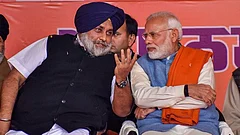
Delhi BJP leaders have begun highlighting Punjab-related issues. Referring to the Shiromani Akali Dal (SAD), Malhotra said the party continues to have support in several areas. “We are planning and preparing to fight elections alone, but the rest is on the party leadership,” he said.
Since 1996, the BJP had contested elections in alliance with the Shiromani Akali Dal. It was a partnership that lasted over two decades before collapsing in 2020 during the farmers’ protest.



With an eye on Punjab ahead of elections, Malhotra also strongly criticised the reported demolition of a 125-year-old gurudwara in Pakistan’s Farrukhabad, condemning the neighbouring country’s administration for inaction.
Final frontier
In north India, Punjab still remains outside BJP’s grasp. It is the only state in the north where the party has so far failed to achieve significant electoral success. In the Assembly elections of 2017 and 2022, the BJP won just three and two seats respectively, out of 117.
Malhotra was appointed Delhi BJP president as a Hindu, Khatri Punjabi face, while former Congressman-turned-BJP leader Kewal Singh Dhillon was made the party’s Punjab chief as a Sikh Jatt Punjabi face. The appointments were widely seen as part of the BJP’s broader political strategy to challenge the perception of the party as largely a “Hindu party” in Punjab and expand its appeal among Sikh voters, particularly the politically influential Jatt Sikh community.
Sikhs make up nearly 57 per cent of Punjab’s population, while Hindus account for roughly 38 per cent. For decades, the BJP’s support base in the state has remained largely concentrated among urban Hindu voters, limiting its wider electoral reach.
This outreach strategy has become increasingly visible in recent months. At the same time, the party has been attempting to broaden its social coalition by reaching out to Dalit communities through Prime Minister Narendra Modi’s visit to Dera Sachkhand Ballan in February this year.
The BJP wants to appeal to both Hindus and Sikhs. The move is being seen as part of a larger political gamble aimed at breaking the perception of the party as primarily a “Hindu party” in Punjab and strengthening its reach among Sikh voters, especially the influential Jat Sikh community.
What happened in Punjab Municipal elections?
AAP secured a decisive victory in Punjab’s recent civic body elections, winning close to half of all municipal wards contested across the state. Polling was conducted for eight municipal corporations, 75 municipal councils, and 20 municipal committees, with the outcome widely viewed as an important political boost for the party following a period marked by internal defections and political setbacks.
The results, however, were not without controversy, as opposition parties raised concerns over alleged irregularities during the electoral process. Shiromani Akali Dal leader Bikram Singh Majithia accused the state government of using administrative machinery to sway the outcome in AAP’s favour.
According to the Punjab State Election Commission, AAP won 954 out of the 1,977 wards contested statewide. The Indian National Congress finished in second place with 393 seats, while the Shiromani Akali Dal secured 192 wards.
The BJP won 172 wards, a relatively modest performance that placed it behind independent candidates, who collectively secured 251 seats. The BJP emerged dominant in Abohar, where AAP finished second. In Pathankot, traditionally considered a BJP stronghold, the party won the largest number of wards but fell short of the numbers required to form a majority, with the Congress finishing behind it.















